Without health insurance, poverty is just a medical bill awayRemember the Affordable Care Act? We still have a long way to go
American Inequality has now hit +7,000 email subscribers! 🎉 Send to a friend and tell them to join our rapidly growing community 🚀
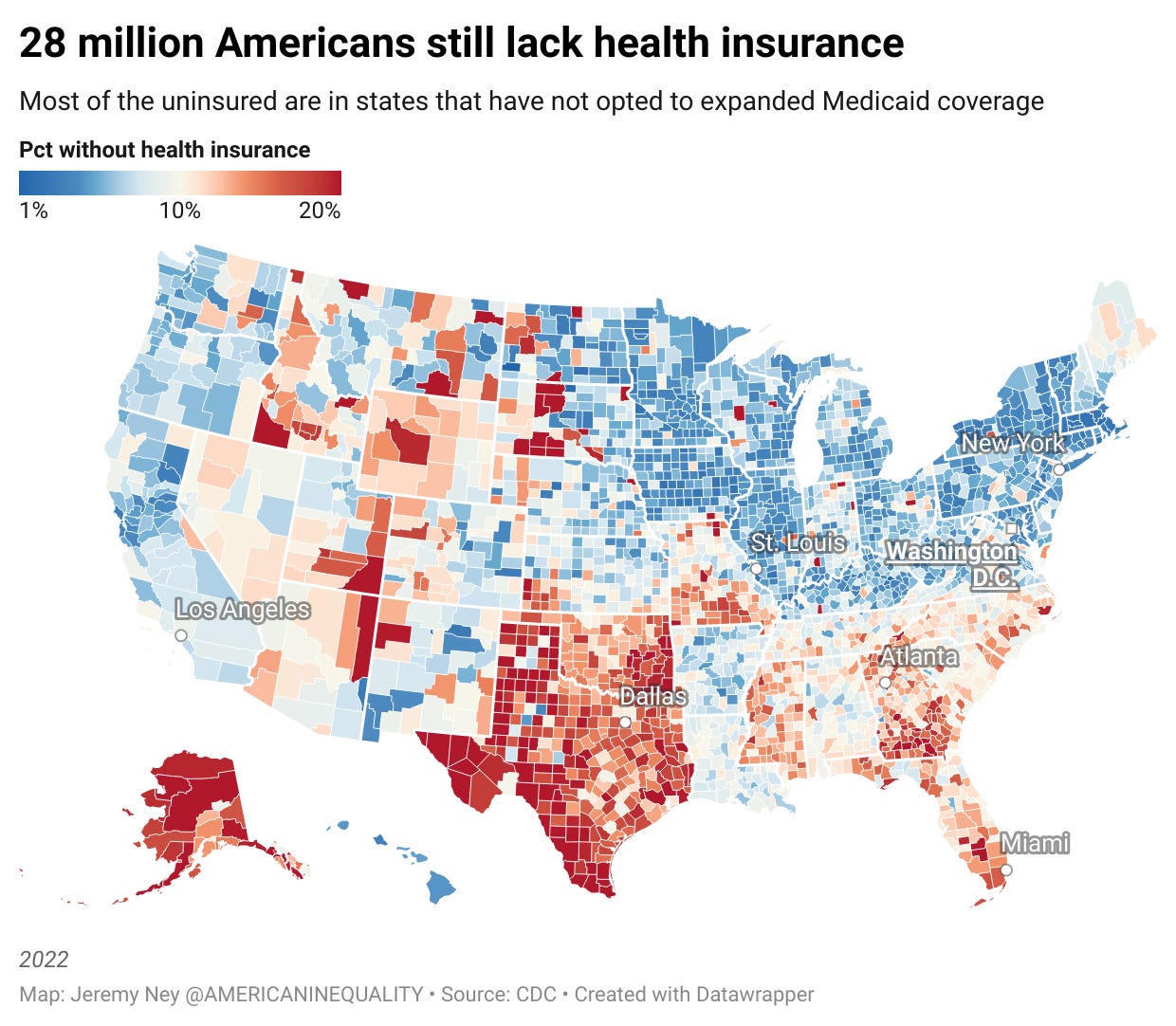
America is the only high-income country that does not guarantee health coverage for all its citizens. As a result, 28 million Americans still have no health insurance. In 2018, medical bills forced 8 million people into poverty. Despite the devastating effects of the COVID-19 pandemic over the last 3 years, insurance rates have not meaningfully changed. When we dig into specific states, Texas is a microcosm of the country’s broader issues, with the lowest health insurance coverage rates in the country, leading to massive inequality across communities. Lack of health insurance produces inequalities. Families without insurance have higher child mortality rates than those with insurance and lower overall life expectancies. They are 20% less likely to seek the care they need, and they are 2x more likely to have trouble paying medical bills, causing cycles of poverty.
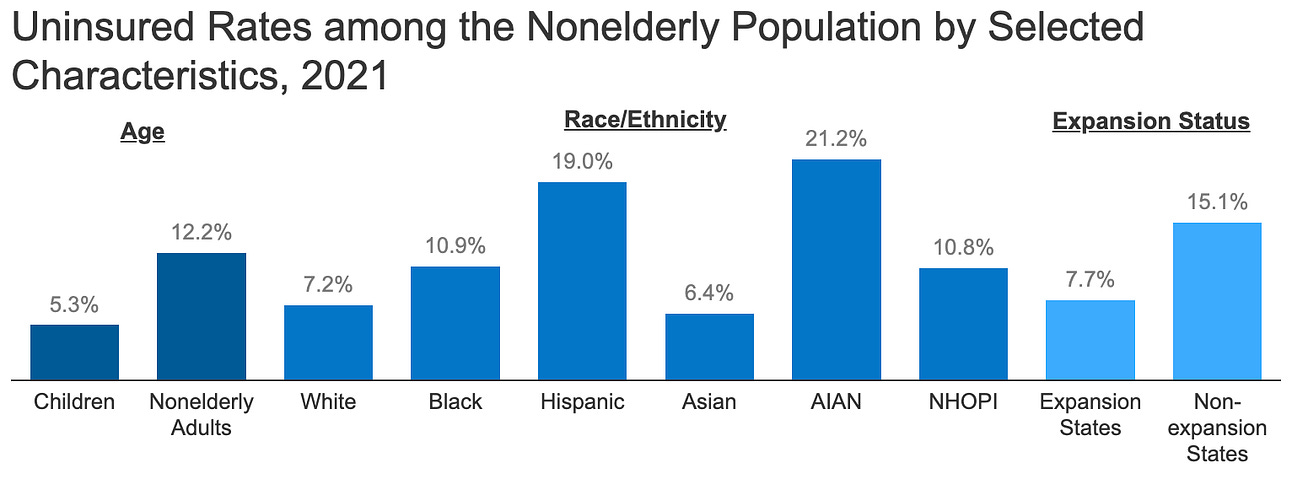
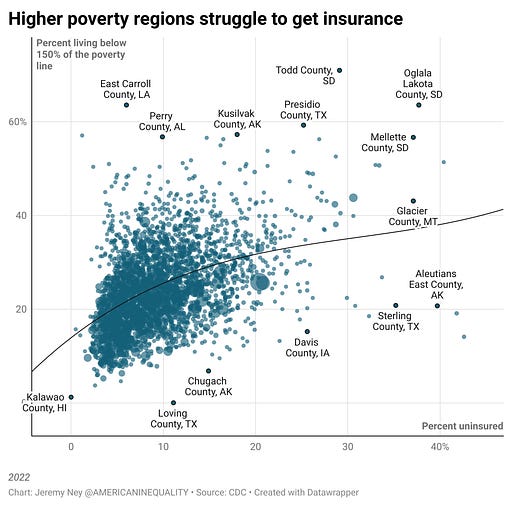
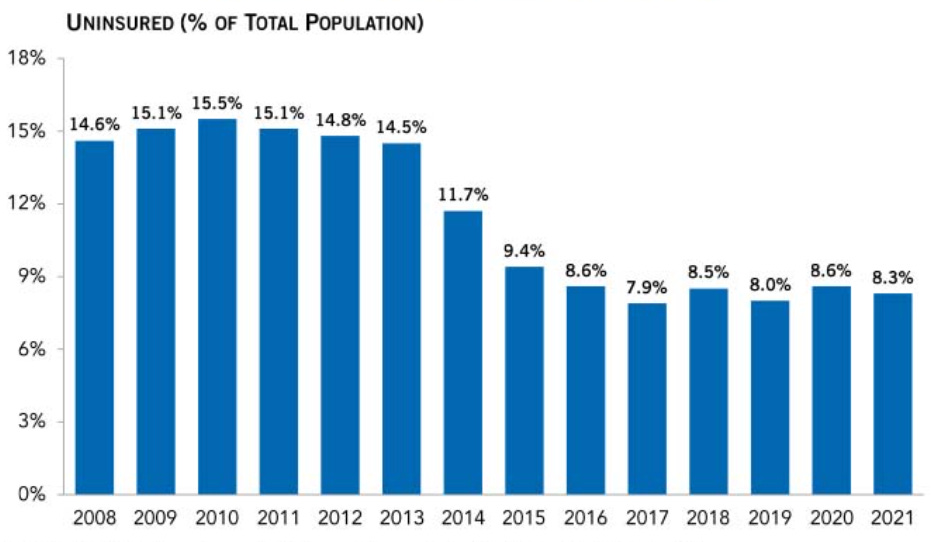
The Affordable Care Act (ACA), often referred to as Obamacare, made tremendous strides in reducing the share of uninsured Americans. Since 2010 when the ACA was passed, the number of uninsured Americans has fallen by nearly half, from 15.5% of the population to 8.3% of the population (48 million Americans to 28 million Americans). In the last year alone, a record-breaking 16.3 million people selected a healthcare option from the ACA open marketplace. Nevertheless, over the last 7 years the share of uninsured Americans have largely stagnated, which is why we thought this would be a great topic to cover. High costs decrease insurance enrollmentThe #1 reason Americans cite for not having insurance is the high cost of enrollment. Access is available, but costs keep people out. Although the ACA helped households save an average $800 annually on their annual premiums, the average annual premium for employer-sponsored health insurance is $7,739 per year for single coverage and $22,221 per year for family coverage. 13 million of the 28 million uninsured Americans are in low-income households earning 200% below the federal poverty line. Elderly Americans are the least likely demographic to be insured, often because health insurance costs are much higher for this group than for younger, healthier adults. Nearly half of the uninsured population are people of color.
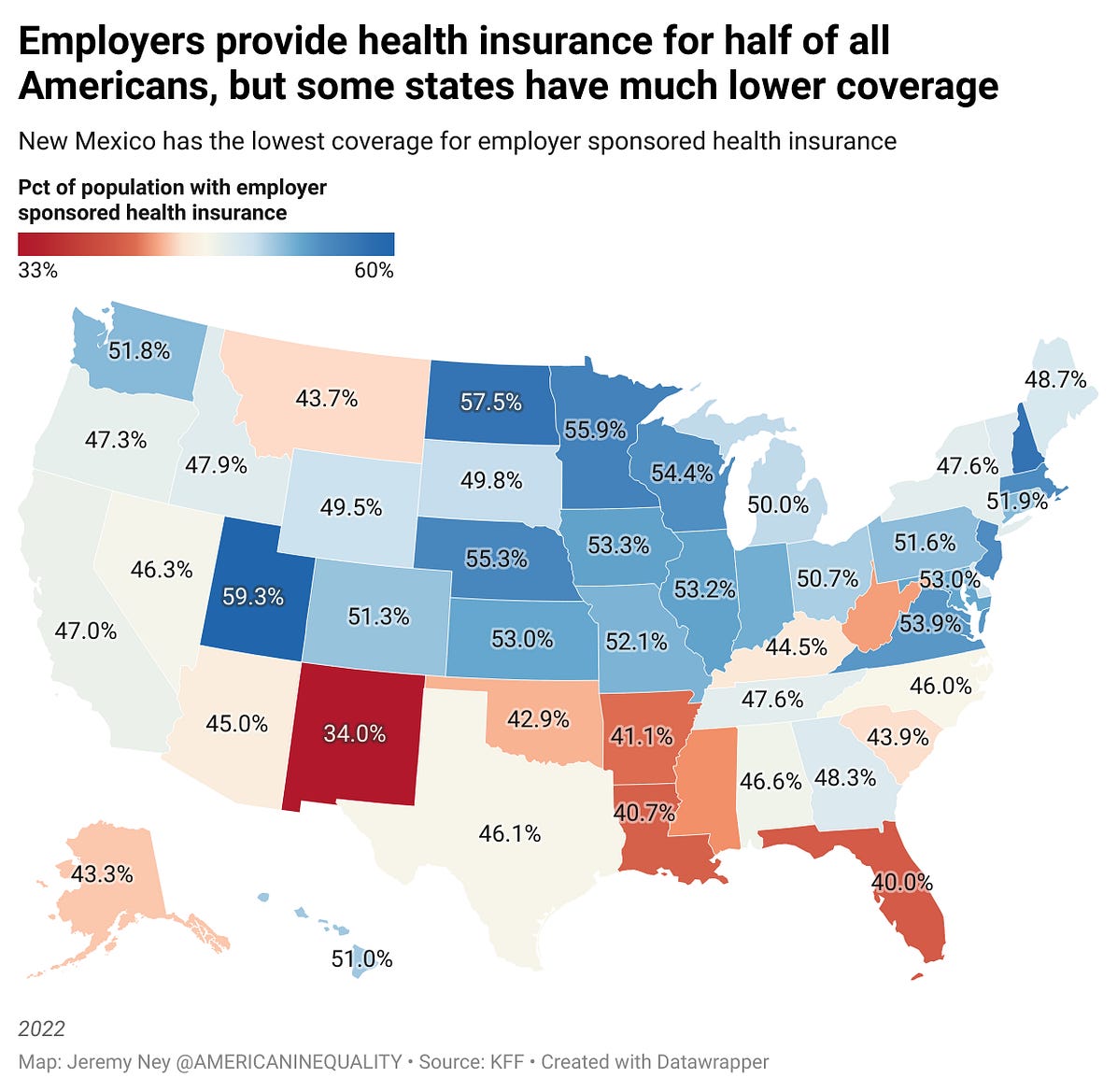
Texas has the lowest share of insured residents because it suffers from the perfect storm of healthcare challenges - poor state support, high costs, and systemic factors. Nearly 1 in 5 Texans does not have health insurance, more than double the national rate. First, the state has not expanded Medicaid coverage, which has prevented 1.4 million families from otherwise getting health insurance. Many of these families are living in poverty. But 10 states have not expanded Medicaid as well, so what else makes Texas special? The second arm of the perfect storm in Texas is that it has high healthcare costs. Texas is the 4th most expensive state for healthcare, with residents spending $17 out of every $100 on healthcare costs. There are fewer rules on how much doctors can charge for procedures and the state has fewer facilities, particularly in remote regions - all of which drive up costs. The impact of lost earnings and poor health in Texas is expected to rise from $57 billion in 2016 to $178.5 billion by 2040. Finally, Texas’s large immigrant population has led to a lower share of the population receiving health insurance. Non-citizen immigrants are 3x more likely to lack insurance than are American citizens. Immigrants can be both less likely to get insurance because they are excluded from certain systems - perhaps they can’t get government issued ID cards or their jobs only recognize them as contractors - or they are excluded because high prices make insurance inaccessible. What is Medicaid expansion?‘Medicaid expansion’ is a major component of the Affordable Care Act, which stipulates that state can provide health insurance to residents who earn less than $18,754 (or $38,295 for a family of 4) by using federal funds to pay for that coverage. States are able offer this benefit because under the ACA the federal government agreed to reimburse states for 90% of the costs. In National Federation of Independent Business et al v. Sebelius, the Supreme Court ruled that states could not be coerced into expanding Medicaid. Employer insurance distorts market forcesHalf of Americans, or 156M people, get their insurance through their employer. An additional 60 million Americans are covered under Medicare, 58 million are covered under Medicaid, and 12 million are covered under military insurance.
Employer sponsored health insurance did not develop because the Founding Fathers wanted it this way. Instead, it grew because of war and taxes. During WW2, FDR signed Executive Order 9250 to prevent companies from raising wages too quickly as the American workforce went to fight overseas. Companies in turn started competing on benefits, namely by offering more generous health insurance. By 1943, the IRS determined that employer-based health insurance should be exempt from taxation, making it cheaper to get health insurance through a job than by other means. In 1940, only 9% of Americans had health insurance. Following the IRS’s changes, 50% had insurance by the end of 1950. “Job-lock” occurs when employees stay in jobs they’d otherwise leave because they don’t want to lose their insurance. 1 in 3 employees in America say that they would leave their job if it didn’t also mean losing their insurance. This creates a perverse incentive in the market, with some researchers estimating that insurance based job-lock reduces employment mobility by 25%. The Congressional Budget Office has similarly calculated that 2.5 million Americans pick their jobs based on the insurance benefits offered. For Kirk Eichenwald, “Health insurance rules my life.” Kirk has a pre-existing condition, like 133 million other Americans, which has not only created job-lock for him, it has also defined his choices in life. Kirk has had chronic seizures from epilepsy since he was 18, often ending up in the hospital. When he convulsed in public, strangers often called him an ambulance which he could hardly afford. While the ACA probably saved his life, he’s working on getting German or English citizenship to ensure he’ll be covered regardless of how the political winds blow. As the field of gig-work grows, these employees continually struggle to find affordable insurance since their employers rarely provide this benefit. 23% of gig-workers lack insurance, despite the fact that many of them may be eligible to get care of coverage through the ACA for as little as $10 per month through multiple tax credits. When millions of workers lost their jobs during the pandemic, Hispanic Americans and Asian Americans were most negatively impacted from losing their employer sponsored insurance.
The insurance rate has largely stagnated as federal and state efforts to get Americans enrolled have slowed. While the Obama administration put a huge emphasis on increasing insurance enrollment from 2010 to 2016, the Trump administration made no similar effort. Although the Biden administration has renewed efforts, the data has not yielded new results. The Path Forward32 countries offer free healthcare to their citizens. America spends far more on health insurance, yet we live far shorter lives. On a national scale, the U.S. spent 17.8% of GDP on healthcare, nearly twice as much as the average OECD country. The dollars spent do not translate to the desired health benefits. While the US has a long way to go before ever reaching the model of those 32 countries, there are several lessons to learn from global communities.
When families lack reliable health insurance, inequality follows shortly afterwards. 1 in 10 Americans carry medical debt, and those who carry this debt are far less likely to seek help. Healthcare is deeply connected to opportunity, particularly because it’s so closely linked with employment. It’s time to break the stagnation in insurance enrollment and get more families the backstop they need. You’re on the free list for American Inequality. Thanks so much for being part of our community! Most sincerely, Jeremy
|






Комментариев нет:
Отправить комментарий
Примечание. Отправлять комментарии могут только участники этого блога.