Unraveling Alzheimer's Inequalities: From New Drugs to Healthcare DisparitiesAlzheimer’s is the #5 killer of Americans, but location and demographics play a big role
This article I wrote also appeared this morning in TIME Magazine. 🎉 Go check it out to see some new interactive maps.
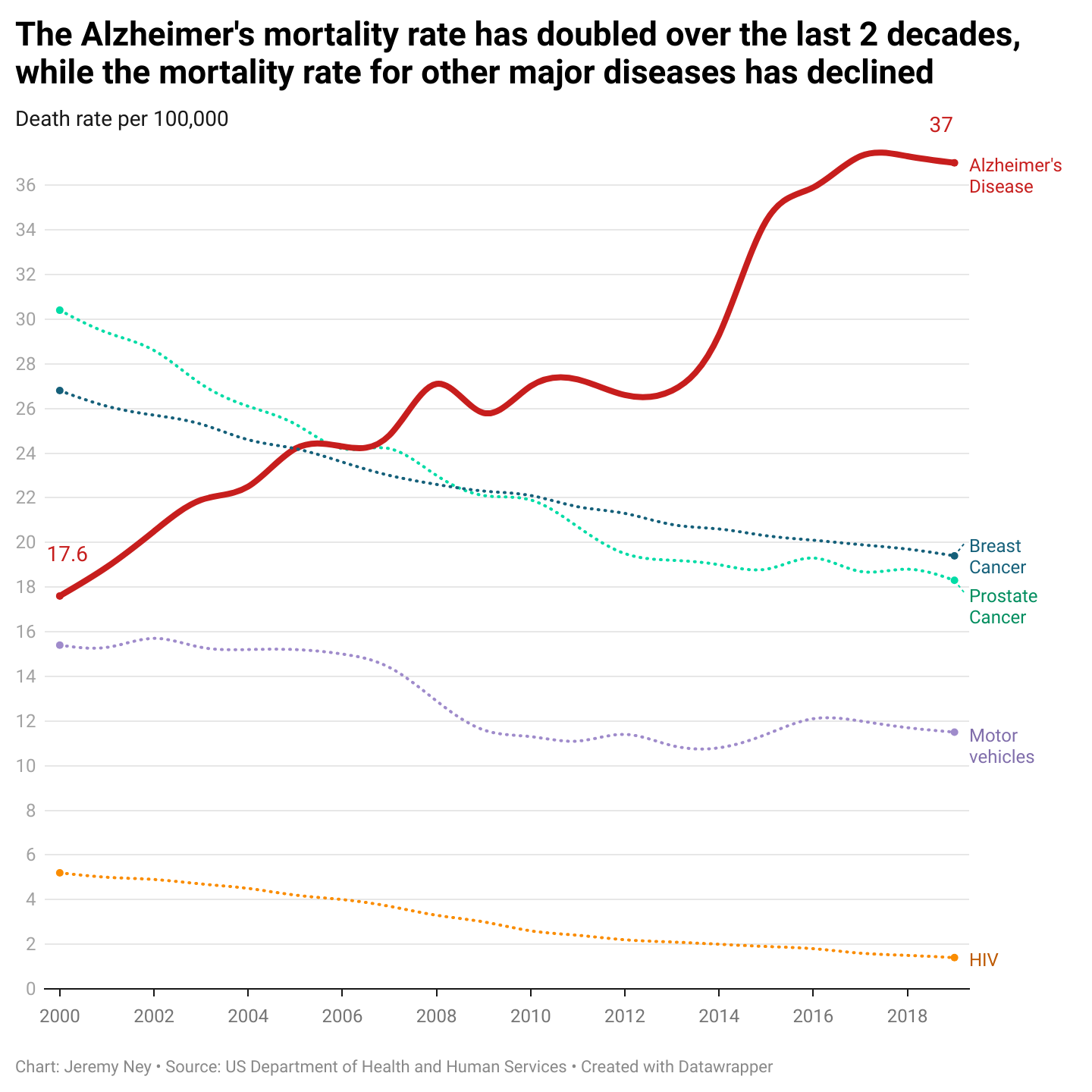
The FDA in mid-July for the first time ever approved an Alzheimer’s drug, Leqembi. The annual price-tag will run patients $26,500. The same week, the Alzheimer’s Association for the first time ever released county-level data to identify which communities are most struggling with the disease. 6.7 million Americans live with Alzheimer’s disease and 134,000 of them will die because of it each year. We’ve known these aggregate numbers for a while now, but with new data and new drugs, healthcare specialists can now better target attention and resources. More Americans will die from Alzheimer’s this year than will die from breast cancer, prostate cancer, and car accidents combined. In the next 25 years, it’s expected that the number of Americans with Alzheimer’s will double as the disease continues to grow in prevalence and as life expectancies increase. Doctors and scientists don’t quite know all the reasons that people develop Alzheimer’s. Doctors agree that it is probably caused by some combination of age-related changes, along with genetic, environmental, and lifestyle factors.
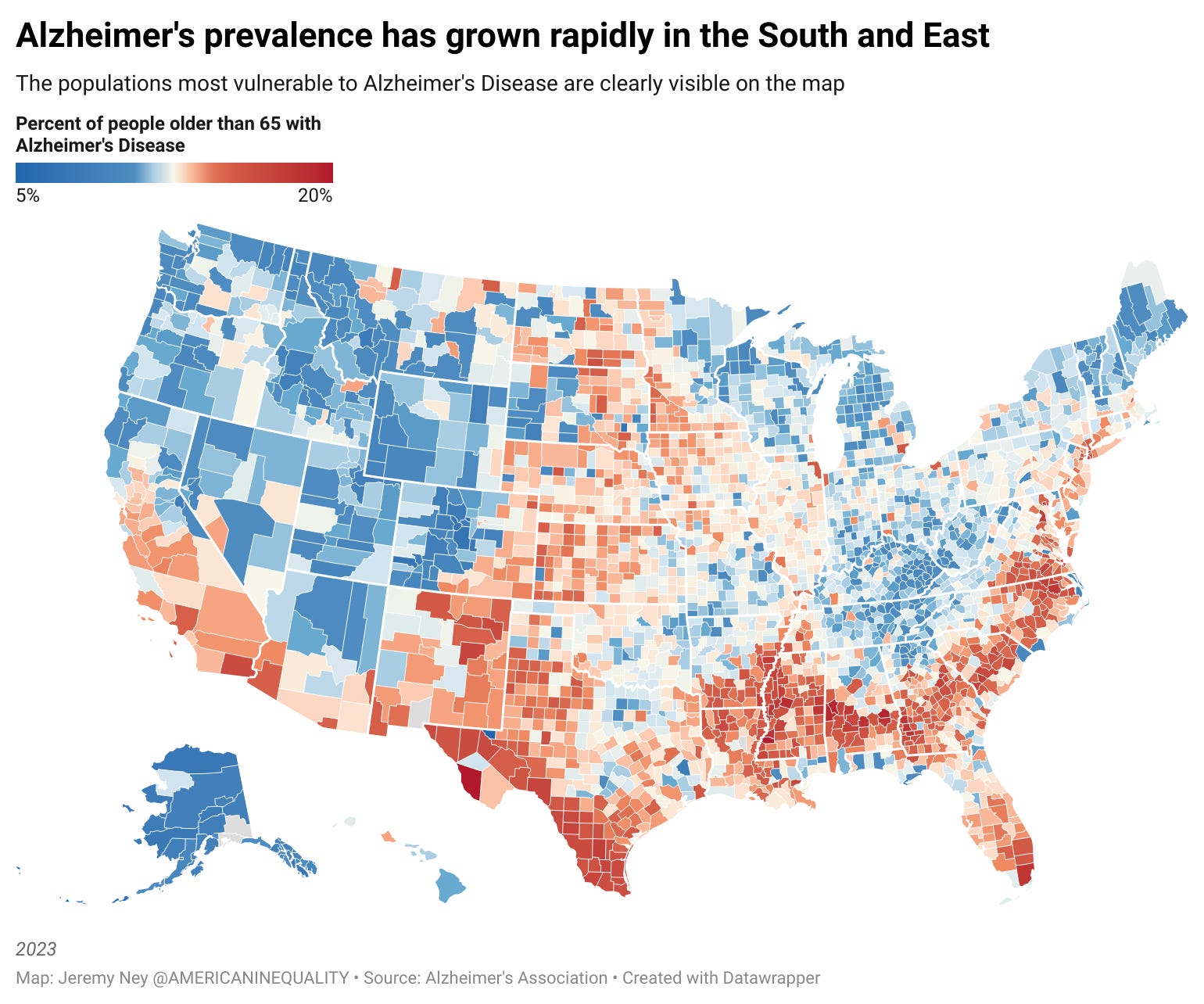
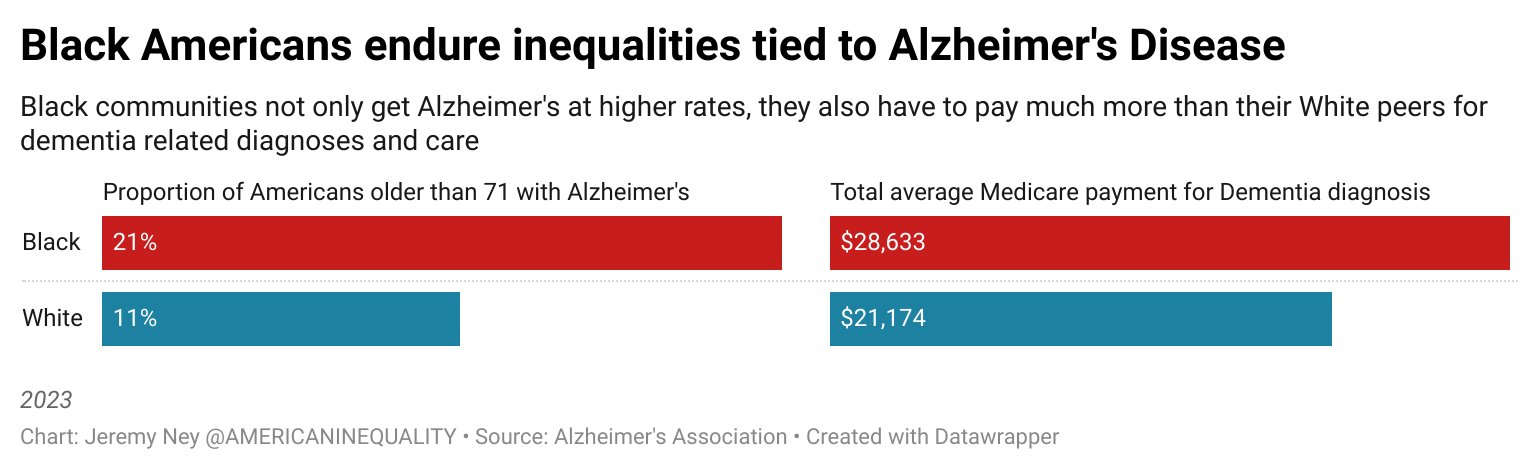
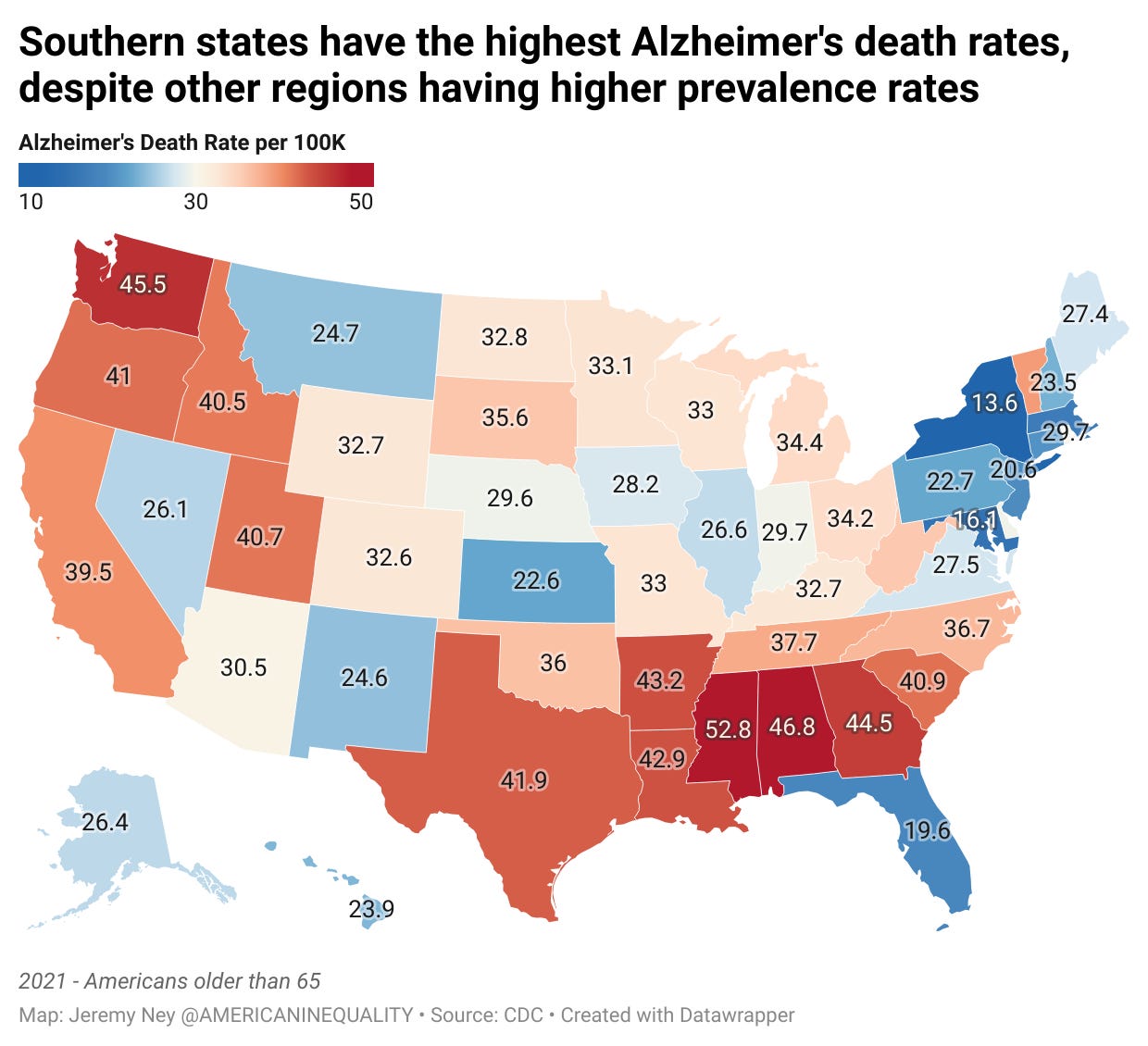
With new data just released, patterns of inequality are slowly emerging. The evidence is reflected in the map above. Black populations in the Mississippi delta region, elderly populations in southern Florida, Hispanic populations along the border with Mexico, and the low-income White populations in the Appalachians are all visible in the data, showing that Alzheimer’s is not only a disease that impacts the elderly, but also dramatically impacts different communities as the social determinants of health come into stark relief. The CDC states this clearly, “Lower levels of education, higher rates of poverty, and greater exposure to adversity and discrimination may increase the risk of Alzheimer’s disease.” Researchers can see this clearly in the data. Older Black Americans are twice as likely to develop Alzheimer’s as older White Americans according to the National Institute of Health. Hispanic Americans are 1.5x as likely to develop Alzheimer’s, and researchers also found that for each one-point increase on a scale of socioeconomic deprivation, there was an 8% increase in the odds of developing Alzheimer’s. “The conditions in places where people are born, live, learn, work, and play are known as social determinants of health (SDOH). These conditions can have a profound effect on a person’s health, including their risk for Alzheimer’s disease and related dementias,” the CDC goes on to say. The build up of beta-amyloid plaques and tangles may cause Alzheimer’s, but social conditions show much greater risk for some Americans even before that chemical change begins to happen. Black Americans die more often from Alzheimer’sIn 2017, researchers finally figured out why Black Americans are both more likely to develop Alzheimer’s Disease and to die from it: stress.
Black Americans experience more stress than their White peers, which has led to higher rates of Alzheimer’s prevalence. Specifically, researchers have studied how job loss, financial burdens, and housing insecurity have created stresses on Black Americans more so than on White Americans, leading to higher rates of Alzheimer’s. On top of this, Black Americans end up paying 35% more in Medicare payments for their dementia diagnoses. Black Americans who live in areas “challenged by poverty, low education, unemployment, and/or substandard housing… had significantly increased odds of having Alzheimer’s-related biomarkers and impaired cognition” according to new research from the Alzheimer’s Association. Alzheimer’s has become a leading cause of deathDeaths from Alzheimer’s have more than doubled over the last two decades. Meanwhile deaths from heart disease and stroke have actually declined. Alzheimer’s is a disease that impairs memory and cognition - making it harder to remember who you are, where you are, and what is happening around you. Alzheimer’s not only robs you of an identity, it kills you by impairing your motor skills as your body essentially forgets how to swallow or breathe properly.
When our American Inequality article about inequalities in life expectancy made its way around the web, many wrote back saying that quantity of years wasn’t everything - quality was hugely important. Alzheimer’s is probably the worst disease in this respect. It not only destroys the quantity of years one has left to live, but it also ravages the quality of those years. One state in particularly shows the lethal effects of these intersecting forces on both quantity and quality of years. With a high percent of Black Americans, high percent of low-income Americans, and poor access to health-care, Mississippi illustrates the life-or-death consequences of Alzheimer’s inequalities. Mississippi has the highest Alzheimer’s death rateMississippi has the highest mortality rate from Alzheimer’s in America with nearly 53 out of every 100,000 people dying from Alzheimer’s in the state. From 2000 to 2019, deaths from Alzheimer’s in Mississippi increased 267%, nearly double the national average which also increased a startling 145%.
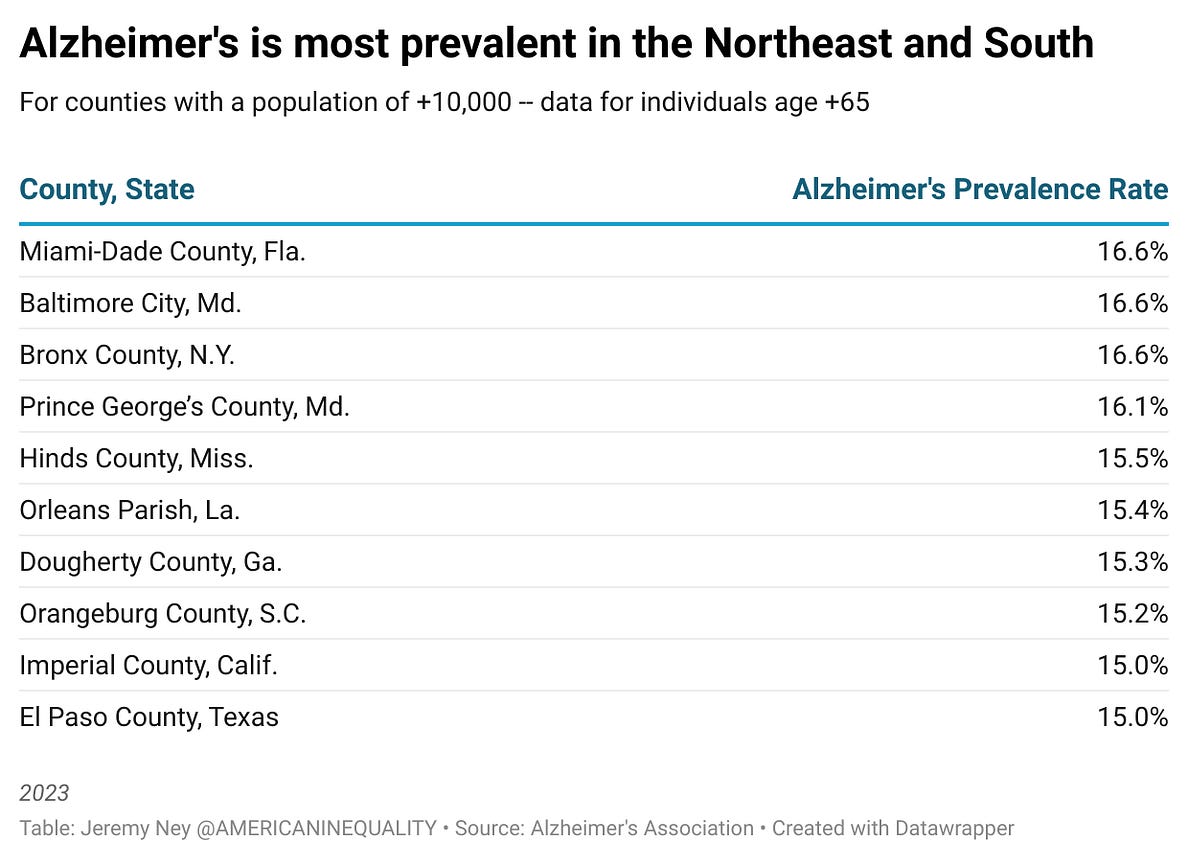
The primary reason Mississippi has such high Alzheimer’s deaths rates has to do with its medical care. Quality medical care can reduce Alzheimer’s death rates in two ways: Reducing complications, and slowing the progression. Even before the FDA began approving new drugs like Leqembi, several medications have existed to help slow the progression of Alzheimer’s and other dementias, but without access to affordable care many Mississippi residents never get these drugs. In addition, 29% of Americans with Alzheimer’s die from pneumonia as the disease causes them to forget how to swallow, inadvertently inhales food particles or liquids that cause bacterial infections. Doctors know how to treat pneumonia and other complications or co-morbidities, but only if the sick can actually get into doctor’s offices to receive that care. In June, the nonprofit Commonwealth Fund ranked Mississippi last of all 50 states in terms of the quality of its healthcare system. When Dr. Daniel Edney, Mississippi’s state health officer, was asked about the report he was hardly surprised, saying “If we had 60 states, we’d be 60th in health.” The interwoven nature of inequality becomes apparent in Mississippi. Top of this the fact 39% of Mississippi residents are Black (the highest Black population of any state in America) and that Mississippi also has the lowest median household income of any state at $46,511. Even though New York and Maryland are the states with the highest prevalence of the disease (1 in 8 residents in each state has Alzheimer’s) Mississippi has a 3x higher Alzheimer’s death rate. New York actually has the lowest death rate at 19 deaths from Alzheimer’s out of every 100,000. This is a testament to the tremendous healthcare systems that both New York and Maryland have, though it’s important to acknowledge that challenges in specific communities persist, such as in Baltimore, MD and in the Bronx, NY. The Path ForwardWe can address Alzheimer’s inequalities by focusing on people, proof, and process. Check out our 3 solutions below.
Alzheimer’s continues to both create and reflect healthcare inequalities across the US. Rising death rates, new drugs, and recently available data have brought this conversation into the light. Meanwhile, Black communities, residents of Mississippi, and caregivers continue to suffer. However, growing the supply of caregivers, improving data accuracy, and providing more information to the public can go a long way toward helping Americans who may be losing their most precious treasures: their memories. You’re on the free list for American Inequality. Thanks so much for being part of our community! Most sincerely, Jeremy
|






Комментариев нет:
Отправить комментарий
Примечание. Отправлять комментарии могут только участники этого блога.