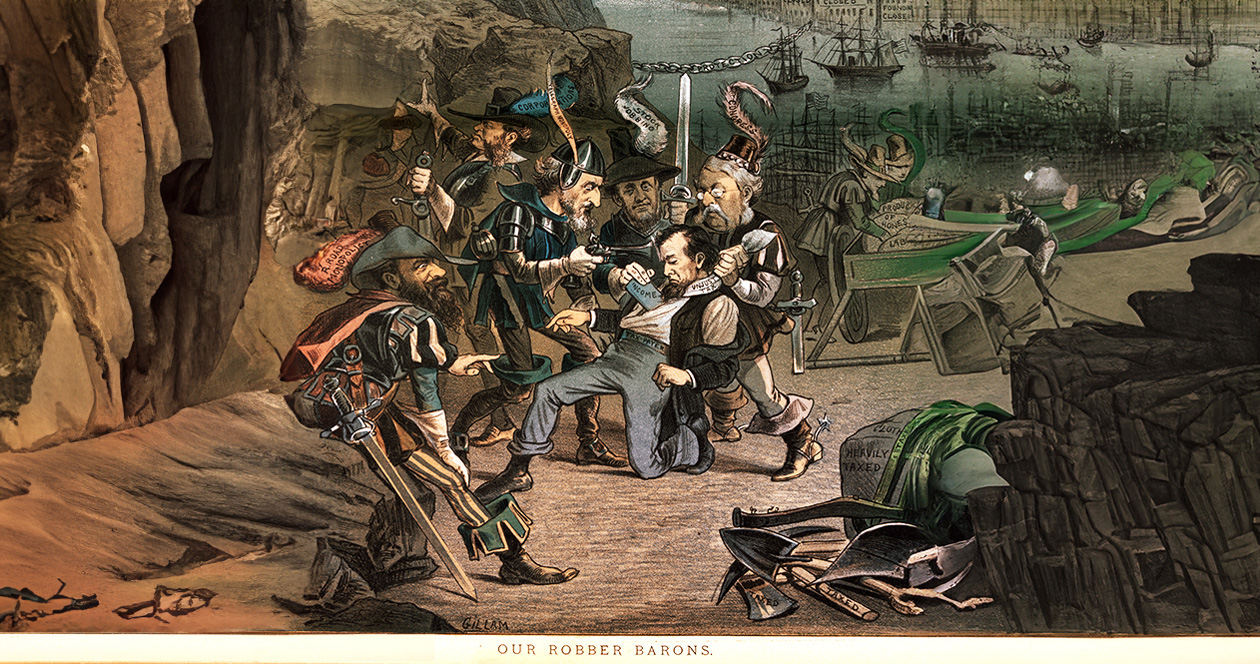
| | Are we in an "idea drought"? Bloomberg columnist Adrian Wooldridge thinks so, arguing that today's big businesses are content to spend their time and capital "fine-tuning their management machines with incremental ideas or on defending their walls by buying up rivals rather than on the wholesale rethinking of markets." And it matters because when there's no innovation, companies just "revert unthinkingly to old ideas": Multinational companies, for example, will revert to the national fiefdoms of the 1970s despite the information revolution or rely on the old technique of employing retired politicians to give them political advice despite the volatility created by populism. AI is spreading scientific management techniques to knowledge workers—break work down into distinctive tasks, make liberal use of sticks and carrots and monitor everything the worker does—despite ample evidence that, over the long-term, scientific management lowers both morale and productivity. The only way to escape being trapped by old thinking is to produce some new thinking. The sooner the better. + One old idea that's coming back in fashion: the merger. Even though, as both Bloomberg and the Financial Times recently stressed, M&A deals often fail to generate the gains they promise. | | | | | Protecting innovation from monopolies Earlier this month, FTC chair Lina Khan joined the Financial Times' Rana Foroohar for a conversation on the future of American innovation. Touching on debacles as varied as the 2022 baby formula shortage and Boeing's recent troubles, Khan outlines the risks of consolidation, not only to consumers but to the safety and security of the nation as a whole. But besides the vulnerabilities that consolidated markets amplify, they also stifle innovation, as Khan makes abundantly clear: History and experience show us that lumbering monopolies mired in red tape and bureaucratic inertia cannot deliver the breakthrough innovations and technological advancements that hungry startups tend to create. It is precisely these breakthroughs that have allowed America to harness its cutting-edge technologies and have made our economy the envy of the world. To stay ahead globally, we don't need to protect our monopolies from innovation. We need to protect innovation from monopolies. We need to choose competition over national champions. It's an excellent talk. And so is the Q&A session with Foroohar that follows it, in which Khan dives a little deeper into Big Tech, cloud computing, AI, cybersecurity, and US industrial policy. Watch it here. (Note: Khan's talk starts at 24:05.) | | | | | Avoiding robber baron rents The path from innovation to market consolidation can be swift. In "Rising Tide Rents and Robber Baron Rents," a new working paper for the UCL IIPP's Algorithmic Attention Rents project , I delve into "how innovators lose their edge and their ideals." Here's the prevailing way businesses devolve: In the early stages, a new technology creates value that lifts all boats so to speak—these "rising tide rents" benefit society as a whole and can "encourage innovation and the development of new markets." But this moment is short-lived. Growth inevitably slows, and businesses begin to lean on their market power to demand rents that produce no value save to their own profit margins. And they most often levy these "robber baron rents" by enshittifying their products , harming users and partners alike. As I and my coauthors in the Algorithmic Attention Rents project argue, addressing these abuses will require a raft of solutions—better regulation and regular, mandated disclosures among them. + Ilan Strauss, Mariana Mazzucato, and I will be discussing how big tech platforms control attention and shape markets with UCL's Zeynep Engin and University of Cambridge's Jon Crowcroft on April 3 at 9:00am PT. It's free, so I hope you'll take part. You can register here. + And Cory Doctorow will be joining me on the O'Reilly learning platform on May 14 at 9:00am PT for a conversation on enshittification and the future of AI. If you're an O'Reilly member, you can register here. And if you're not, you can participate by signing up for a 10-day free trial of O'Reilly. We'll remind you again as we get closer to the event. + Here's a related article Mariana and Ilan published recently in Project Syndicate: "The Algorithm and Its Discontents." | | | | | | —Tim O’Reilly and Peyton Joyce | | | |




Комментариев нет:
Отправить комментарий
Примечание. Отправлять комментарии могут только участники этого блога.