The Anxious Generation: Regional DisparitiesThe great rewiring of childhood is taking its toll on Kentucky and Tennessee
I’ve been writing about inequality for a decade now, starting from my time at the Federal Reserve. There is more data today on these issues than at any other point in history, which offers a clearer picture on the state of the world. At American Inequality, my goal is to visualize that data and join it with stories of real people to help you all get the most accurate picture of what is going on nationally, in communities, and in people’s lives for the biggest social issues of our time. Every article includes a ‘Path Forward’ so we don’t just talk about problems, but can also data-driven identify solutions that have proven to work elsewhere. INTERESTING ON THE WEB
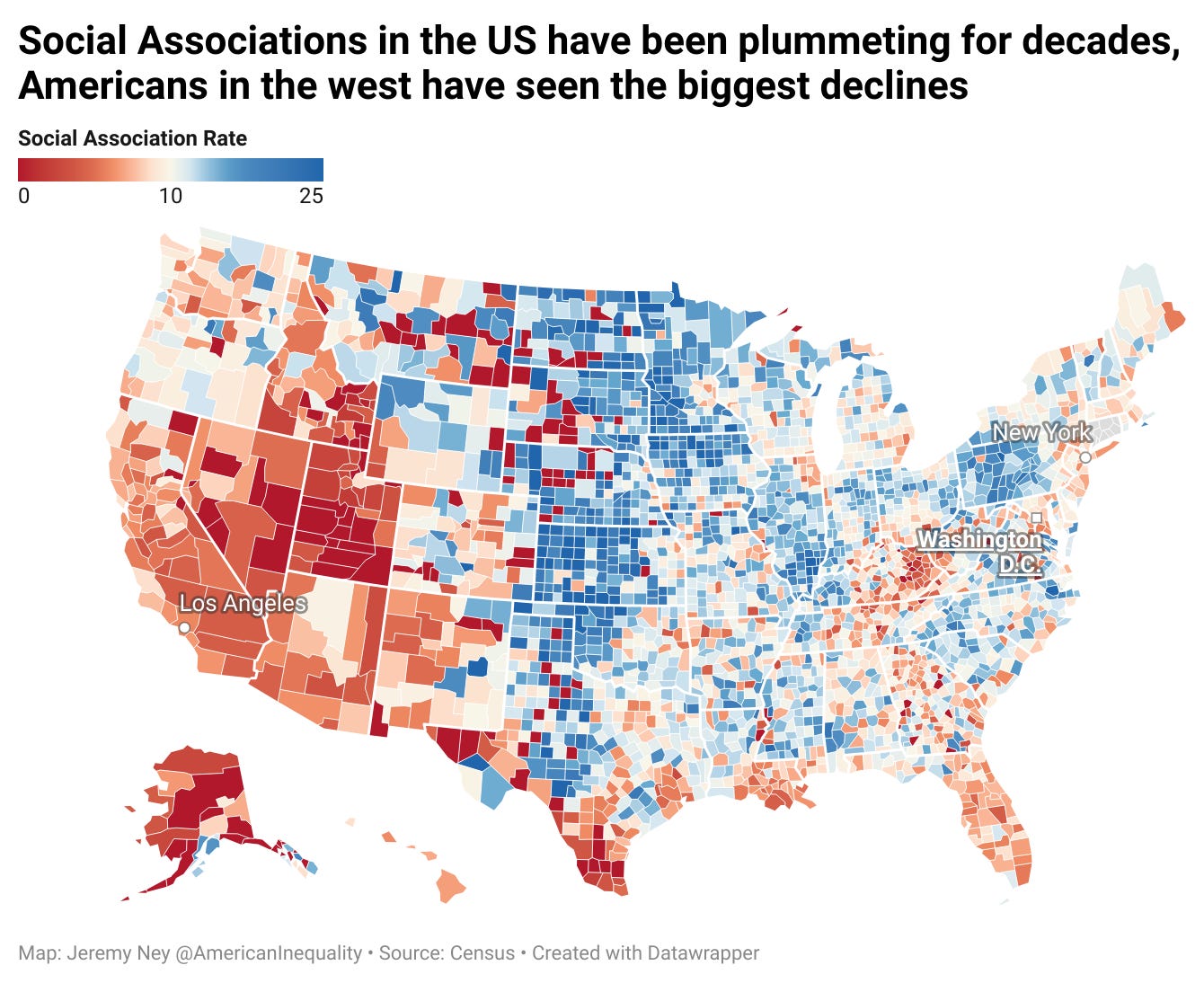
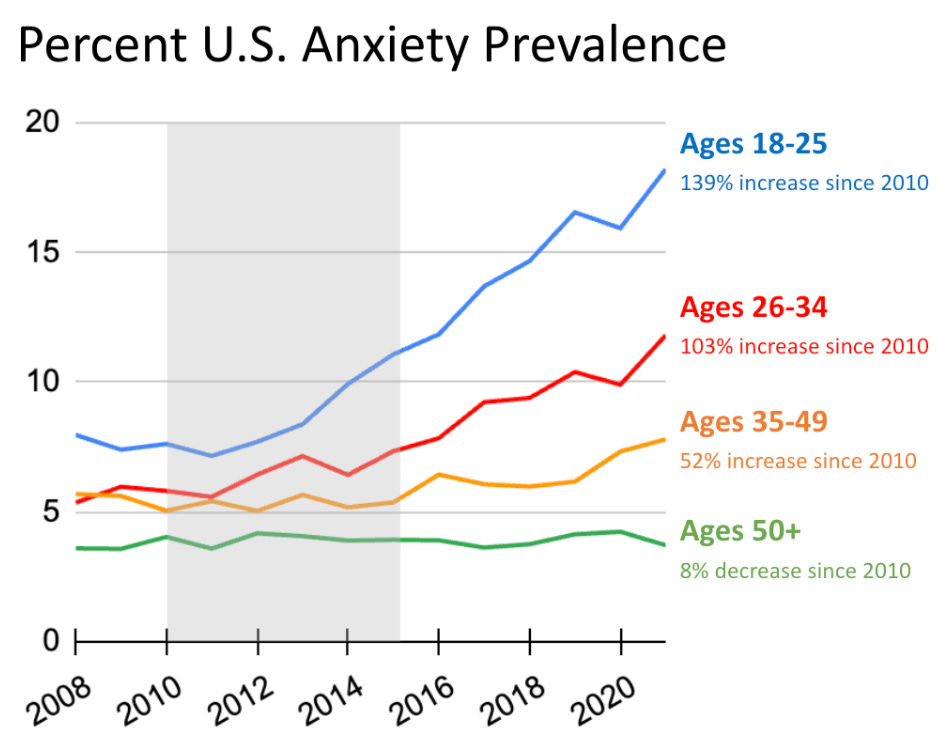
More than half a million people across 150 US counties claim that they have zero social associations. In Jonathan Haidt’s new book The Anxious Generation, Haidt explains that social associations are key to childhood development. He urges children to get off their phones and to have more ‘real-world’ experiences in which they interact with other people in real-time and in a physical space. Haidt argues that the rise of depression, anxiety, and teen suicide is in large part a product of our phone-based world. Two New York schools just began preventing students from having phones in school, and NY Governor Kathy Hochul is expected to announce plans that would make this permanent state wide. At first the students rebelled to the change, but then they began to appreciate the change. AP test scores increased, grades bounced back to pre-pandemic averages, and attendance at sporting events and other activities jumped by 50%. Social associations have been on the decline in America for decades. Robert Putnam’s Bowling Alone tracked the multi-decade decline in how people interacted with each other. People stopped going to church, stopped volunteering, stopped being part of social clubs, stopped engaging in civic activities, and this decline led to a range of social harms. People actually ended up earning less money when they had fewer social interactions because those types of interactions helped them find better jobs and learn to work better in the workforce. The Great RewiringThe Anxious Generation takes a national and historical perspective on the rise of social media and its impact on Gen-Z, but when we start to break this down by region, we see that some areas are likely to be more anxious than others.
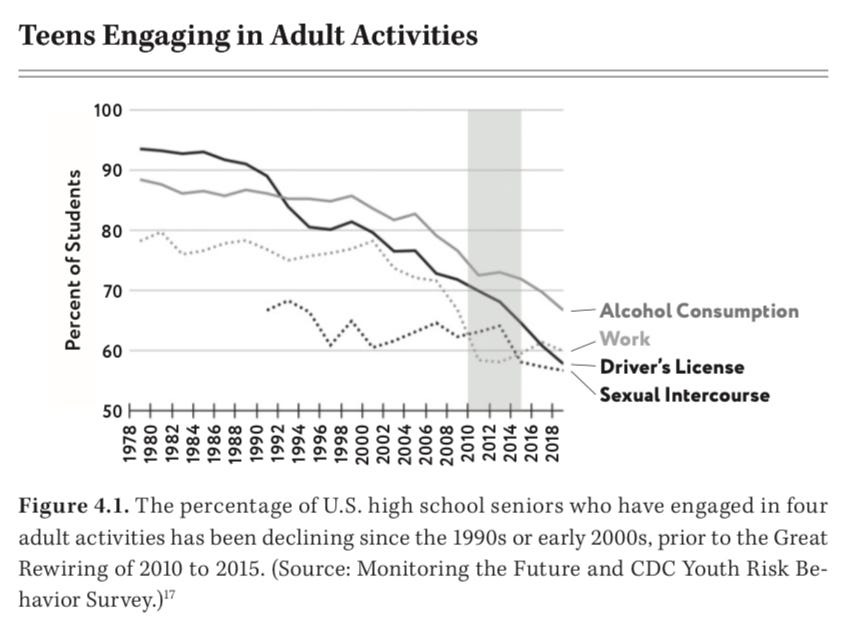
While the breakdown of social associations is detrimental for adults, it is even more dangerous for children. The “phone-based childhood” began in the late 2000s and accelerated in the early 2010s as smart phones burst onto the market, social media took off, and better broadband helped us remain constantly online. Between 2010 and 2015, Haidt explains that America saw a “Great Rewiring of Childhood.” In 2010, Apple introduced the iPhone 4 which was the first of its phones to have a front-facing camera. This did not just make it much easier to take selfies, it also fundamentally changed the way we saw ourselves in the digital world. Haidt argues that our move away from a play-based childhood to a phone-based childhood led to concrete negative impacts for child safety. These were causal, and not just correlations, though some have pushed back on the research.
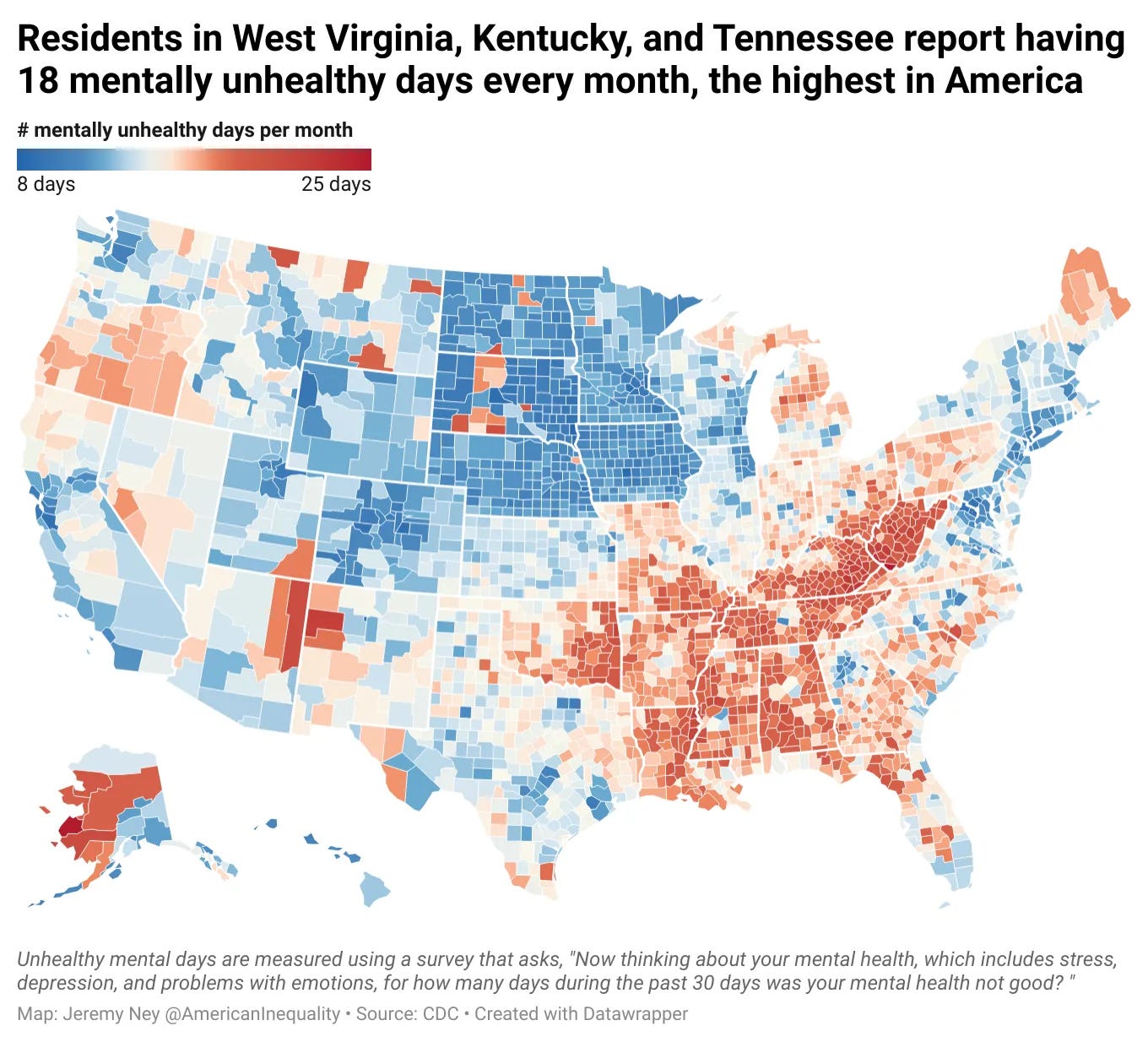
Tennessee and Kentucky have the highest social media use and the highest rates of anxietyThis anxiety and depression showed up most in Tennessee and Kentucky. Residents in these two states report having 18+ mentally unhealthy days per month on average.
The National Telecommunications and Information Administration analyzed the percentage of each state’s population aged 15 or over using the internet for social media in 2021. The results found that Tennessee is the state with the highest use of social media, with 81.1% of residents using the internet for social media. Residents of Kentucky have the highest average number of connections across social media platforms. Overall, 115 million people in the United States live in an area that is designated as a Mental Health Professional Shortage Area (HPSA), according to the Department of Health and Human Services. A region is deemed an HPSA if the ratio to mental health professional to residents is smaller than 1 per 30,000 people. Social associations are plummeting in California, Nevada, and Colorado. One of the causal studies that Haidt looks at in his book evaluates the rollout of Facebook at different universities in its early days. Researchers found that schools which had earlier access to Facebook (notably in California) had higher rates of anxiety, depression, and students citing worse mental health than their peer universities nearby that had not yet received access to the social media site. MIT's Alexey Makarin, one of the researchers, shared this on that study, “The data comes from more than 350,000 student responses across more than 300 colleges. Almost immediately after Facebook arrives on campus, we see an uptick in mental health issues that students report.”
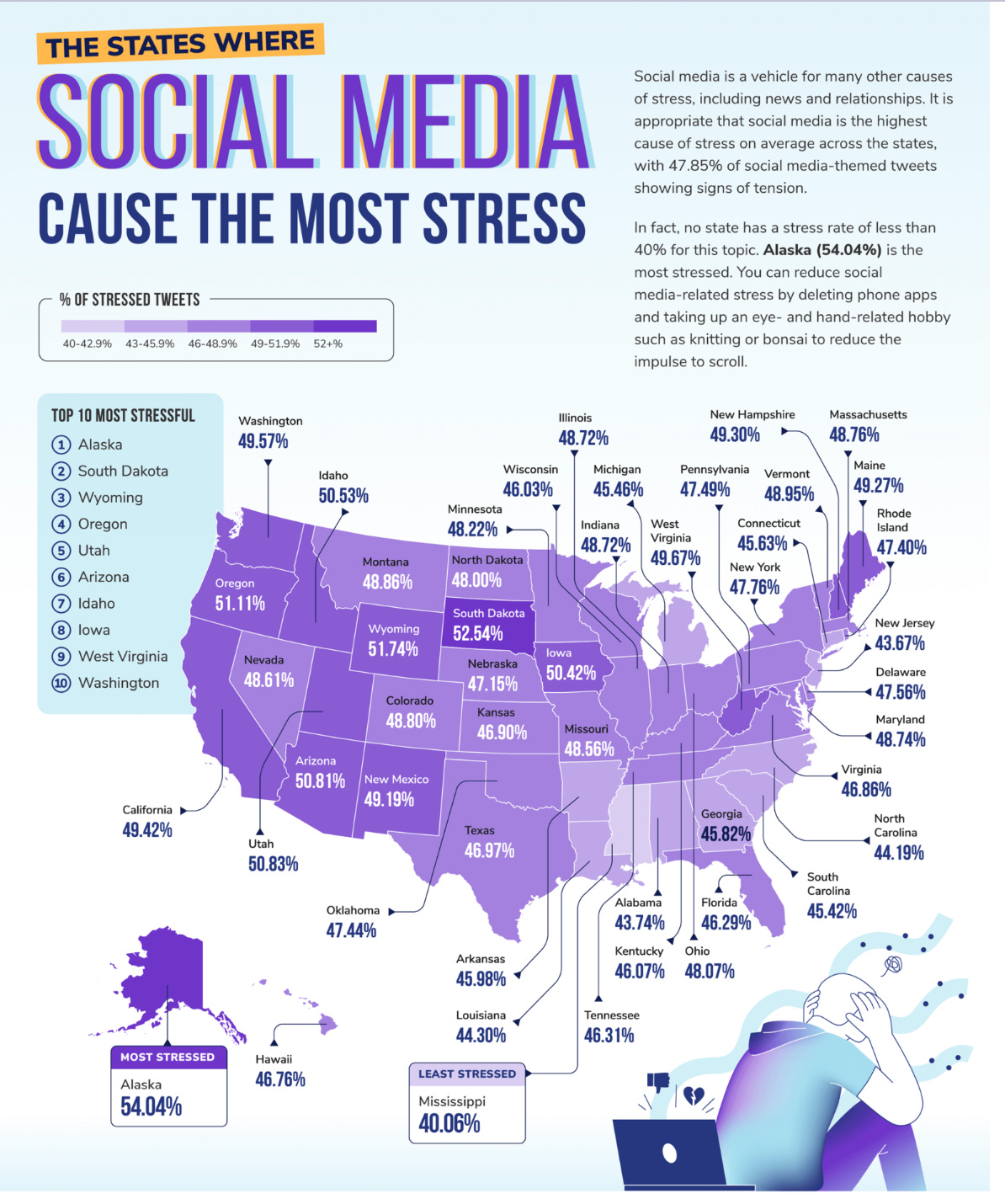
Social media causes the most stress in Alaska, South Dakota, and Wyoming based on data from over 4 million tweets. Many people who live in these communities are typically in rural or remote regions and social media may be one of the primary ways to connect with others around them. They rely on it heavily for connection, validation, and self-worth. That moment of waiting for a ‘like’ or comment to come in is causing stress and anxiety for teens in regions. The Counseling and Support Studies for Youth has reported on the following direct impact from social media on health: Studies have directly linked time spent online with a rising risk of depression. The British millennium cohort study, which followed 19,000 children born in 2000-02, found that depression rates rose in proportion to hours spent on social media. The effect was most pronounced amongst girls. Girls spending over five hours a day on social media were three times as likely to become depressed as those who did not use the platforms. This research does not just emerge from adults or Boomers who shake their fists at social media — millions of teenagers are sharing how it is negatively impacting them, like Katie from Great Neck, NY. “Social media greatly affects my body image. There are beautiful people online, and with TikTok’s “that girl” or “small waist” trends, I wonder why I can’t have the same flat, toned stomach or the same tiny, hourglass waist despite all the exercising and healthy eating I do. But even knowing that it can be unhealthy, I can’t help but ask myself if just a little overexercising or a little starvation could pay off.” The Path ForwardPhones are experience blockers, according to Haidt, and government agencies and tech companies need to put more guardrails in place to protect children from the known harms. He recommends several solutions, some of which draw from his own academic research in ancient practices of spirituality, others from clear lines that will help schools make changes, and others from his own conclusions of the research. I’ll list those here for education purposes, but I think there might be more data-driven conclusions that we can draw, which I’ll also include.
Let’s not forget that social media can be an incredibly powerful tool for change. For Gen-Z in particular, which the Anxious Generation targets, social media has been one of their strongest levers for advocacy. The Anxious Generation does not argue against all of social media, instead it argues for guardrails for children to protect their mental health. Check out more on Twitter, Instagram, or FacebookYou’re on the free list for American Inequality. Thanks so much for being part of our community! Please share with others and don’t forget to subscribe. Most sincerely, Jeremy
|




Комментариев нет:
Отправить комментарий
Примечание. Отправлять комментарии могут только участники этого блога.