Поиск по этому блогу

Search1

123

понедельник, 23 февраля 2026 г.

5 Days, 500 Talks, 1 AI Mission

Over five days at Bharat Mandapam, the India AI Impact Summit carried the energy of a turning point.‌  ‌  ‌  ‌  ‌  ‌  ‌  ‌  ‌  ‌  ‌  ‌  ‌  ‌  ‌  ‌  ‌  ‌  ‌  ‌  ‌  ‌  ‌  ‌  ‌  ‌  ‌  ‌  ‌  ‌  ‌  ‌  ‌  ‌  ‌  ‌  ‌  ‌  ‌  ‌  ‌  ‌  ‌  ‌  ‌  ‌  ‌  ‌  ‌  ‌  ‌  ‌  ‌  ‌  ‌  ‌  ‌  ‌  ‌  ‌  ‌  ‌  ‌  ‌  ‌  ‌  ‌  ‌  ‌  ‌  ‌  ‌  ‌  ‌  ‌  ‌  ‌  ‌  ‌  ‌  ‌  ‌  ‌  ‌  ‌  ‌  ‌  ‌  ‌  ‌  ‌  ‌  ‌  ‌  ‌  ‌  ‌  ‌  ‌  ‌  ‌  ‌  ‌  ‌  ‌  ‌  ‌  ‌  ‌  ‌  ‌  ‌  ‌  ‌  ‌  ‌  ‌  ‌  ‌  ‌  ‌  ‌  ‌  ‌  ‌  ‌  ‌  ‌  ‌  ‌  ‌  ‌  ‌  ‌  ‌  ‌  ‌  ‌  ‌  ‌  ‌  ‌  ‌  ‌  ‌  ‌  ‌  ‌  ‌  ‌  ‌  ‌  ‌  ‌  ‌  ‌  ‌  ‌  ‌  ‌  ‌  ‌  ‌  ‌  ‌  ‌  ‌  ‌  ‌  ‌  ‌  ‌  ‌  ‌  ‌  ‌  ‌  ‌  ‌  ‌  ‌  ‌  ‌  ‌  ‌  ‌  ‌  ‌  ‌  ‌  ‌  ‌  ‌  ‌  ‌  ‌  ‌  ‌  ‌  ‌  ‌  ‌  ‌  ‌  ‌  ‌  ‌  ‌  ‌  ‌  ‌  ‌  ‌  ‌  ‌  ‌  ‌  ‌  ‌  ‌  ‌  ‌  ‌  ‌  ‌  ‌  ‌  ‌  ‌  ‌  ‌  ‌  ‌  ‌  ‌  ‌  ‌  ‌  ‌  ‌  ‌  ‌  ‌  ‌  ‌  ‌  ‌  ‌  ‌  ‌  ‌  ‌  ‌  ‌  ‌  ‌  ‌  ‌  ‌  ‌  ‌  ‌  ‌  ‌  ‌  ‌  ‌  ‌  ‌  ‌  ‌  ‌  ‌  ‌  ‌  ‌  ‌  ‌  ‌  ‌  ‌  ‌  ‌  ‌  ‌  ‌  ‌  ‌  ‌  ‌  ‌  ‌  ‌  ‌  ‌  ‌  ‌  ‌  ‌  ‌  
  -  
1770012626775-strzt
1770012626775-strzt

5 Days, 500 Talks, 1 AI Mission

THE BELAMY

Weekly Newsletter of AIM

Monday, Feb 23, 2026 | By Mohit Pandey

Now, subscribe to our Digital & Print Editions >


Over five days at Bharat Mandapam, the India AI Impact Summit carried the energy of a turning point. The conversation moved from jobs to gigawatt data centres, from sovereign language models to physics-driven AI for batteries and even to the idea of an 'AI version of UPI'. 

With over 2.5 lakh registered attendees, it became the biggest AI summit in the Global South. CEOs, including Sundar Pichai, Sam Altman, Dario Amodei, Demis Hassabis and Alexandr Wang, shared space with the pioneers of the Indian sovereign AI mission. It wasn't subtle, or small, and it certainly wasn't quiet.

1771831154871-z1fugb

GPUs, Data Centres, AI Factories

Union IT Minister Ashwini Vaishnaw announced that 20,000 additional GPUs will soon power up under the IndiaAI Mission in the coming weeks. This expansion, he said, is the next phase of India's AI strategy, with AI deployed responsibly on healthcare, education and defence.

Then Mukesh Ambani, Chairman of Reliance Industries, went bigger. He pledged ₹10 lakh crore over seven years to build AI infrastructure across India, calling it "patient, disciplined nation-building capital". 

This is one of the largest private commitments to AI infrastructure globally.

Moreover, Tata Sons Chairperson N Chandrasekaran announced a partnership with OpenAI to build what he described as India's first large-scale AI-optimised data centre. The facility will start at 100 megawatts and scale to one gigawatt, putting India in the league of hyperscale AI hubs.

NVIDIA unveiled partnerships with Indian firms, including L&T, to build what was described as India's largest gigawatt-scale AI factory. Investment figures were not disclosed.

Microsoft President Brad Smith said the company is on track to invest $50 billion by the end of the decade across the Global South, with India among the principal beneficiaries. 

Meanwhile, Google CEO Sundar Pichai outlined subsea cable projects linking India to Singapore, South Africa and Australia, along with additional fibre routes to the United States, under Google's $15 billion India investment plan.

Sarvam and BharatGen Take the Centre Stage

Then it was about AI models, focusing on India, and the biggest announcements came from Sarvam AI. After two weeks of daily drops, the company launched Sarvam 30B and Sarvam 105B, two LLMs designed specifically for Indian languages. 

Shortly after, Sarvam introduced Indus, a multilingual chatbot powered by its Sarvam 105B model. Available in beta across web and mobile, Indus supports text and voice interactions. The reaction has been intense, with some comparing it to ChatGPT, while others calling it "India's DeepSeek moment".

Then came BharatGen. The team unveiled three sovereign AI systems. Shrutam is an LLM-based automatic speech recognition platform. Sooktam is a text-to-speech model. Patram is a vision language model built for document intelligence. These launches followed the earlier release of Param2, its 17-billion-parameter language model for India.

At this stage, Sarvam and BharatGen appear to mirror the dynamic seen between OpenAI and Anthropic globally, though it remains to be determined which is which. What is clear, however, is that both are essential to India's sovereign AI ambitions. 

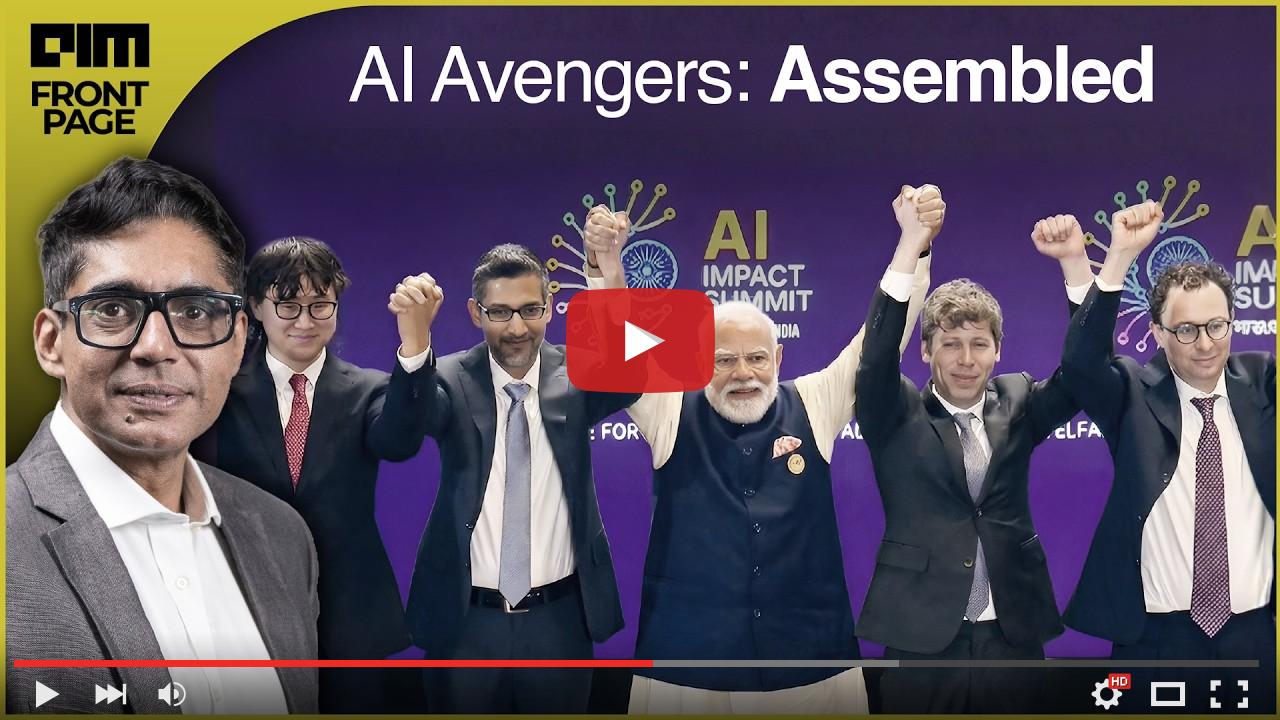
Speaking of which, Google, OpenAI, Meta and Anthropic joined hands with Sarvam, BharatGen, Gnani.ai and Soket AI Labs to announce the New Delhi Frontier AI Impact Commitments, an iconic photograph that quickly became emblematic of the summit.

AIM Network Deep Dive >>

As the race for AI dominance intensifies, some of the world's biggest tech leaders gathered in India for the summit. In this Front Page analysis, we look at a particularly awkward moment between OpenAI's Sam Altman and Anthropic's Dario Amodei—former coworkers turned fierce rivals.

video_preview_913378300509e462039ad7dce0162533.jpg

The Under Discussed Marvels

Equally significant, though less widely discussed, were several other announcements.

Tech Mahindra launched an eight-billion-parameter Hindi-first education LLM under Project Indus. The model is built in collaboration with NVIDIA and trained using 500 million synthetic tokens generated via NVIDIA NeMo Data Designer to address data scarcity. 

Positioned as an education-focused sovereign LLM, it is designed to support agentic AI use cases in Hindi. Project Indus has been in the works for several years now. The similarity in name to Sarvam's chatbot, Indus, may or may not be coincidental.

Soket AI did not formally announce any model, but CEO Abhishek Upperwal said that the model is currently under training and will go live soon.

The voice layer saw some of the most practical announcements.

Digital India BHASHINI Division launched VoicERA, an open source end-to-end multilingual voice AI stack deployed on the BHASHINI National Language Infrastructure. 

Designed to be pluggable and interoperable, VoicERA allows government departments to deploy voice-enabled citizen services at scale. This extends India's digital public infrastructure logic from payments to language AI.

One of the most promising releases came from Gnani.ai with its Inya VoiceOS, a voice-to-voice foundational model that operates directly in acoustic and semantic space, eliminating traditional speech-to-text and text-to-speech pipelines. 

The system promises real-time spoken intelligence with lower latency. Along with this, the company also launched Vachana STT and TTS models, which form part of the broader InyaOS system. 

Finally, CoRover.ai announced that its BharatGPT platform now supports over eight lakh concurrent users. It also launched BharatGPT Mini, an offline AI appliance built on NVIDIA Grace Blackwell architecture. Marketed as a DeskAI appliance, it runs fully offline and targets enterprise, defence and BFSI use cases where data localisation is critical.


Developers, Alert! AMD AI Engage is Here >>

AMD-AI-Engage2_1
AMD-AI-Engage2_1

Join AMD AI Engage, an AMD-led initiative for developers and AI enthusiasts. Strengthen your AI skills, participate in challenges, and unlock opportunities for advanced certification experiences with AMD and industry experts. Register now.


Not every major announcement was about chatbots or language models.

Shodh AI unveiled Project Skanda, described as India's first sovereign generative AI model for material science. SkandaMeso-1 runs at roughly 350 million parameters and focuses on mesoscale battery microstructures rather than text. 

Built on NVIDIA PhysicsNeMo, it enables inverse design of battery architectures based on performance targets such as 1,000-cycle life. The company simulated over one million electrochemical scenarios to create a structured dataset.

NeuroDx launched MANAS-1, a 400-million-parameter brain foundation model designed to decode human brain electrical activity and support early diagnosis of neurological disorders. Also selected under the IndiaAI Mission, the startup positioned MANAS-1 as a step towards AI-driven neurological diagnostics.

The Stage Was Set

When Prime Minister Narendra Modi inaugurated the summit and unveiled the MANAV Vision, a human-centric framework for responsible AI deployment, it was clear that India is now taking AI extremely seriously. 

His speech itself was a demonstration. It was dubbed live into 11 languages using AI, with real-time sign language interpretation.

Vaishnaw outlined plans for an 'AI version of UPI', a digital public infrastructure layer that would allow developers and even other countries to build AI solutions on India's stack.

In several separate discussions, the CEOs gave their two cents on the AI world

Altman predicted that by 2028, more intelligence would reside in data centres than outside them. Amodei argued that India's developer base could translate frontier AI breakthroughs into a broad economic transformation. Hassabis said AGI could emerge within five to eight years. Meanwhile, Yann LeCun reiterated that LLMs are useless.

Few countries have hosted a gathering of this scale. The whole AI world was brought together under one roof. The timing, too, felt deliberate. India found itself hosting the event at the perfect time, amid trending conversations around AI bringing money and use cases.

Now the obvious next question turns to execution. Can 20,000 GPUs translate into a competitive training run? Can sovereign LLMs keep pace with global benchmarks? Can gigawatt data centres come online without running into power bottlenecks? Can AI public infrastructure achieve the kind of scale and trust that UPI accomplished in digital payments?

Yes, the queues were long. Yes, there were memes about robots and dogs. But those were fleeting moments. The sovereign signal of intent, ambition and investment was much louder than the background noise.

AIM Launches GCC Council in Partnership With LinkedIn India

1771565451340-77vs7v

AIM, in partnership with LinkedIn, has launched the AIM Global Capability Centre (GCC) Council—a curated, invite-only leadership forum that brings together senior GCC leaders from India and the broader GCC ecosystem. Click here to find out more.

Now, subscribe to our Digital & Print Editions >

For Brand collaborations, reply to this email or write to info@aim.media

You received this email because you signed up to the updates from AIM. Click here to unsubscribe if you do not want to receive emails from us.

  -  

Комментариев нет:

Отправить комментарий

Примечание. Отправлять комментарии могут только участники этого блога.