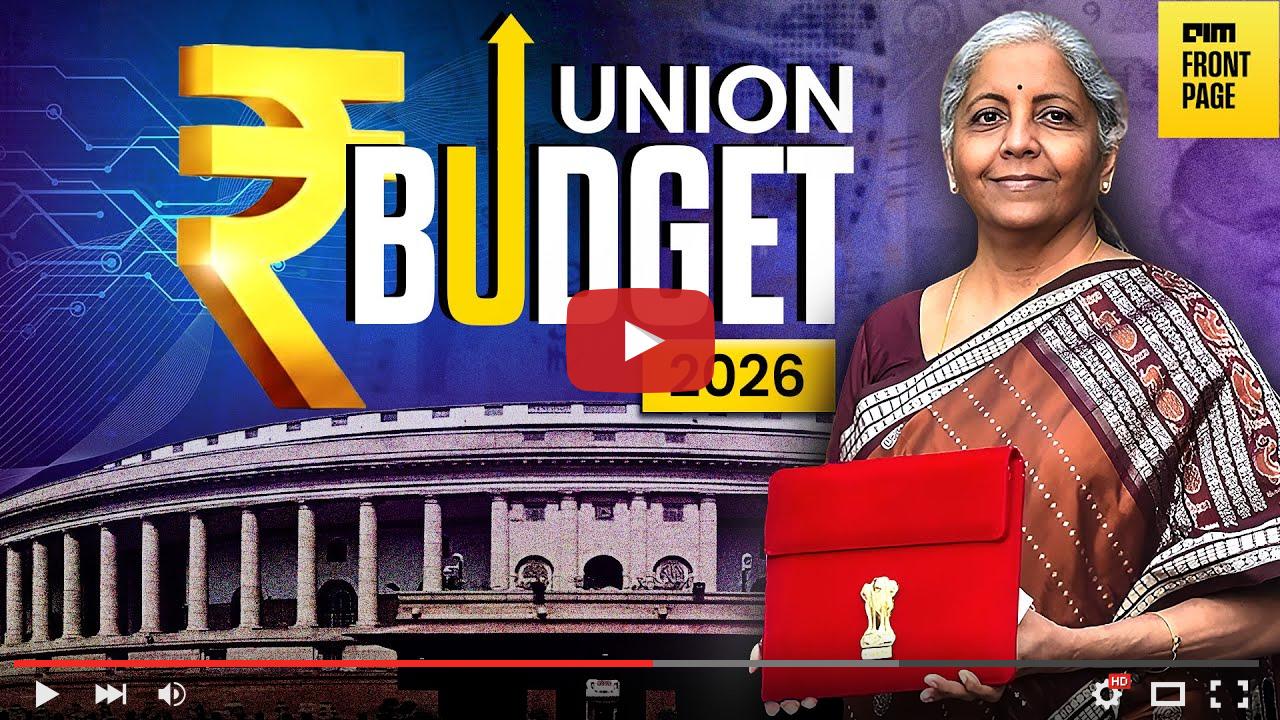
Healthcare Becomes Manufacturing Policy Healthcare arrived with a blueprint this year. Biopharma Shakti gets ₹10,000 crore over five years to build domestic capacity in biologics and biosimilars. Three new pharma research institutes will be created, while seven existing ones will be upgraded. Moreover, a thousand clinical trial sites will be accredited nationwide. The country plans to train 1.5 lakh caregivers in one year. Allied health institutions will add one lakh professionals across fields like radiology, anaesthesia, behavioural health, and operation theatre technology. Five regional medical value tourism hubs will bundle hospitals, research, AYUSH, diagnostics and rehabilitation into integrated clusters. As many as 17 cancer drugs get customs duty exemption, while seven rare diseases get import duty relief. Assistive technology also gets a boost through support to the Artificial Limbs Manufacturing Corporation of India with AI integration and retail-style assistive marts. Agritech AI goes local with Bharat VISTAAR The government will launch Bharat VISTAAR, a multilingual AI advisory system that integrates Agri Stack databases with crop science packages and delivers region-specific guidance directly to farmers. The aim is to improve yields, reduce risk, and make advice local. Farmers receive crop-specific suggestions, weather inputs and production decisions in their language. Alongside this, the Budget pushes livestock, dairy and poultry modernisation, and strengthens value chains led by farmer-producer organisations. Indian IT finally gets what it asked for: certainty. The compliance maze for software exporters has been simplified. All software development, IT-enabled services, KPO and contract R&D now fall under one category: Information Technology Services. One safe harbour margin of 15.5% applies across the board. The eligibility threshold jumps from ₹300 crore to ₹2,000 crore. Approvals move to automation. The same safe harbour can run uninterrupted for five years. Unilateral APAs are targeted to close within two years, with a six-month extension. For IT firms, this is a major win. Less litigation, less officer interaction, more predictability. In a sector that thrives on thin margins and global contracts, certainty is often more valuable than incentives. MSMEs, Design, and Skills Get Spread Bets Two hundred legacy industrial clusters will be upgraded. A ₹10,000 crore SME Growth Fund is set to back future champions. The Self Reliant India Fund gets another ₹2,000 crore. The animation and gaming industry gets formal backing through the Indian Institute of Creative Technologies labs in 15,000 schools and 500 colleges. A new design institute will come up in eastern India. Add that to five university townships near industrial corridors, one girls' hostel per district, a national hospitality institute, and a tourism skills push complete the talent pipeline. This is long-cycle capacity building. This Budget avoids theatrics. Instead of announcing the next trillion-dollar dream, it funds pipes, parks, corridors, clinics, clusters, data halls and classrooms. Nothing screams. Everything stacks. Budget 2026 didn't just attract global AI players, it expanded the AI and cloud market without picking winners—making India globally competitive while strengthening sovereign Indian cloud, AI/GPU compute and data-centre operators at the core of this ecosystem. | 





Комментариев нет:
Отправить комментарий
Примечание. Отправлять комментарии могут только участники этого блога.