Поиск по этому блогу

Search1

123

понедельник, 23 марта 2026 г.

Accenture & the AI Tailwind

Accenture's Q2 FY26 appears strong at first glance, but a closer look reveals a more restrained story.‌  ‌  ‌  ‌  ‌  ‌  ‌  ‌  ‌  ‌  ‌  ‌  ‌  ‌  ‌  ‌  ‌  ‌  ‌  ‌  ‌  ‌  ‌  ‌  ‌  ‌  ‌  ‌  ‌  ‌  ‌  ‌  ‌  ‌  ‌  ‌  ‌  ‌  ‌  ‌  ‌  ‌  ‌  ‌  ‌  ‌  ‌  ‌  ‌  ‌  ‌  ‌  ‌  ‌  ‌  ‌  ‌  ‌  ‌  ‌  ‌  ‌  ‌  ‌  ‌  ‌  ‌  ‌  ‌  ‌  ‌  ‌  ‌  ‌  ‌  ‌  ‌  ‌  ‌  ‌  ‌  ‌  ‌  ‌  ‌  ‌  ‌  ‌  ‌  ‌  ‌  ‌  ‌  ‌  ‌  ‌  ‌  ‌  ‌  ‌  ‌  ‌  ‌  ‌  ‌  ‌  ‌  ‌  ‌  ‌  ‌  ‌  ‌  ‌  ‌  ‌  ‌  ‌  ‌  ‌  ‌  ‌  ‌  ‌  ‌  ‌  ‌  ‌  ‌  ‌  ‌  ‌  ‌  ‌  ‌  ‌  ‌  ‌  ‌  ‌  ‌  ‌  ‌  ‌  ‌  ‌  ‌  ‌  ‌  ‌  ‌  ‌  ‌  ‌  ‌  ‌  ‌  ‌  ‌  ‌  ‌  ‌  ‌  ‌  ‌  ‌  ‌  ‌  ‌  ‌  ‌  ‌  ‌  ‌  ‌  ‌  ‌  ‌  ‌  ‌  ‌  ‌  ‌  ‌  ‌  ‌  ‌  ‌  ‌  ‌  ‌  ‌  ‌  ‌  ‌  ‌  ‌  ‌  ‌  ‌  ‌  ‌  ‌  ‌  ‌  ‌  ‌  ‌  ‌  ‌  ‌  ‌  ‌  ‌  ‌  ‌  ‌  ‌  ‌  ‌  ‌  ‌  ‌  ‌  ‌  ‌  ‌  ‌  ‌  ‌  ‌  ‌  ‌  ‌  ‌  ‌  ‌  ‌  ‌  ‌  ‌  ‌  ‌  ‌  ‌  ‌  ‌  ‌  ‌  ‌  ‌  ‌  ‌  ‌  ‌  ‌  ‌  ‌  ‌  ‌  ‌  ‌  ‌  ‌  ‌  ‌  ‌  ‌  ‌  ‌  ‌  ‌  ‌  ‌  ‌  ‌  ‌  ‌  ‌  ‌  ‌  ‌  ‌  ‌  ‌  ‌  ‌  ‌  ‌  ‌  ‌  ‌  ‌  ‌  ‌  ‌  ‌  ‌  ‌  ‌  
  -  
AIM-Logo
AIM-Logo

Accenture & the AI Tailwind

THE BELAMY

Weekly Newsletter of AIM

Monday, March 23, 2026 | By Mohit Pandey

Now, subscribe to our Digital & Print Editions >


Last quarter, CEO Julie Sweet said that Accenture would stop reporting standalone AI bookings, arguing that as AI becomes embedded across all services, it is "less meaningful" to track it separately. This came shortly after the company described AI returns for clients as "underwhelming" in the prior quarter.

This quarter, however, Sweet said she sees AI as the new tailwind for the company.

Accenture's Q2 FY26 appears strong at first glance, but a closer look reveals a more restrained story.

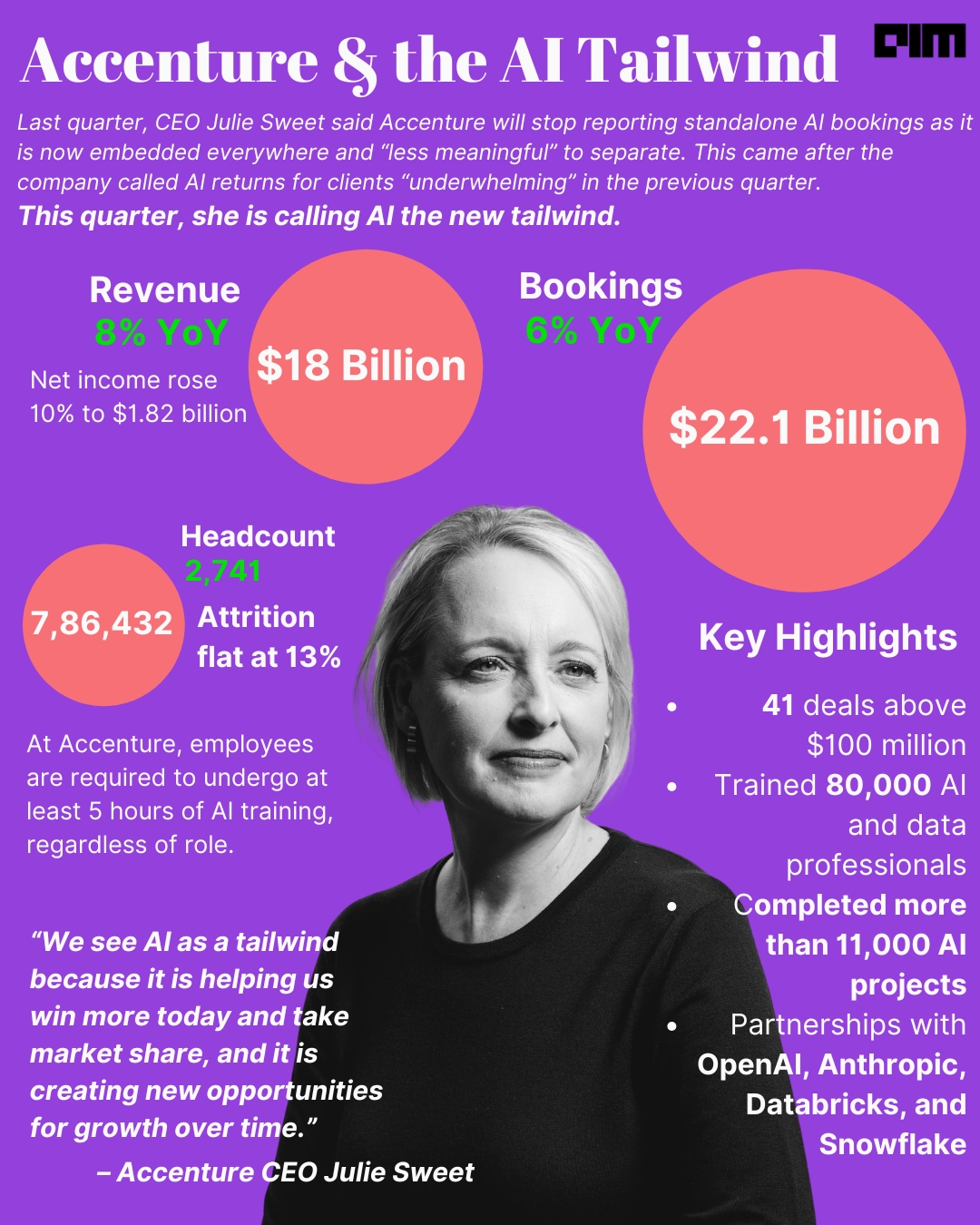
Bookings hit $22.1 billion, up 6% year-on-year. Revenue came in at $18 billion, up 8%. Net income rose 10.1% to $1.82 billion. The company also signed 41 deals above $100 million, up from 33 last quarter.

Accenture-and-the-AI-Tailwind

By no measure is this a weak quarter. But neither does it represent the turning point many had anticipated.

The broader pattern remains unchanged. Enterprises are spending, but selectively. Large transformation deals continue to anchor demand. AI is part of the conversation, but not the driver of a new spending cycle.

Sweet leaned more strongly into the AI narrative this time. "We're accelerating our critical work with clients to scale advanced AI across their enterprise, and we're seeing strong AI-driven growth," she said.

On the investor call, she sharpened that further. "We see AI as  tailwind because it is helping us win more today and take market share, and it is creating new opportunities for growth over time."

The messaging is clear. The signal, less so. AI is helping Accenture win deals and shape pipelines, but it is not yet translating into accelerated growth.

Nothing New

Nothing in this quarter departs from what Accenture said three months ago.

In Q1, the company reported $2.2 billion in AI bookings while still cautioning that the broader demand environment had not changed. That position holds.

Guidance remains at 3-5% growth in local currency—stable, not expanding.

The tension sits in plain sight. Accenture is talking about scaling AI across enterprises while simultaneously downplaying AI as a standalone metric. As Sweet said last quarter, measuring AI revenue separately is becoming less meaningful as it becomes embedded into every deal.

AI is everywhere in Accenture's messaging. It is nowhere near a clean, distinct driver of growth. The structure of deals explains why.

These 41 large deals are not AI-first contracts. They are still anchored in data modernisation, cloud migration, and managed services. AI is layered into these programmes rather than triggering a separate budget cycle.

At least half of Accenture's AI work is tied to data modernisation. That is not deployment. That is preparation.

AIM Network Deep Dive >>

In this episode of Front Page, we go behind the curtain of Accenture's Q2 FY26 earnings. We explain why this quarter is a massive warning sign for the rest of the industry, including the Indian IT giants.

video_preview_2ea250cfd23d163b1e3577bb64966094.jpg

But There's Change

Accenture has already built the machine. It now has 80,000 AI and data professionals and has completed more than 11,000 AI projects. It maintains deep partnerships with OpenAI, Anthropic, Databricks, and Snowflake, and is training tens of thousands of employees on new models.

Operating metrics are also improving. Margins expanded to 13.8%, up 30 basis points. Free cash flow jumped to $3.7 billion from $1.5 billion last quarter. The company returned $2.7 billion to shareholders.

None of this suggests hesitation. The real question is conversion.

How quickly will this scale translate into faster growth? So far, it has not. The more interesting signal comes from how Accenture itself is evolving internally.

On a recent Rapid Response podcast, Sweet pushed back on the idea that AI will hurt entry-level hiring. In fact, Accenture is hiring more early-career workers than last year. The reason is simple: younger employees are often more fluent with AI tools.

"I've had clients tell me that it's the college graduates who come and say: 'What do you mean you're not using this [AI tool]?'" she said.

There is a clear shift underway. AI is not replacing entry-level roles. It is reshaping expectations. At Accenture, AI usage is now part of how performance and promotions are evaluated. Employees are required to undergo at least five hours of AI training, regardless of role.

This mirrors what is happening with clients. AI is not a standalone capability anymore. It is becoming a baseline expectation across functions. That also helps explain the slower revenue impact.

When a technology becomes embedded, it stops appearing as a separate line item and starts behaving like infrastructure. Accenture has already flagged this trend.

In Q4 FY25, Sweet noted that AI returns were underwhelming for clients. That matters more than any booking number. Until AI projects are directly tied to financial outcomes, enterprises will not scale spending aggressively. 

Instead, they will experiment, integrate, and optimise within existing budgets. That is exactly what this quarter reflects. Strong bookings. Stable growth. Expanding pipelines. But no breakout.


Humanising Healthcare - AI and Innovation at Optum

In this episode of The Power Exchange by AIM, we explore the intricate world of healthcare innovation through a special conversation with Rohit Agarwal, Senior Vice President and Head of Transformation, Innovation, and Enablement at Optum Global. 

video_preview_9cb8befbffa374a51490b37c136a6116.jpg

Where Does This Leave Indian IT?

Accenture is positioning itself correctly for an AI-led future. It is investing in talent, partnerships, and training at scale, while embedding AI into every transformation deal.

Indian IT firms also seem to be following a similar path. After several quarters of hesitation, some firms have started reporting AI revenue separately, even while acknowledging that AI is part of every deal. It makes sense, though at times it feels more like signalling than substance.

With IT firms ready to announce their quarterly results from the third week of April, starting with TCS, the situation remains one to watch.

Moreover, much like Accenture, TCS has also announced partnerships with OpenAI for AI projects, similar to Infosys' work with Anthropic. Wipro and HCLTech are moving in the same direction. If Accenture describes AI as a tailwind, Indian IT is likely experiencing a similar dynamic—integrating AI across deals without calling it out explicitly. 

They may simply be more cautious in how they frame it for now.


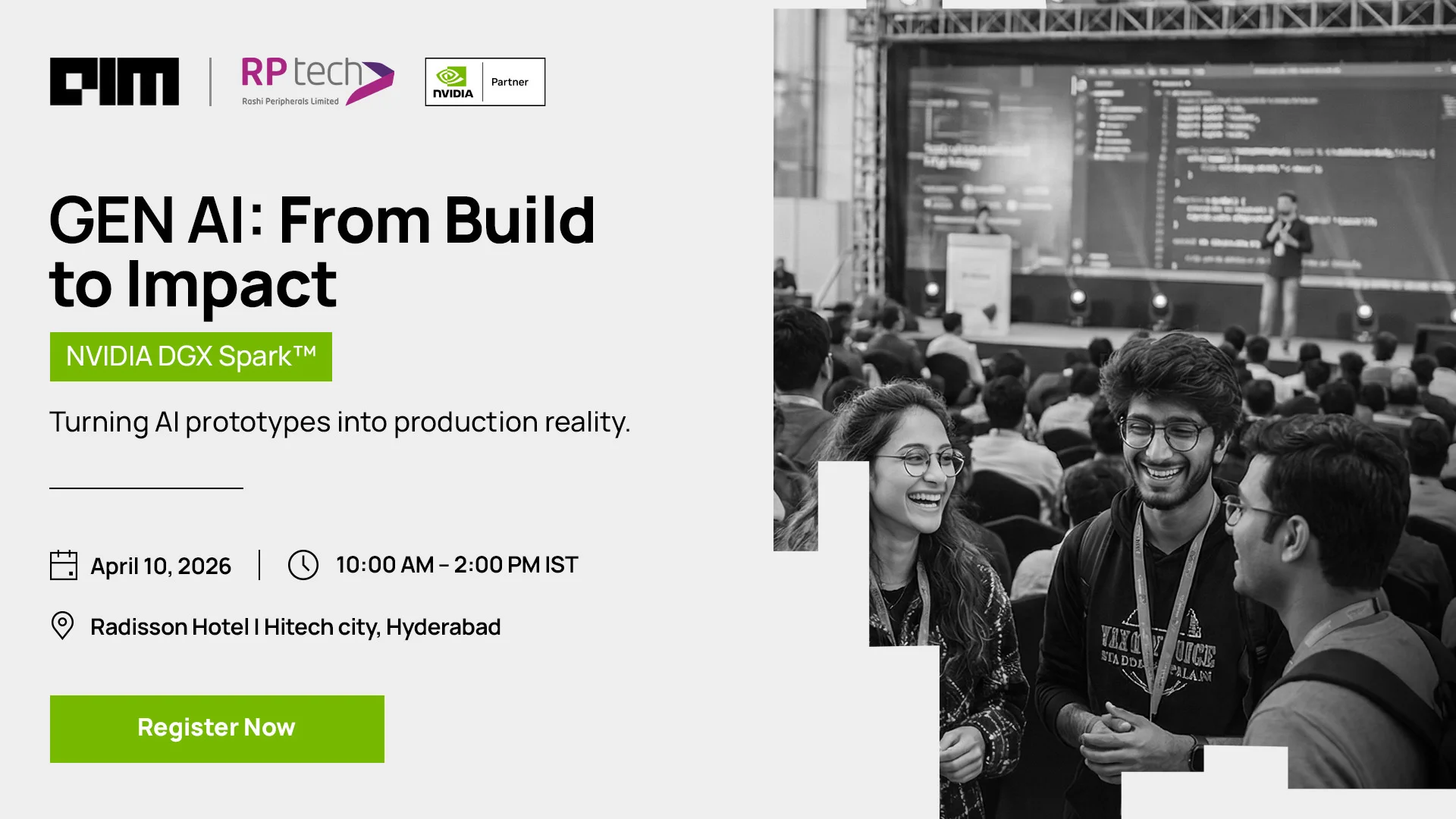
AIM, RPTech and NVIDIA partner to Host 'GenAI: From Build to Impact' meetup in Hyderabad, showcasing DGX Spark for AI developers.

1773464524238-naeoms

Rashi Peripherals Limited (RPTech), an NVIDIA partner, in association with AIM, is hosting GenAI: From Build to Impact, a developer meetup focused on building and scaling real-world generative AI applications, using its DGX Spark™ platform. 

The event will showcase how developers can use NVIDIA DGX Spark™, the company's desk-side personal AI supercomputer, to accelerate the generative AI development lifecycle from model experimentation and fine-tuning to high-performance inference. Click here to find out more about GenAI: From Build to Impact.

Now, subscribe to our Digital & Print Editions >

For Brand collaborations, reply to this email or write to info@aim.media

You received this email because you signed up to the updates from AIM. Click here to unsubscribe if you do not want to receive emails from us.

  -  

Комментариев нет:

Отправить комментарий

Примечание. Отправлять комментарии могут только участники этого блога.