
The latest news and links, phew! A couple new image gen models, fun web projects, a lot of game books recently, a load of narrative generation papers and articles, the usual tooling help. If you find this useful, it’s time consuming to write it: help support my work and business taxes with a subscription! TITAA #77: Lost in PseudoliteratureMidJourney v8 & Uni-1 - Art Search - Pretext - Narrative AI & Style - Tools - Procgen AI
I’ve been updating my tools to make this newsletter easier to produce — this week, Claude made me a bunch of custom skills for ffmpeg gif creation and optimization that was a huge help over running such scripts manually. Lemme know if I go overboard on the gifs. Two weeks ago, I spent many hours trying to create a shortcut action on my Mac for screencap image resizing and moving across folders etc, all of which would’ve been easier with just code and Claude. Sunk costs but lessons learned. Onto it before any new news comes out: TOC:
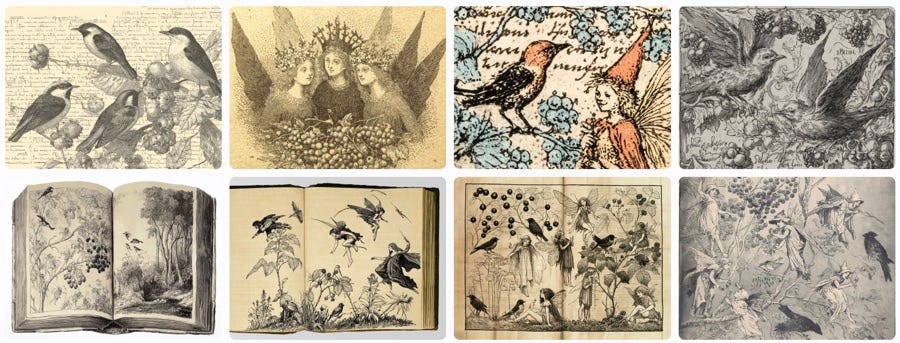
AI CreativityImage GenerationMidjourney v8 is in alpha/beta (on their alpha site), and while they say you can use your existing customized profiles and moodboards from v7, I am… not so sure? It does seem quite different, in my limited comparison tests. I think v8 tends towards more detailed images, which works well with the increased resolution on offer (2K). But in my tests, the beta model has a tendency to show frames, borders of pages being held, and in these of “A medieval manuscript page, with fairies, berries, and birds on it”, actual books and pages:
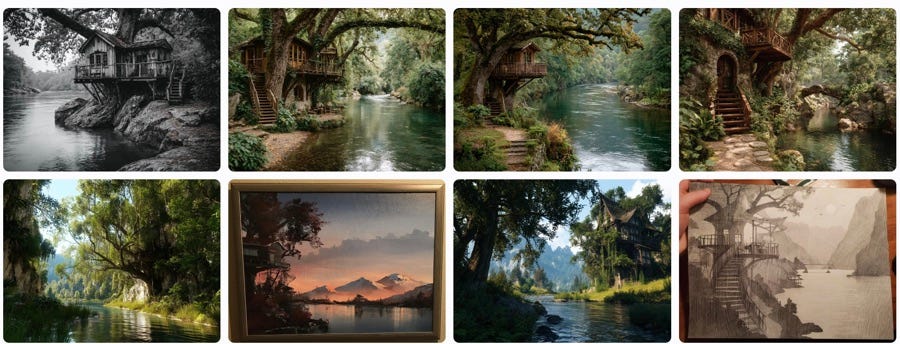
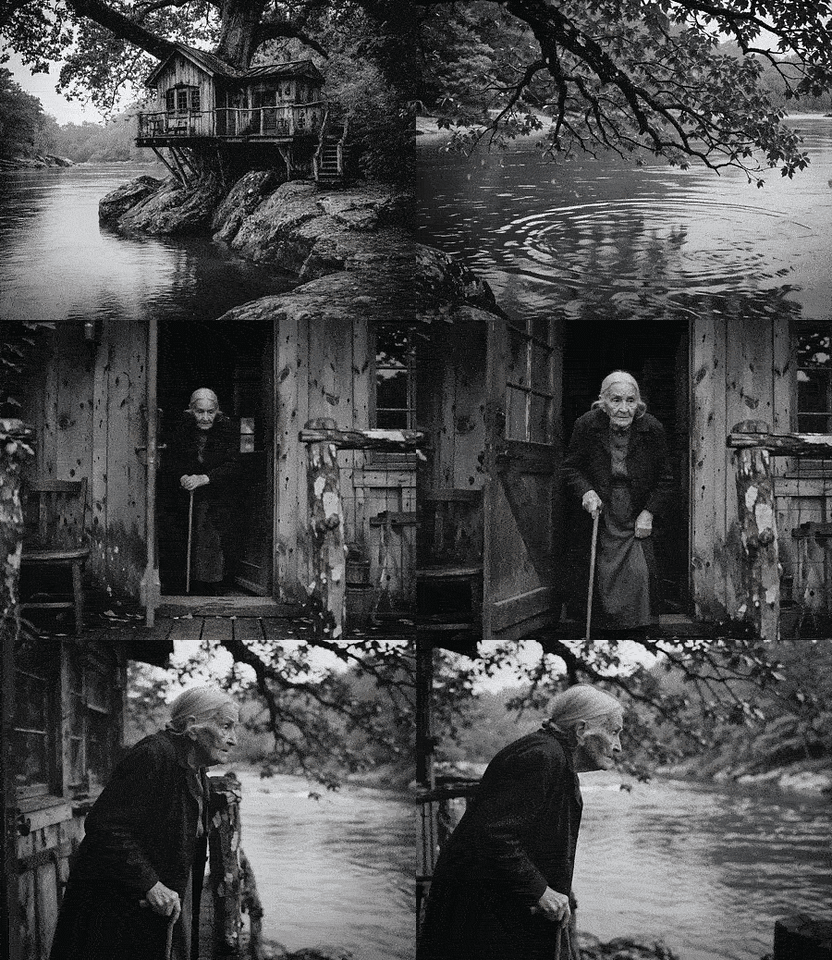
Here’s a simpler prompt without any personalization profiles added: “A tree house beside a river.”
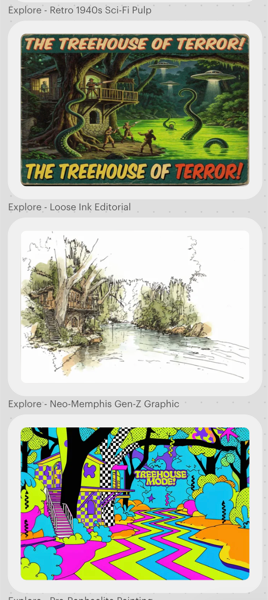
I definitely think the details and variety in v8 (with same settings for chaos and stylization) are better, apart from the frames issues. Meanwhile, Luma Labs dot AI released their Uni-1 image model, which comes with style exploration options on a big tldraw-type canvas. It’s actually pretty snappy, and they have a lot of options built-in with a chat agent managing your requests to help drive. I uploaded a Midjourney image of a generic AI-ish “tree house by a river” and got these from amid their 18+ built-in style reinterps:
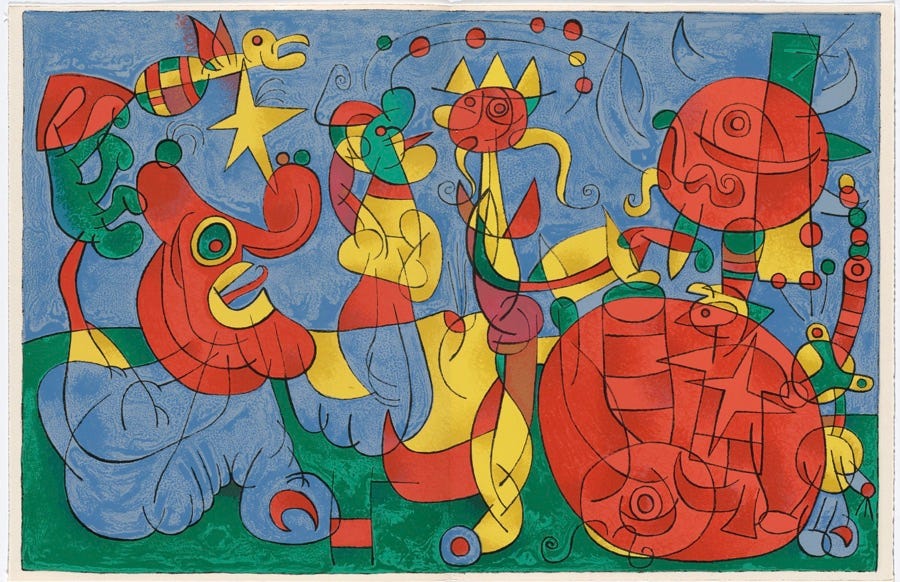
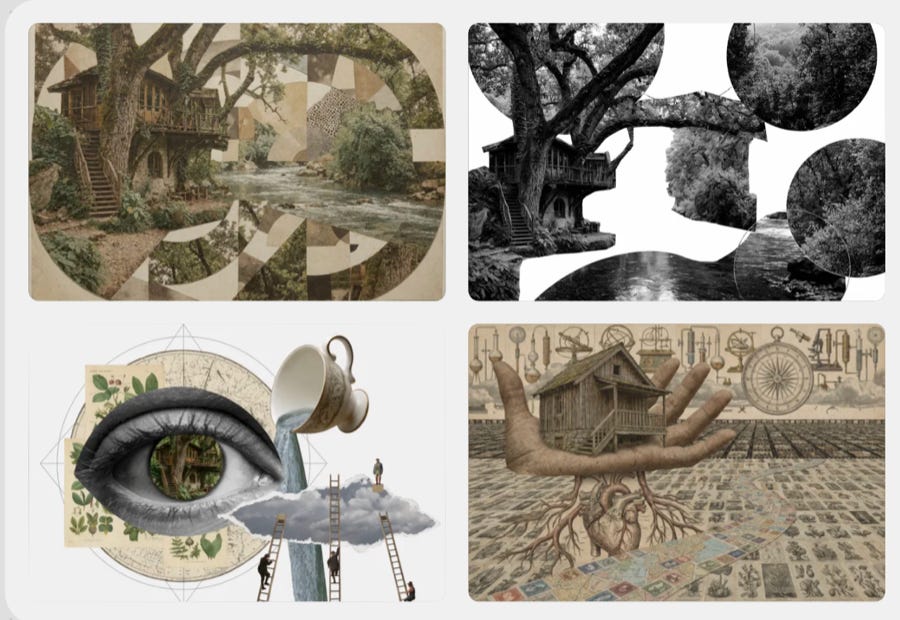
I was more impressed by the variation on the surreal collage art style that it gave me, which are all very different:
I heard a few people on X saying it was the best alternative to MJ style they have seen, but I’m a big fan of the moodboard and profile personalization options in MJ and am not sure pre-canned styles will get me there. Video GenerationPixverse v6 is available on some APIs such as Fal (text to video, image to video, transitions, etc). It has a “multiclip” setting which means you can ask for scene clips, even in a short video. It didn’t entirely follow my instructions here, but it did do something cinematic with this tree house clip. (Crappy gif, mine.)
Interactive video: In research news, this ShotStream has a demo of (not great but fast) video generation on demand, a kind of interactive video authoring that would be excellent to play with. Some of the authors work at Kling, which is promising. Also there is a model. Also see the FastVideo Dreamverse demo / project intro. Captain Safari — I’m pretty blown away by this drone video footage generator (you may remember I got a drone recently). I just want to play with this in VR forever? There is code. “A world engine with pose-aligned 3D memory that generates drone-over-landscape footage.” I guess we all know Sora is dead now as OpenAI focuses themselves more. Google just added a cheaper “lite” version of Veo 3.1, too. 3D Tools and SplatsMaking more consistent 3D world footage — mostly research here.
3D gaussian splats:
Three.js things:
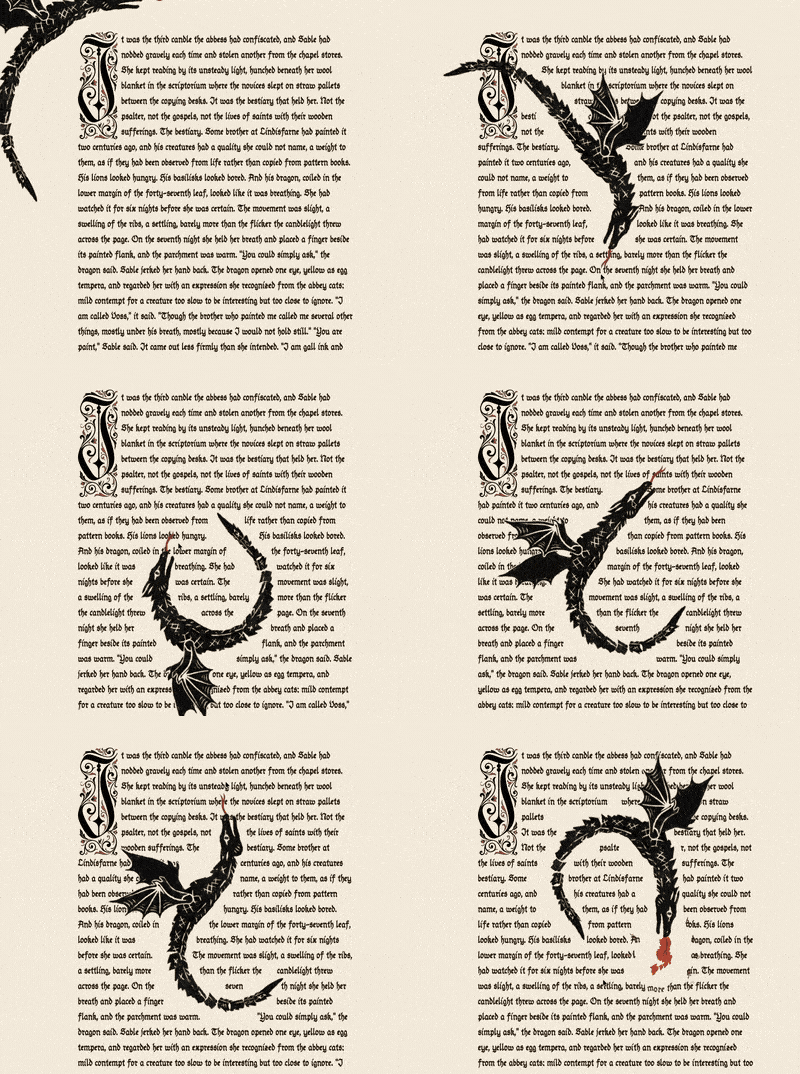
Misc tools: Map Anything (HF Space) — Depth-to-mesh image processing tool. Vibe Coding XR — Google’s XR Blocks + Gemini for rapid AI + AR/VR prototyping. Misc Web / Procgen / FunPretext — Layout and demos without CSS. Pretext isn’t even AI, although Claude helped convert a lot of CSS rules into typescript for this flexible and now accessible reactive text layout library for the web, overwhelming everyone’s X timeline with text toys (and see his demos link) — but my favorite demo was this illuminated manuscript dragon page where you drag the dragon and make it flame. I always need web text help, so I’m excited.
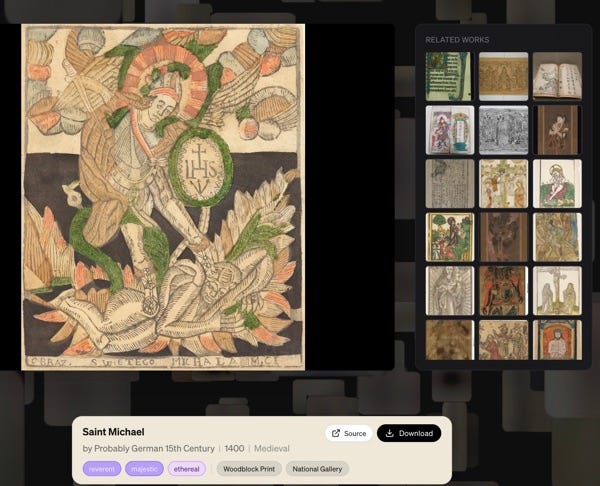
Art search:
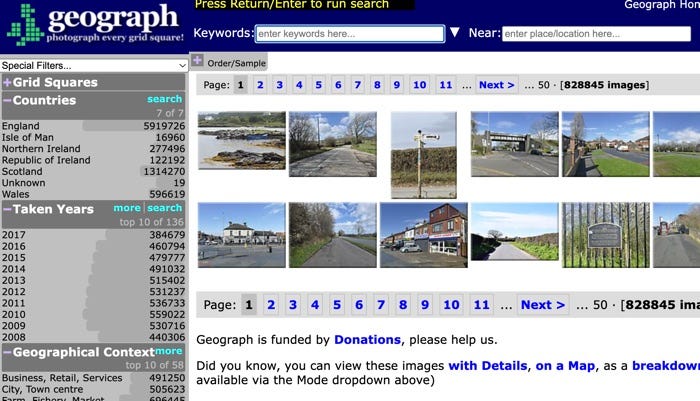
Geograph Britain and Ireland (via Tom Scott) — Photos geotagged across Britain and Ireland, trying to fill in all the bits square km by square km. The site is a bit awkward, kind of a 1990’s wiki-like thingy, with maps that aren’t cool enough for the data here… But you know I love a lot of landscape photos, and this sure has them. (Their wordcloud list of common words has “postbox” as easily the most common.)
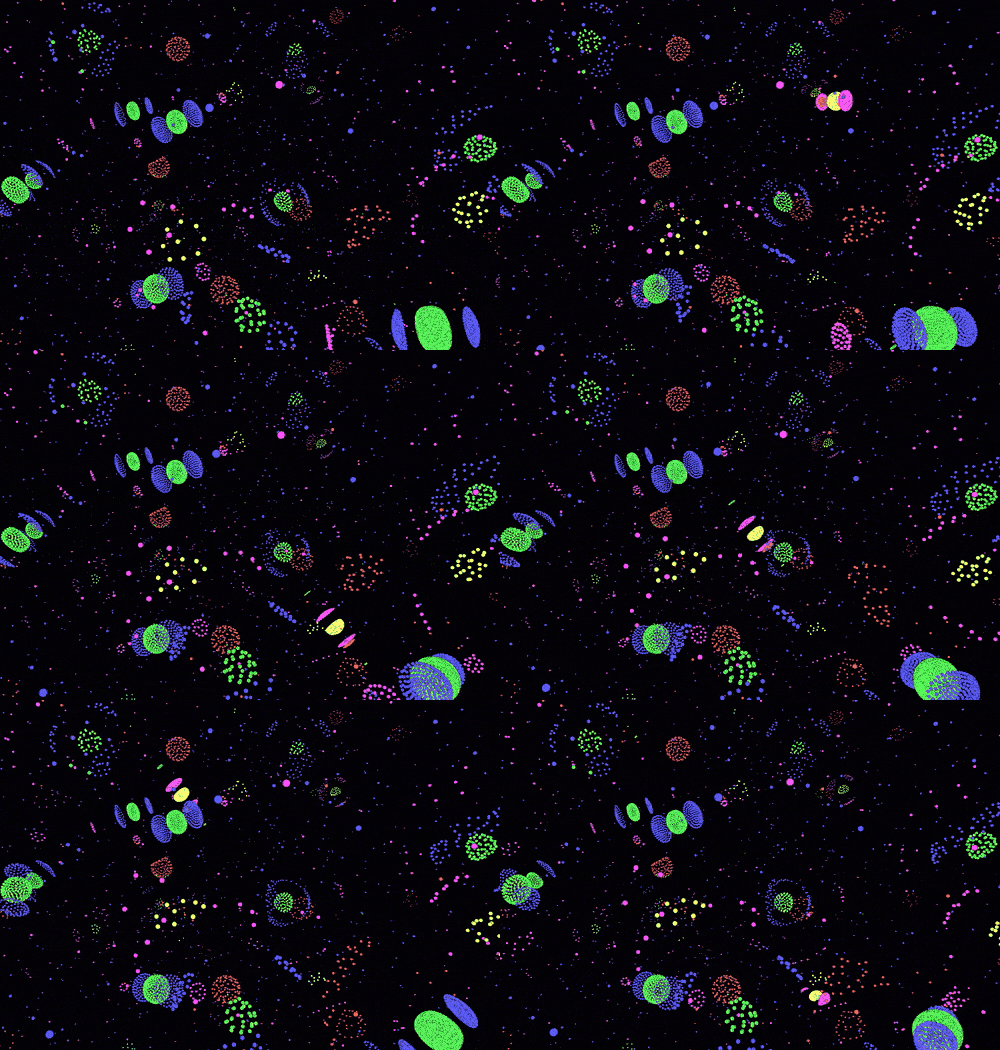
Particle Life in the browser in 3D — you have to toggle the 3d in the control panel on top left. It definitely takes some play to get interesting life simulations that last, but it’s pretty mesmerising. Gif:
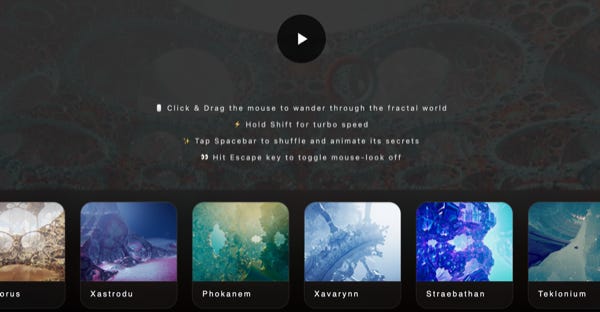
FractalWorlds — 3D fractal explorer in Three.js. This is really pretty amazing tbh. I would love in VR.
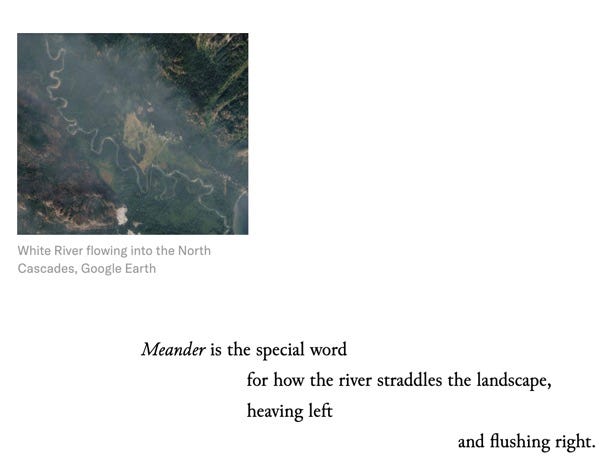
Meanders by Allison Chan and Shelby Wilson — From The latest HTML Review. “I am drawing a map from the sea to the sky.”
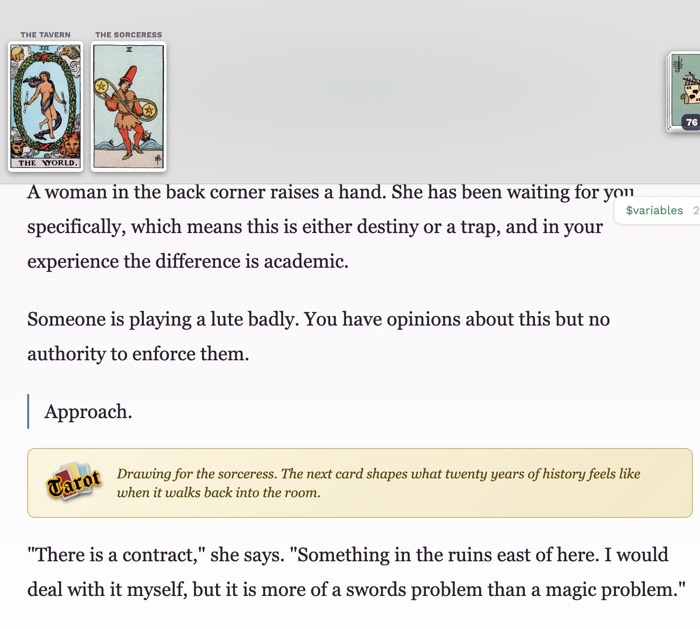
GamesArc-AGI is now game based. This is the “general intelligence” test for AI models, to try to assess where they stand compared to human general intelligence. An article by Ryan Rigney, a game guy. “So far, none of the models from the biggest AI Labs have managed to score even 1% on ARC-AGI-3’s collection of 135 puzzle games. Many humans, meanwhile, have scored 100%.” tarot.yarnspinner.dev — Yarn Spinner’s tarot story game for April 1 is fun and snappily written, as one hopes for in interactive fiction. (H/t Jacob Garbe.)
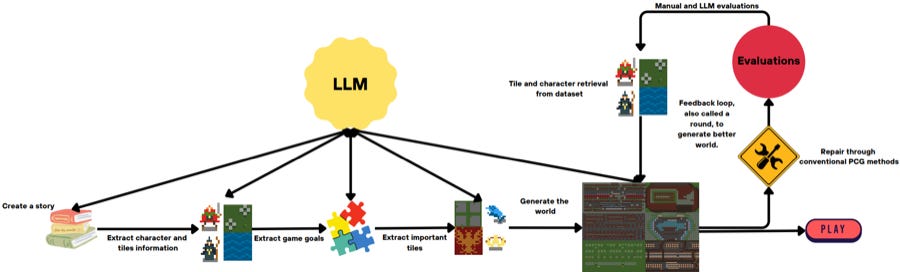
Procgen + AI working together — two articles (h/t Julian Togelius). Agentic PCG: Procedural Content Generation via Tool-using LLMs. Includes maze and level generation, with and without chat interaction to direct. “We build a tool-using LLM framework for procedural content generation, where an agent iteratively edits, evaluates, and optimizes game levels with environment feedback.” And this was a Togelius join 2 years ago, Word2World (paper, code) wherein an LLM generated games from a story text.
More game books:
Fresco (via Florence Smith Nicholls) — Egyptian action-adventure game coming, where you alternate between exploring a 3D temple as an archaeologist and navigating 2D frescoes etched in stone.
Running Doom Over the AT Protocol — A tech post. Doom runs on anything, it seems, including Bluesky’s protocol. “The answer is yes. Sorta. It plays terribly. No-one should want this. But it works. You can try it yourself.” Tools:
Narrative & Creativity & Text StyleFirst, general press: Hachette Pulls Horror Novel Over Suspected AI Use — The Shy Girl controversy. Also see: Lincoln Michel’s analysis of what the cancellation means for AI-authored fiction: “The published books that have used LLMs used them in thoughtful, artistic ways. Not to simply generate a book the author didn’t “have time” to write or even read before it was uploaded. What we’re talking about with this case is something closer to traditional copy and paste plagiarism than anything creative.” The Human Skill That Eludes AI — Jasmine Sun in The Atlantic on what AI still can’t do in creative writing, and musings on why. “What I learned is that modern LLMs are built in a way that is antagonistic to great writing; they are engineered to be rule-following teacher’s pets that always have the right answer in hand.” I don’t buy some of her arguments about life experience and humanity, but do buy that teaching a model to be a creative writer or stylist is a very different goal than creating a math model or a fact checker or a legal brief writer… I’m still a fan of the idea of a fine-tuned style specific model, and really need my 6 months off to work on this. Wolff Judgment (via Garbage Day) — A copyright/tropes court judgment relevant to narrative ownership questions. In this recent case, a judge ruled that tropes, or “scènes à faire” (new to me! most excellent!) are not copyrightable, and dismissed this contest between paranormal romance novels.
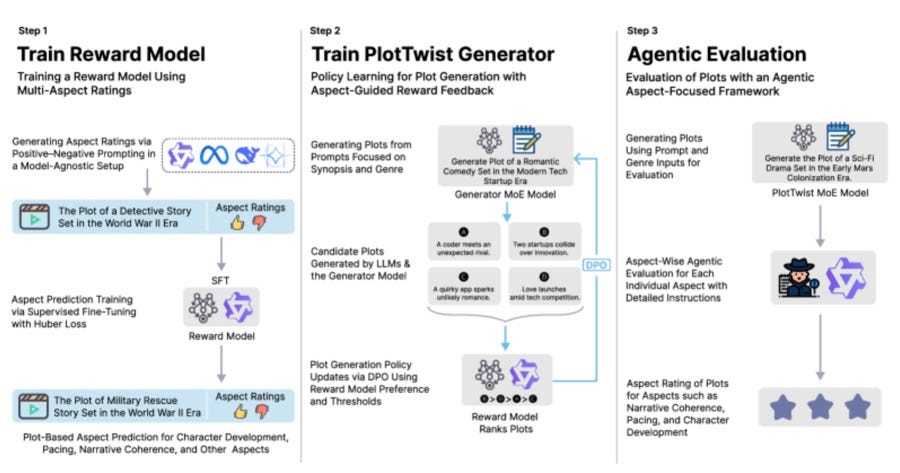
(Damn I wish I’d been there.) Tech:The Second Son of the House of Bells / autonovel — NousResearch released both a Claude-generated novel and their open-source novel generation pipeline. The novel is an experiment; the tool is the real story. I haven’t read the novel and heard it was badly done. “An autonomous pipeline for writing, revising, typesetting, illustrating, and narrating a complete novel. From a seed concept to a print-ready PDF, ePub, audiobook, and landing page — all generated by AI agents. Inspired by karpathy/autoresearch: the same modify-evaluate-keep/discard loop, applied to fiction.” Papers:
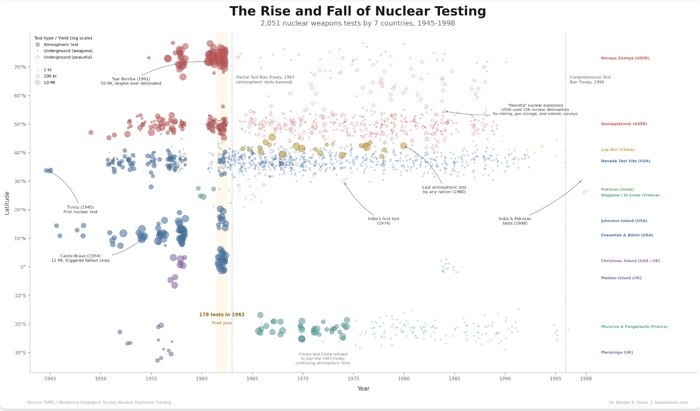
Data Science / Infovis / AI ProgrammingThe Rise and Fall of Nuclear Weapons Testing — Randal Olson’s latest data visualization was made with Claude’s help as part of the series on Teaching an AI to Make Beautiful Charts. Hmm: “The AI agent iterated on the design until it passed the Tufte Test” that he created.
posterskill — “A Claude Code skill that generates print-ready conference posters from your paper. Point it at your Overleaf source and project website — it extracts the content, downloads figures, fetches logos, and builds an interactive poster you can edit in your browser. Single HTML file, no build step.” The cool thing is the editability interaction, less so the “automate it for me” side. The Claude Code agent wrapper self-leak — some summary roundups: Alex Kim, Seb Raschka on X. Historical data projects I liked:
Deep research agents:
RAG:
OCR: Chandra — OCR model that handles complex tables, forms, and handwriting with full layout preservation. Speech/Text:
Hugging Face tools:
A Poem: “I Speak With the Future”We sit on our skeletons’ bones. We hear with our skeletons’ bones. We speak of beauty by moving our jaws and our teeth. The original meaning of Paradise: a place, a walled garden. Our lives, our stories, this hour inside one. A staircase from Piranesi. A hummingbird drinking. Outside it, vanishing species and rivers. Outside it, Nanjing, Ninevah, Dresden. Outside it, Gaza, Sudan, Myanmar, Kyiv. Here. The world starts and ends, starts, ends, ends again, restarts. A kalpa is brief, and wall-less. Unborn ones, take nothing for granted. Not nectar, not thirst. May your lives be uneclipsed, your failures be passing. May you have your portions of beauty, of grief, in a garden whose plants and birds I cannot imagine. I picked this poem because of things I read and watched recently, but it fits with the little life simulations, too. Stay game, everyone, but also touch grass. Best, Lynn (@arnicas on mostly bluesky, mastodon, ex twitter). You’re a free subscriber to Things I Think Are Awesome. If you’re a fan, and you want to support me in writing this, consider becoming a paying subscriber in order to get the complete mid-month updates including the new esoterica section and the end-of-the month media recs separate post—or buy me a coffee to express your appreciation.
|





Комментариев нет:
Отправить комментарий
Примечание. Отправлять комментарии могут только участники этого блога.