| |
It is only going to get intense from here. OpenAI recently announced opening its first office outside of the US, entering Google DeepMind’s home turf – London.
| | | |
The fight is on and OpenAI should be scared. Firstly, its employees are leaving to join Google DeepMind. Secondly, the founder of DeepMind, Demis Hassabis, is certain that the company’s next LLM project will eclipse ChatGPT.
This new project, known as Gemini, includes the development of advanced language models more powerful than GPT-4 and is expected to be multimodal. Moreover, it combines its abilities from AlphaGo, the company’s reinforcement learning-based system that has the capabilities of planning, reasoning, and problem-solving.
If Google DeepMind claims that Gemini is going to be multimodal, it might actually have the best understanding and generating model out there right now.
Interestingly, DeepMind and Google have something that no one else has – YouTube. For DeepMind, getting data from YouTube is the best thing it could have asked for – multimodal, multilingual, and multiregional. In other words, YouTube is a data gold mine for visual, audio, and textual data in almost every single language.
Read the full story here.
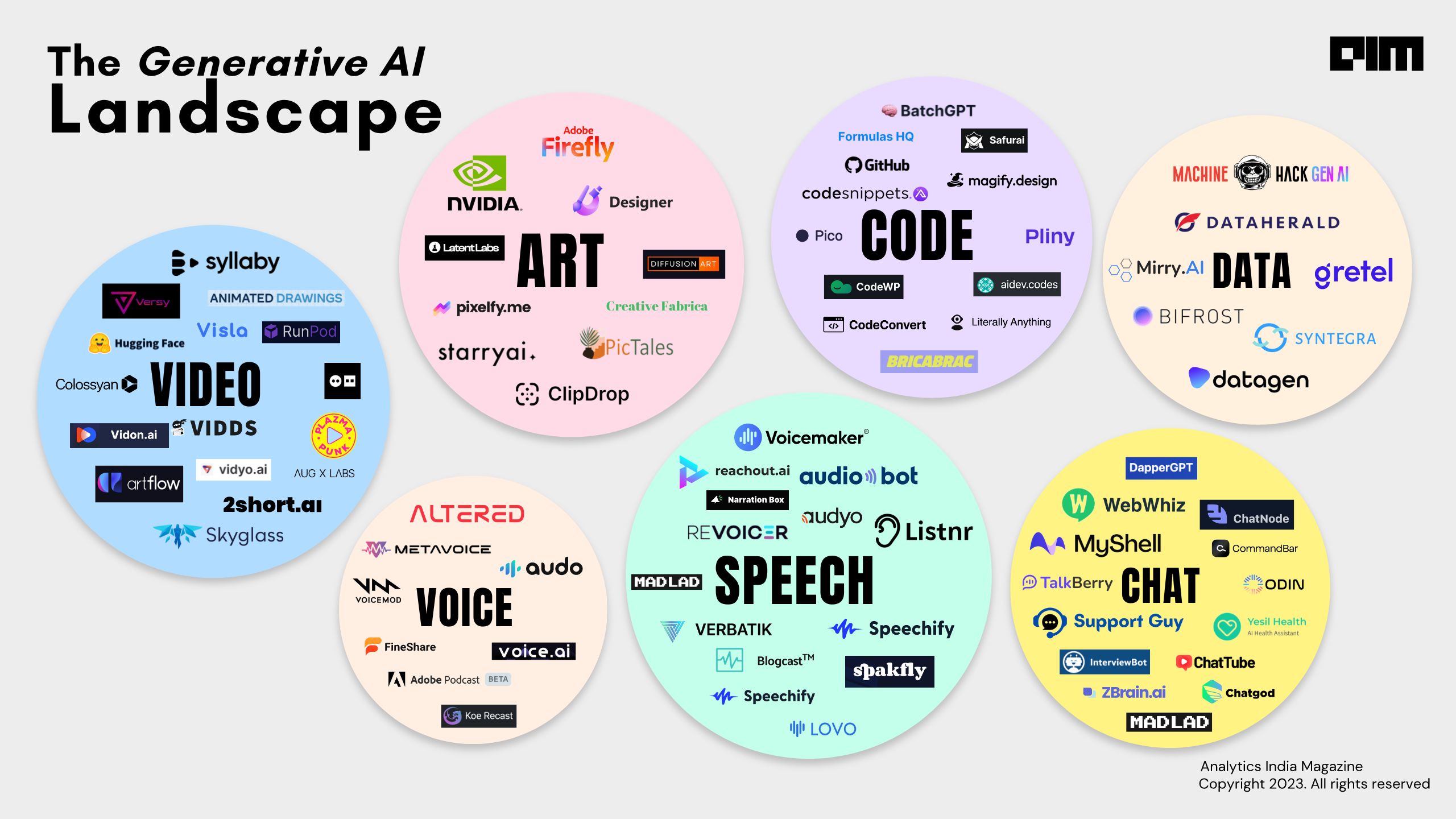
The Generative AI Landscape
Here’s a quick glimpse of all the popular generative AI tools for video, data analysis, art, code generation and more. | | | |
Canva Crumbles
What low-code and no-code did for programming, Canva did for design — eliminated the need for budding designers to spend hours mastering complex Adobe software. It also claimed a significant market share from Adobe, with over 100 million users flocking to Canva for their design needs.
In response, Adobe launched Adobe Express as a direct competitor to Canva, initially as an iOS app which later expanded to desktop as Adobe Spark. Now, with Firefly integration, powered by NVIDIA’s Picasso suite of models, Adobe surpasses Canva’s OpenAI-powered Magic Design. Once again, Canva finds itself playing catch-up to Adobe. Read more here.
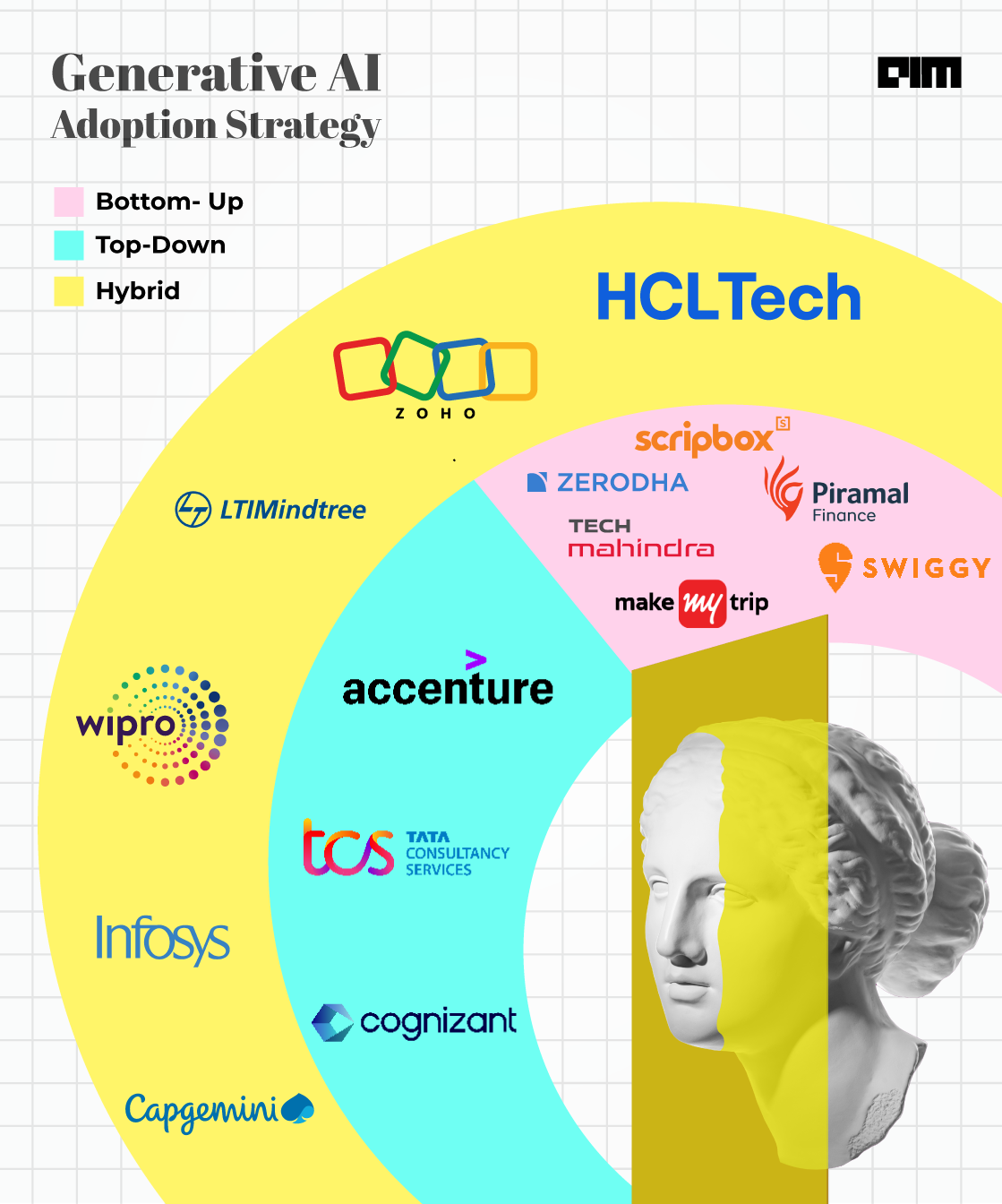
Generative AI Adoption Strategy
AIM has been closely watching the generative AI landscape, besides talking to industry experts from some of the leading companies in the country to understand their generative AI adoption strategy. The answers are quite surprising.
Unlike previous AI adoption, which was mostly top-down, generative AI adoption seems to be being pushed in all directions – i.e. top-down, as well as bottom-up. Read: How Companies Are Botching Generative AI
| | | |
Qlik Clings onto Generative AI
In an era where numerous traditional BI players fear losing market share to generative AI, Qlik has taken a proactive approach to gain an advantage. Just recently, Qlik made a significant announcement — the introduction of a suite of OpenAI connectors. These connectors are designed to enable customers to effortlessly and securely integrate generative AI content into Qlik, empowering a diverse range of cloud analytics and automation applications.
What’s even more interesting is that its R&D team comes up with something new every six weeks. Qlik’s Geoff Thomas told AIM that by the end of this year, the company is looking to launch more connector capabilities, which would probably be integrated into every SaaS solution and more.
Check out the complete story here.
| | | | TAUSIF ALAM & AMIT RAJA NAIK Thursday, Jun 29, 2023 | Was this email forwarded to you? Sign up here | | | | | | | | | | Stay Connected info@analyticsindiamag.com © 2023 Analytics India Magazine
| | | | | | | | |










Комментариев нет:
Отправить комментарий
Примечание. Отправлять комментарии могут только участники этого блога.