| | | | | | Monday, Jul 24, 2023 | Was this email forwarded to you? Sign up here | | | |
This week, the spotlight was on Llama 2 and the surprising Microsoft-Meta alliance. The AI ecosystem is abuzz with intriguing discussions, with some predicting that OpenAI might be affected as enterprises and developers lean towards smaller, cost-effective open-source models, while others think otherwise.
But the raging question is, will Llama 2 dethrone OpenAI? | | | | | | | | | |
For many teams building generative AI applications, OpenAI will remain the secret sauce for success. Here’s why?
Knowingly or not, OpenAI is supporting the open-source AI ecosystem, helping developers and teams train their models on ChatGPT "output data" (based on GPT-3.5 and GPT-4). Some popular ChatGPT datasets include LIMA, ShareGPT, Alpaca Dataset, MiniGPT-4, HC3, Dolly and others.
The list of open-source models that have benefited from OpenAI’s ChatGPT is long. Alpaca was built by fine-tuning Meta’s LLaMA using OpenAI’s text-davinci-003 data. Vicuna was trained on fine-tuned data from a LLaMA-based model using conversations gathered from ShareGPT as well. And not to forget, Google Bard was in the eye of a storm for training on conversational data from ChatGPT. “I’m not that annoyed at Google for training on ChatGPT output, but the spin is annoying,” Sam Altman had said.
Previously, Andrew Ng had also raised ethical concerns saying that the first mover advantage has no meaning in LLMs as developers and researchers, who want to build specialised or GPT-anything applications, can skip several tedious and costly steps in the process. There is no need to collect or label datasets.
The winners
While Microsoft and Meta's partnership left a dent on OpenAI, it surely paved the way for Microsoft to tap into the best of both worlds – responsibly.
In other words, Meta's Llama 2 will accelerate the open-source AI research and commercial applications, while OpenAI continues to work towards AGI and build larger foundational models. Either way, Microsoft’s all set to reap the benefits.
Last month, the tech giant released Orca, a 13-billion parameter model, aka a smaller open-source alternative to GPT-4 that learns to imitate the reasoning processes of large language models. This small model learns from rich signals from GPT-4, including explanation traces and step-by-step thought processes, along with other complex instructions, guided by teacher assistance from ChatGPT.
At the time, the team had only released a preview of the model citing LLaMA’s release policy restrictions. But now, everything’s going to change. Microsoft is surely going to unleash an army of tiny LLMs with Llama 2 for edge use cases.
The losers
The Meta-Microsoft alliance, on the surface, looks to democratise LLMs with Llama 2, but there’s a catch – it is not easily accessible for companies that have more than 700 million active users, such as Apple, Google and Amazon, alongside government organisations. Simply put, Llama 2 is NOT open source.
On the bright side, within a few days of Llama 2’s launch, open-source developers have been experimenting with it, building a whole new wave of use cases and applications. We hope to see a lot more interesting use cases in the coming months, besides awkward posts like –
“ChatGPT is the tip of the iceberg, Llama 2 is the whole iceberg.”
| | | | | | | |
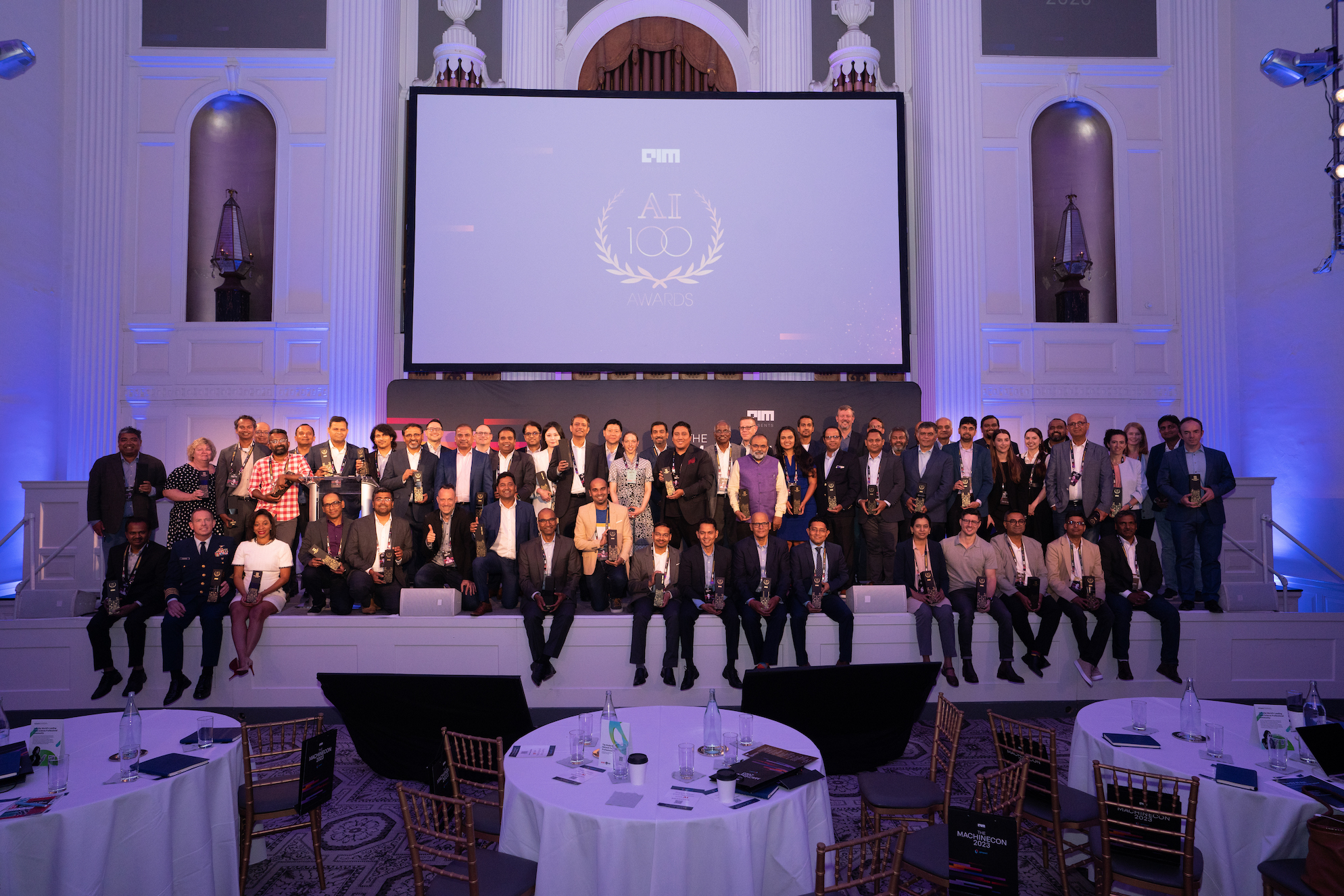
MachineCon USA was a grand success. The event witnessed insightful sessions, powerful keynotes, and deep-dive workshops, alongside celebrating some of the milestones achieved by brilliant minds in the field.
| | | |
We congratulate all the winners of the prestigious AI100 Awards for setting new benchmarks and inspiring aspiring minds. Keep innovating and keep making a difference… Until next time!
| | | |
Top Stories of the Week >>
| | | |
LLMs are an Ethical Nightmare
While users struggle with problematic outputs of language models, researchers have been striving to solve them one by one. A collectively authored research paper from Stability AI, Meta AI Research, and others has established a set of open problems so that ML researchers can comprehend the field’s current state quicker and become more productive. Read more here.
ChatGPT Plugins Store is a Hot Mess
Four months back, OpenAI made an exciting release by launching plugins and a lot of folks, including us, touted it as an iOS App Store event.
Today, there are 500+ plugins available on the store, but sadly, it is nowhere near the App Store. It lacks rankings and subcategories for different verticals. Currently, navigating the ChatGPT Plugin store reveals just three broad categories – New, Top, and Popular. It’s time, they started sorting the mess.
| | | | | | | | - The Telecom Regulatory Authority of India has recommended a structure for regulating AI through the lens of a risk-based framework in a 141-page document. The Ministry of Electronics and Information Technology (MeiTY) has been proposed as the designated administrative ministry for overseeing AI in India. As part of the framework, there are also plans to establish an independent statutory authority known as the Artificial Intelligence and Data Authority of India.
- Citing the importance of effective AI governance both domestically and globally, OpenAI, in coordination with the White House, has released an eight-point document outlining its commitments. Read more here.
- Infosys recently announced that it has about 80 active client projects in generative AI, citing Topaz, its generative AI offering, at the recent earnings call.
- OpenAI recently introduced a new feature called ‘custom instructions’, aimed at providing users with enhanced control over ChatGPT’s responses. Check out the details of the latest feature here.
- Indian edtech startup Scaler recently launched a GPT-4-powered AI teaching assistant for learners. More details here.
- McKinsey & Company recently announced its collaboration with Cohere to offer AI solutions to its enterprise customers. Read more here.
- Building on their existing partnership, Capgemini has co-created an Azure Intelligent App Factory, in collaboration with Microsoft, for organisations to scale responsible and sustainable generative AI capabilities.
- MongoDB announced a significant expansion of its strategic partnership agreement with Microsoft, aimed at simplifying customers’ cloud adoption journeys.
- In a bid to tackle AI plagiarism, over 8,000 authors have collectively expressed their concerns in an open letter initiated by the US Authors Guild, urging the leaders of six major AI companies (OpenAI, Alphabet, Stability AI, Meta, IBM, and Microsoft) to seek consent and offer compensation for using their copyrighted work to train models.
| | | | | | Download our mobile app Access our stories, video content and events on the go. | | | | Stay Connected info@analyticsindiamag.com
© 2023 Analytics India Magazine Pvt Ltd and/or its affiliates. All rights reserved. For more information, email info@analyticsindiamag.com
| | | | | | | | |
.jpg)











Комментариев нет:
Отправить комментарий
Примечание. Отправлять комментарии могут только участники этого блога.