Image generated using Microsoft Image Creator and Adobe Photoshop | | | | | It's been a while since we shared one of our "deeper reading" recommendations, so this week we're calling attention to four recent books that dig into some of the thorniest issues we're facing in the Next Economy—and offer guidance on how to create a world that works in the best interest of its citizens, not one that simply props up systems that are ineffective or downright harmful. | | | | | The Unaccountability Machine: Why Big Systems Make Terrible Decisions – and How the World Lost Its Mind 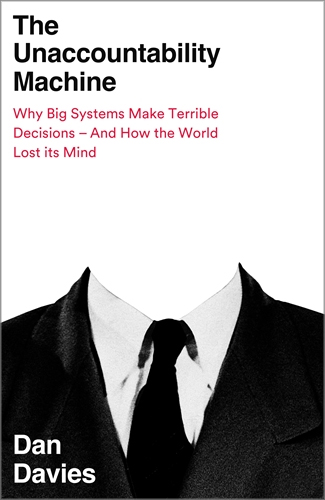 Dan Davies's excellent new book illustrates "why markets, institutions and even governments systematically generate outcomes that everyone involved claims not to want." Davies sketches a history of decision-making since the middle of the 20th century, demonstrating how accountability has shifted from individuals to "opaque and complicated rule books"—systems and processes that aren't really accountable to anyone at all. In parallel, he offers a fascinating deep dive into the history of Stafford Beer , management cybernetics, and the road not taken. (Beer's observation that "the purpose of a system is what it does" highlights why so many company mission statements seem like such a mockery.) The Financial Times' Felix Martin argues that The Unaccountability Machine "makes a compelling case that in the age of AI [cybernetics'] time has finally come." And in his glowing, lengthy review, Henry Farrell goes deeper into Beer's approach and explains how we might "use cybernetics as a common framework for understanding all sorts of problems that span information and politics," including those that Jennifer Pahlka details in Recoding America. Davies's concept of "accountability sinks" is a great example of what Edwin Schlossberg meant when he noted that "the skill of writing is to create a context in which other people can think." After reading The Unaccountability Machine, you'll never think about the dysfunction of large organizations the same way again. + You can read a short excerpt of The Unaccountability Machine here. + The Financial Times' Stephen Bush thinks through the potential benefits of accountability sinks in the age of AI. | | | | | Power and Progress: Our Thousand-Year Struggle Over Technology and Prosperity 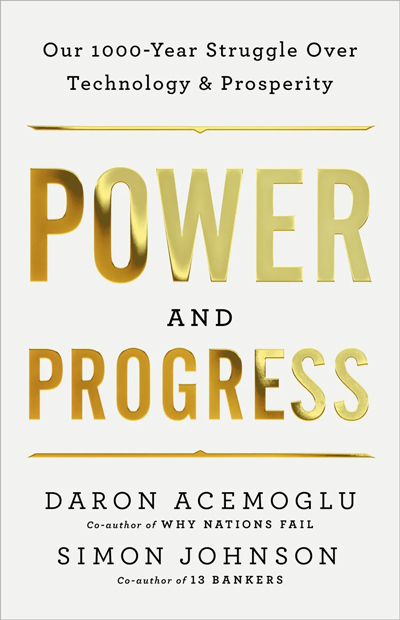 How do you balance the progress technological advancements have made possible with the suffering those very same technologies have caused? And what role does power—including both the power of capital and the "countervailing power" of labor organizing—play in determining that progress? Those are the questions economists Daron Acemoglu and Simon Johnson attempt to answer in Power and Progress. As they argue in their prologue (which you can read here), "Progress is never automatic." Bill Janeway sums up Acemoglu and Johnson's thesis in his review: "The economic outcomes we experience have never been wholly the consequence of markets efficiently allocating resources to their optimal uses. On the contrary, how the costs and benefits of technological progress are distributed is a matter of social choice—even if it does not always seem so." It's an astute point, and it's a cautiously optimistic one. Although, as Acemoglu and Johnson note, "today's 'progress' is again enriching a small group of entrepreneurs and investors, whereas most people are disempowered and benefit little," we have the chance to make better choices in the future and usher in "a new, more inclusive vision of technology." (And Acemoglu and Johnson make a few recommendations on just how we might go about it.) Power and Progress has been widely reviewed. Here's an interview with Acemoglu and Johnson at Vox, and another in MIT Sloan Management Review. Noah Smith came away unconvinced "that innovation needs to be steered away from automation," and his critique led to a spirited back-and-forth between Smith (along with Brad DeLong) and Henry Farrell that touched on economics, the market, and how to define and locate power. No matter where you come down on Acemoglu and Johnson's book, it's launched a very interesting discussion. + Here's a recent talk Acemoglu gave on the topic at the University of Chicago's Becker Friedman Institute. + More from Acemoglu in Project Syndicate: "Are We Ready for AI Creative Destruction?" | | | | | Underground Empire: How America Weaponized the World Economy 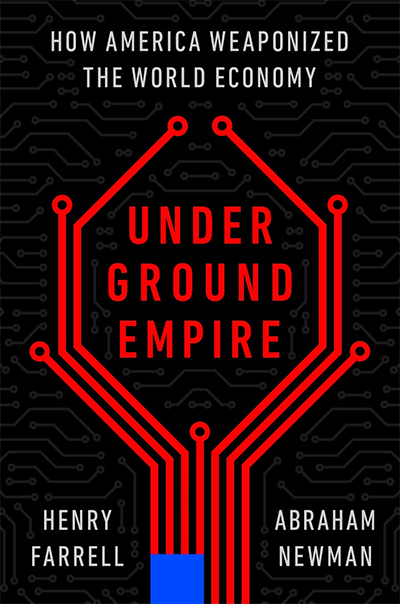 After sharing so many of Henry Farrell's insights above, we'd be remiss not to include his and Abraham Newman's 2023 book, Underground Empire, on this list. In it, Farrell, a professor at Johns Hopkins's School of Advanced International Studies, and Newman, a professor at Georgetown's School of Foreign Service, expose how the US security apparatus uses the global networks at the heart of the world's economy to strengthen and tend to the nation's influence—"turn[ing] the most vital pathways of the world economy into tools of domination over foreign businesses and countries." Paul Krugman called Underground Empire "revelatory," and Cory Doctorow spotlighted the book's useful depiction of "how the rise and rise of world-is-flat rah-rah globalism created a series of irresistible opportunities for 'weaponized interdependence.'" Reviews from the Financial Times, Jacobin, and Foreign Policy each praised the history Farrell and Newman uncover while nodding to the potential limits of their argument. It's an illuminating look at how globalization has made it even easier for nation-states to exercise power to the detriment of adversaries, allies, and their own citizens. + You can watch Farrell and Newman discuss Underground Empire at the Center for Strategic and International Studies and at the London School of Economics and Politics. + Here's Farrell and Newman in the New York Times: "What If These Economic Weapons Fall into Trump's Hands?" + And in Foreign Affairs: "The New Economic Security State." + And here's their 2019 article in International Security staging some of the arguments made in Underground Empire. | | | | | | —Tim O’Reilly and Peyton Joyce | | | |





Комментариев нет:
Отправить комментарий
Примечание. Отправлять комментарии могут только участники этого блога.