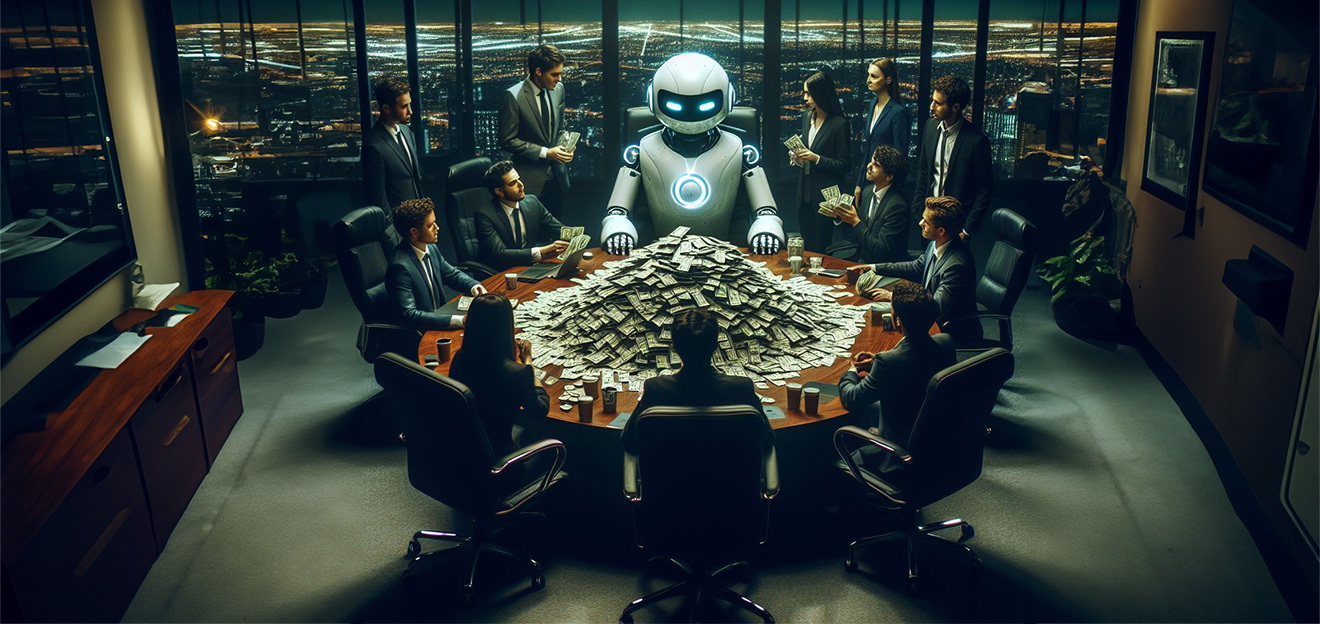
Image generated using Microsoft Image Creator and Adobe Photoshop | | | | | AI has an Uber problem In today’s Silicon Valley, a few very deep-pocketed investors act as a kind of central committee, choosing those who will get the most money and have a head start in a race for monopoly. The market no longer picks the winners. In a recent op-ed for The Information, which has since been republished on O'Reilly Radar , I explain why this dark pattern leads to premature consolidation, less innovation, and more unequal returns to entrepreneurs, investors, and society. We already saw this happen in the ride hailing market. Now it seems to be repeating itself with AI, as companies race to build the largest model (while playing fast and loose with copyrighted data), create unified "AI tool" platforms, and enter into strategic partnerships with Big Tech giants. . .or just get subsumed by them. As I note in my op-ed: At least based on recent reporting by The Information about Anthropic's operating margins, it may be that, like Uber and Lyft, the overfunded AI market leaders may only be able to deliver on investors' heated expectations by crushing all competition. That's not betting on the wisdom of the market and what Hayek called "the utilization of knowledge which is not given to anyone in its totality." That's betting on premature consolidation and the wisdom of a few large investors to choose a future everyone else will be forced to live in. + In Project Syndicate, Silicon Valley historian Margaret O’Mara contends, "AI promises to make Big Tech stronger than ever." + Hunter Walk, a partner at seed stage fund Homebrew, argues that "every time OpenAI cuts a check for training data, an unlaunched competitive startup dies." | | | | | Elon was right (about OpenAI) These days it's rare to agree with anything Elon Musk says, but his recent lawsuit against OpenAI gets one thing right: rather than building AI "for the benefit of humanity" (as OpenAI claims in its mission statement), the company "has been transformed into a closed-source de facto subsidiary of the largest technology company in the world: Microsoft." And while the intentions behind Musk's lawsuit may not be entirely virtuous, it exposes the inconsistency between the values AI companies profess and the demands made on them by their deep-pocketed investors. Bloomberg's Parmy Olson summed up the quarrel quite nicely : "Call it an epic troll by Elon Musk if you want, but the billionaire's lawsuit against OpenAI puts a refreshing spotlight on the endless humanitarian posturing by AI businesses." The nonprofit media organization More Perfect Union was even more direct: "I want to say something that you would never expect to hear from More Perfect Union. Elon Musk is right about something." Its informative 15-minute video breaks down the battle among the small group of billionaires for control of the AI market—and I joined in to offer my thoughts on competition, regulation, and the dramatic interpretation of the dangers of AI these billionaires are pushing: It feels a little bit like a kind of misdirection. They’re basically calling for a kind of regulation of an extreme risk to avoid the regulation of the many proximate harms we can see today. If they were really afraid of it, they would stop doing their research. Instead, they’re racing to accelerate it so they get a monopoly. It’s a lot like the famous line from The Wizard of Oz: "Pay no attention to the man behind the curtain." And a lot of where I spent my time in talking about regulation is this. There is a man behind the curtain or a series of men who are making decisions for their business advantage. And those are the things that we need to be regulating. Why are they moving fast to break things? If you haven't been following the debates around AI too closely, the video contextualizes some fundamental issues while making the case that since AI "is built on the labor of all of humanity, then it should be all of humanity that benefits." It's also a great complement to the arguments I make in my article above. Check it out here. + All the way back in 2017, science-fiction author Ted Chiang wrote: "The idea of superintelligence is such a poorly defined notion that one could envision it taking almost any form with equal justification: a benevolent genie that solves all the world's problems, or a mathematician that spends all its time proving theorems so abstract that humans can't even understand them. But when Silicon Valley tries to imagine superintelligence, what it comes up with is no-holds-barred capitalism." And in a piece published last May in the New Yorker, he proposed that we "think about A.I. as a management-consulting firm, along the lines of McKinsey & Company"—that is, as a way for companies to maximize profits while "evading responsibility" for their actions. A truly beneficial AI, Chiang argued, should help "reduce the concentration of wealth," not enable it. And it's up to those building these technologies to consider how they may be abetting injustice instead of addressing it. + Stratechery's Ben Thompson chatted with analyst Benedict Evans about regulation and AI last week. | | | | | The greatest "public good" the market economy ever produced As I pointed out in my own interview with More Perfect Union, "All of the smaller AI firms are already starting to fall" to the few heavily funded companies. Open source AI companies may offer an alternative, but there's one glaring problem: "The tech industry can't agree on what open-source AI means," says MIT Technology Review . We need to hash out a workable definition. But even more, we must ensure that at least some parts of the AI industry remain open in perpetuity. As economist Tyler Cowen maintains in a recent column, "Open-source software may well be the greatest ‘public good’ the market economy has ever produced." Its monetary value—about $8.8 trillion worldwide—eclipses that of global software sales and the GDPs of India and Germany. But as Cowen emphasizes, that figure doesn't even account for the true economic benefits open source proffers (which could potentially mitigate at least some of the harms we talk about above): By putting open-source in the market, it ensures that commercial producers have to "compete against free." That leads them to lower their prices, which in turn allows more people to buy the closed-source products. Open-source also forestalls the possibility of complete monopoly in the market, since there will now be an open-source alternative. And, from a production standpoint, open-source software also lowers costs, since commercial producers can learn from and even copy its programming ideas. + More from Bloomberg: "Meta Says Limits on Sharing AI Technology May Dim US Influence." | | | | | | —Tim O’Reilly and Peyton Joyce | | | |




Комментариев нет:
Отправить комментарий
Примечание. Отправлять комментарии могут только участники этого блога.