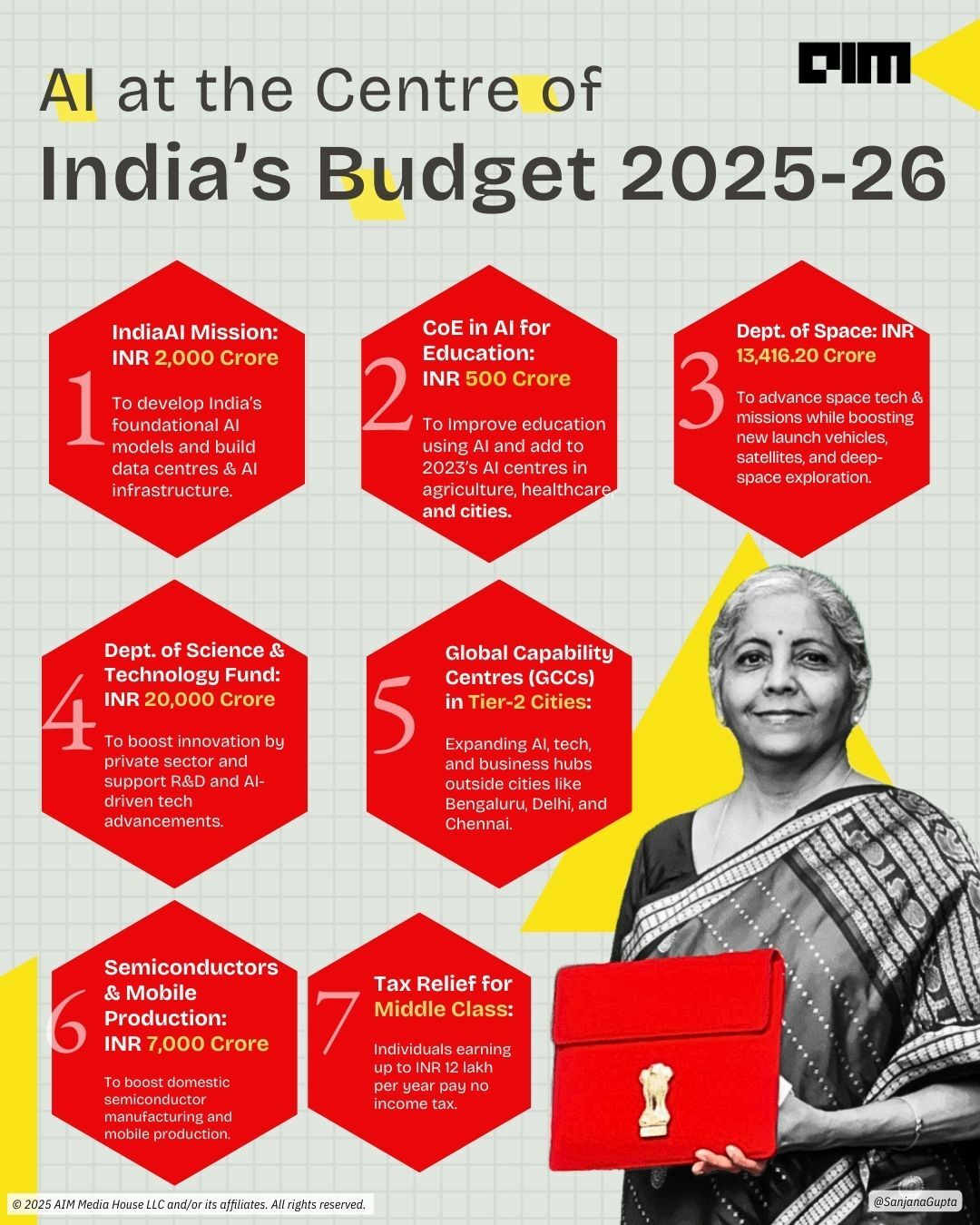
Commenting on the initiative, Microsoft India and South Asia president Puneet Chandok told AIM, "India must capitalise on AI opportunities and leverage its young and dynamic population to create a tech-forward workforce for India and the world." Ankush Sabharwal, founder of CoRoverAI, mentioned during the Budget discussion with AIM that he needs to see how the Centre of Excellence would practically add value, but he believes it is usually about providing focus, which in turn develops talent. "I think India, being the talent hub of the world, should leverage this," he said. Besides talent building, the government allocated ₹20,000 crore to the science and technology department as a corpus for a fund to promote private sector-driven innovation, thereby supporting research, development, and innovation. "A deep tech fund of funds will also be explored to catalyse the next-generation startups as a part of this initiative," Sitharaman said. The Union Budget 2025-26 allocated ₹100 crore for the newly introduced National Geospatial Mission. Moreover, the government announced an 83% increase in the semiconductor budget, raising it to ₹7,000 crore. Will AI Take Jobs? The Budget echoed the Economic Survey 2025-26, which called for investments in education and workforce development guided by supportive institutions. However, it did not address the impact of AI on jobs. India's chief economic advisor, V Anantha Nageswaran, warned that while AI can create jobs in the long run, its immediate impact on employment displacement remains a key concern. AI will displace millions in manufacturing, retail, finance, IT services, and content creation – sectors heavily reliant on automation-prone roles. However, the Budget failed to introduce worker transition support or an AI labour rights framework, leaving vulnerable job sectors exposed to disruption. No corporate AI taxation policy was introduced to ensure that companies benefiting from AI-driven efficiency contribute to workforce transition programs. Additionally, there was no push for AI integration in MSMEs, which could have helped smaller businesses adopt AI rather than being disrupted by it. ISRO Gets a Major Budget Boost The Union Budget 2025-26 allocated ₹13,416.20 crore to the space department for the current fiscal year to advance India's space capabilities, including the development of new launch vehicles, satellite technologies, and deep-space exploration missions. More GCCs Coming to Tier-2 Cities The Union Budget 2025 signalled the government's shift towards tier-2 cities for the expansion of global capability centres (GCCs), moving beyond traditional hubs like Bengaluru, Hyderabad, Delhi, Chennai, Mumbai, and Pune. Sitharaman outlined plans to boost talent, develop infrastructure, and introduce industry-friendly policies in these tier-2 cities. "The benefactors of the GCC industry so far have been large cities like Bengaluru, Hyderabad, NCR, and Chennai. However, tier-2 and tier-3 cities have caught on very well in recent years. There is still a lot of work to be done, but we are encouraged by the positive signs and the acceptance from both the talent side and the industry/business side," said Vikram Ahuja, co-founder of ANSR and CEO of Talent500, during a Budget discussion with AIM. Tax Relief for the Middle Class Apart from AI, the announcement that caught the attention of India's middle and young working class was the new tax regime. Under this regime, individuals earning up to ₹12 lakh per year pay no income tax. For salaried individuals, this limit is ₹12.75 lakh after factoring in the ₹75,000 standard deduction.Check out the detailed Budget analysis with AIM's panel of experts: GV Joshi, economist and former Karnataka State Planning Board member, Pranav Kothari, CEO at Educational Initiatives, Sabharwal, Puneet Gupta, VP and MD of NetApp, Ahuja and Sid Tipnis, consulting partner and leader at Deloitte. |




Комментариев нет:
Отправить комментарий
Примечание. Отправлять комментарии могут только участники этого блога.