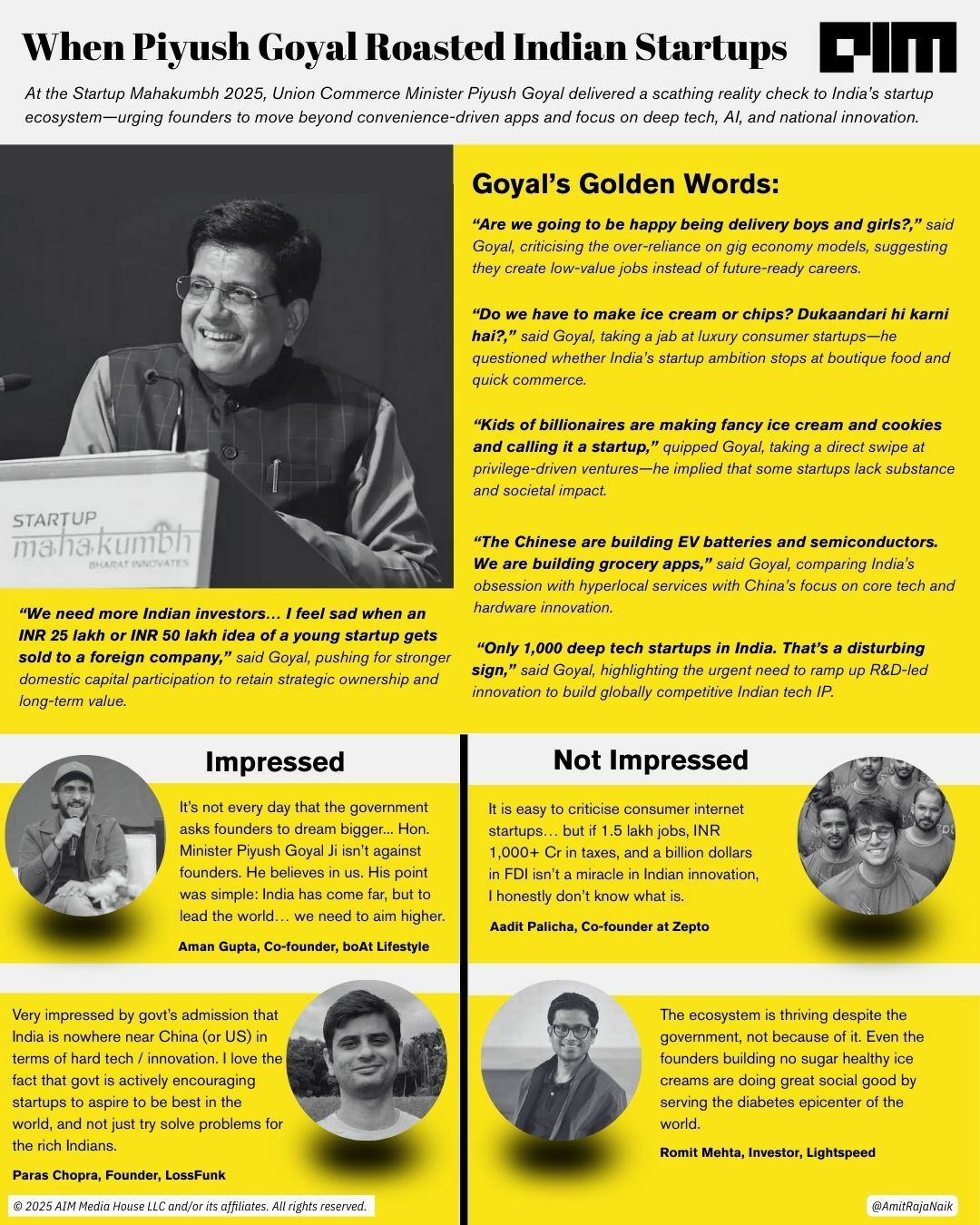
Ever wondered if AI can truly understand human emotions—or just acts like it does? Join the next AIM DECODE session on April 15 to explore the fine line between empathy and algorithms. Register here. AIM x Axtria: As AI transforms healthcare, Axtria is helping life sciences companies tackle rare diseases and accelerate personalised treatments with data-driven platforms and GenAI-powered insights. Read more here. Goyal is both right and wrong… Goyal is right to call for an overhaul of India's startup priorities. However, his critique, while urgent, overlooks the structural realities throttling deeptech. India has fewer than 1,000 deep tech startups—a number he calls "disturbing". But as head of Aarin Capital and former CFO of Infosys, Mohandas Pai, pointed out, this isn't due to lack of ambition. Between 2014 and 2024, India attracted $160 billion in startup funding, while China secured $845 billion and the US $2.3 trillion. Pai also flagged systemic hurdles like restrictive RBI remittance rules, underperforming domestic capital pools, and regulatory overreach on alternative investment funds (AIFs). A Tracxn report, shared exclusively with AIM, further reinforces the depth of the problem—AI funding in India plunged 53% year-on-year, from $305.9 million to $143.6 million in FY25, even as global AI funding surged 62% to $110 billion. Critics like Lightspeed's Romit Mehta argue that blaming founders deflects from policy failures, while founders like TWO AI's Pranav Mistry and Lossfunk's Paras Chopra are quietly building foundational models, multi-agent stacks, and full-stack infra—even as localised models from Ola Krutrim and Sarvam AI inch toward scalability. Yet, as BlackSoil's VP of investment Surabhi Sanyukta noted, most Indian AI startups today are application-layer wrappers on global LLMs, limiting their strategic value. Despite this, there is movement: Accel, WTFund, and Meraki Labs are funding vertical SaaS and infra-first bets, as Nurix AI, Vahan.ai, and KissanAI show traction in enterprise and agriculture AI. Meanwhile, dismissing consumer internet startups as mere 'dukaandari' is a misjudgment. As Zepto CEO Aadit Palicha highlighted, Zepto alone supports 1.5 lakh jobs, contributes over ₹1,000 crore in taxes, and has brought in over $1 billion in foreign direct investment (FDI). These platforms, much like Amazon or Alibaba, are not endpoints—they are enablers. "If we want to get a piece of great technology revolutions, we first need to build great internet companies," Palicha argued. It's a pattern reflected globally: Facebook, Google, Tencent—all began as consumer platforms before evolving into AI giants. Yes, India's AI startup ecosystem has a "fancy ice cream" problem. But it also has a core group of builders who have endured the hype collapse and are quietly scaling. With the right capital flows, procurement reforms, and strategic patience, India can build hundreds of AI-first companies—and at least 10 AI unicorns—in the coming years. In other news, - Meta has finally released its highly anticipated Llama 4 models—Scout and Maverick. These multimodal, open-weight systems outperform GPT-4o and Gemini on key benchmarks. Moreover, a two-trillion-parameter model, Behemoth, is still in the pipeline.
- Kawasaki has unveiled Corleo, a hydrogen-powered robotic horse one can ride. It blends AI and clean energy for futuristic off-road mobility.
- Runway has officially joined the AI unicorn league, raising $308 million to hit a $3 billion valuation as it doubles down on Gen-4 video models and reshapes the future of AI-driven filmmaking.
- Midjourney has launched V7 with faster rendering, enhanced coherence, and built-in personalisation—aiming to stay ahead as OpenAI and Google push native image generation into the mainstream.
- Cognition AI has launched Devin 2.0, its upgraded AI software engineer. It features major IDE improvements and a 96% price cut, starting at just $20 with pay-as-you-go plans.
- Chinese tech giants, including ByteDance, Alibaba, and Tencent, have reportedly ordered $16 billion worth of NVIDIA's H20 GPUs, racing to stock up amid tightening US export controls.
- ISRO is setting up a new multi-purpose space facility in Assam, marking a major boost for regional tech infrastructure and India's satellite ambitions with the upcoming ASSAMSAT mission.
- E2E Cloud has deployed 2,048 NVIDIA H200 GPUs across Delhi-NCR and Chennai, boosting India's AI compute capacity with sovereign cloud infrastructure for large-scale model training.
|





Комментариев нет:
Отправить комментарий
Примечание. Отправлять комментарии могут только участники этого блога.