Why Tariffs are a Tax on the PoorThe Inequality Machine About to Kick into High Gear that No One is Talking About
Listen to this article as a Podcast and make sure to join the newsletter. Send to a friend and get upgraded automatically with cool perks.
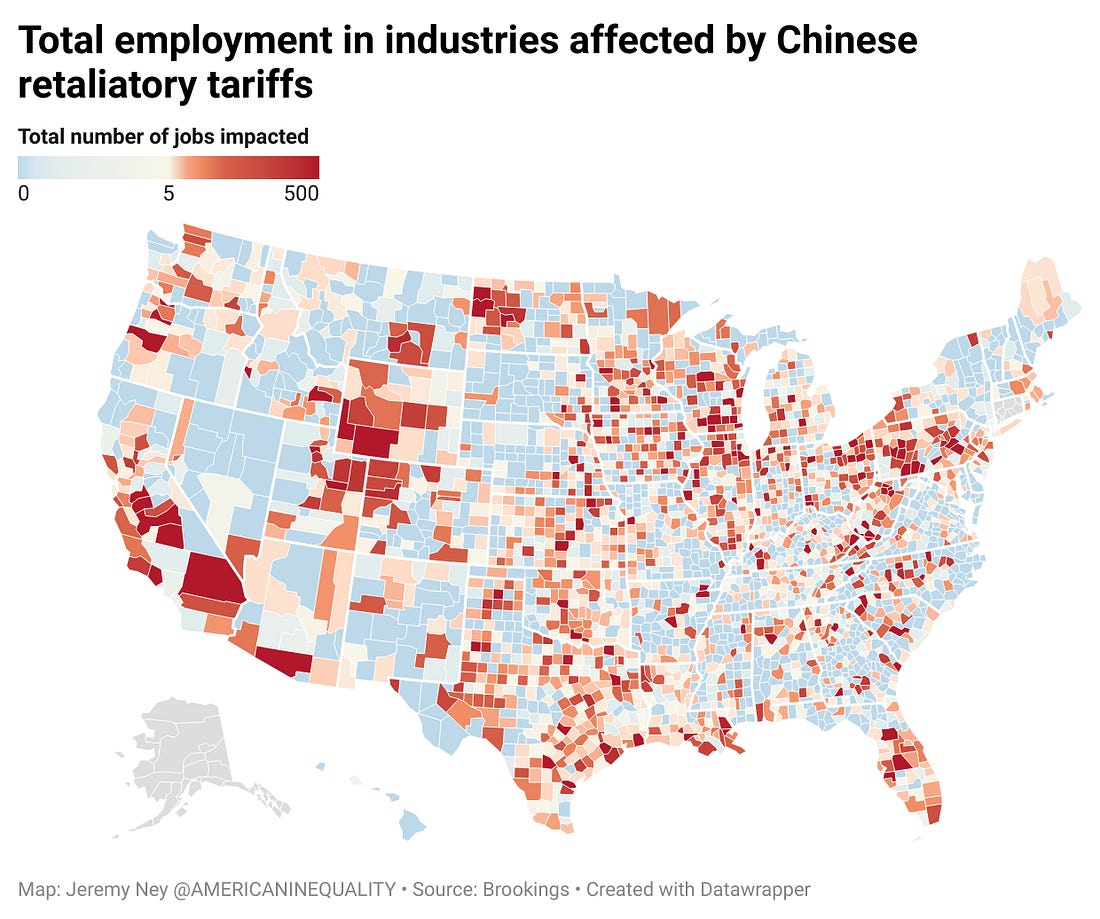
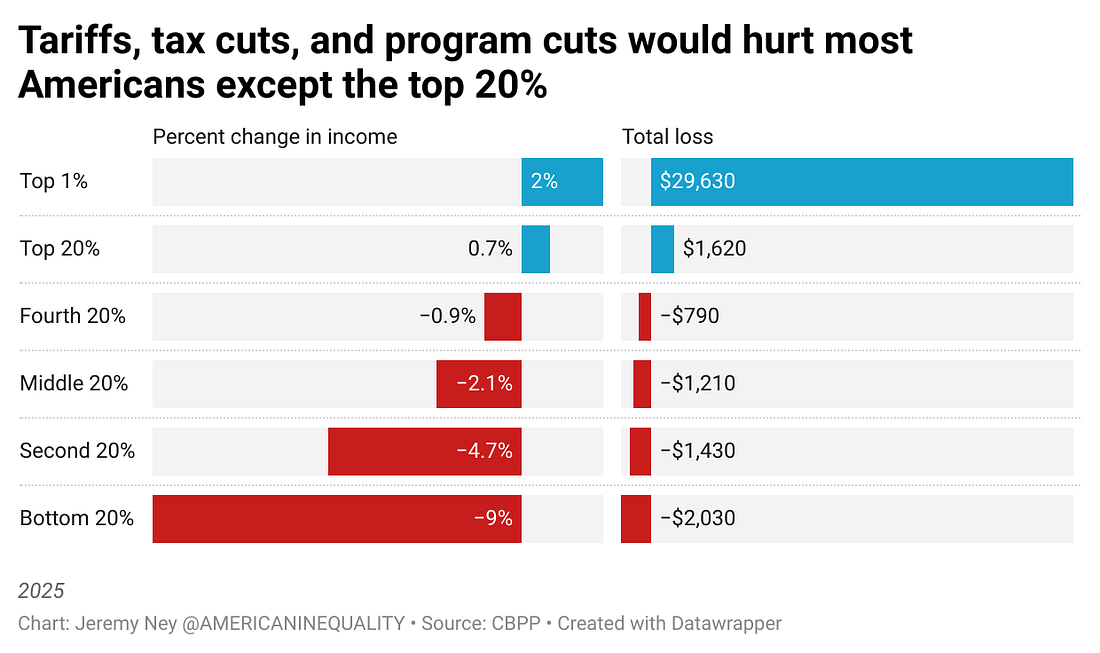
While we may not know what the final outcome of the tariffs will be, we can be completely sure that they will increase inequality because we’ve been here before. Mark Muro and the team at Brookings have identified which of America’s 3,143 US counties are most at-risk from Chinese retaliatory tariffs. China has announced retaliatory tariffs on a total of 80 different products that map to 14 different industries including automobiles, oil and gas, farm machinery, and equipment manufacturing. These 14 industries cover between 400,000 and 700,000 jobs in the United States, but some states and some counties are at much higher risk. Sargent County, N.D. has the highest potential exposure of any county due to its large manufacturing presence, with 59% of its employment in industries potentially affected by the tariffs. Sargent County is relatively small, but Harris County in Texas (where Houston is) has 33,000 jobs which may be at risk, largely in oil and gas. Other notable counties include Wayne County, Mich. (26,000); Alameda County, Calif. (25,000); Jefferson County, Ky. (13,000); and Elkhart County, Ind. (12,000). Tariffs will batter low-income communitiesNot only are these specific counties and industries most at-risk, but so too are low-income communities. According to the Budget Lab at Yale University, which analyzed the impact of the original tariffs Trump announced over a week ago, the average American household would lose about $3,800 annually because of the tariffs. For the lowest income households. The bottom 10 percent of households by income, for example, would spend 4% of their disposable income on tariffs, while the top 10 percent will only pay 1.6%. Tariffs are a tax on the poor If the tariffs bring on a recession, low-income communities will suffer the most. During the Great Recession between 2007 and 2009, the number of people living below the poverty line increased by nearly 5 million. When layered on top of the tax cuts, program cuts, and others that have also started putting the economy into a tailspin, the bottom 20% of earners in the US are set to lose $2,030 annually, or 9% of their incomes. Lessons from the China Trade Shock of 2001But America has also been here before during the China Trade Shock. My former advisor, Gordon Hanson, published groundbreaking research with David Autor and David Dorn about the role of China joining the World Trade Organization in 2001. The authors find that the impact of China having new access to global trade decimated several US industries and counties. The China trade shock reduced US manufacturing employment by 1 million U.S. manufacturing jobs, and 2.4 million jobs overall, explaining about 16% of the total decline in manufacturing employment in the US between 2000 and 2007. Hanson, Autor, and Dorn’s research has resurfaced as many are trying to identify which parts of the US may be at risk again from China targeting certain US industries with retaliatory tariffs. At that time, North Carolina furniture producing counties like Randolph County and Chatham County were hit the hardest. In 2000, the furniture industry in Hickory, N.C., employed more than 32,000 people, a fifth of the area’s private-sector workers. Within a decade, that number had been cut by nearly 60 percent — a devastating blow that was repeated in many regions. “The communities that were most exposed to the China trade shock were those that were highly specialized in labor-intensive manufacturing. Because factories closed and jobs disappeared in these places over two decades ago, they have no industrial base or industrial work force to be reactivated by US tariffs on China. The ineffectiveness of Trump tariffs on generating job growth in China-shocked communities will simply be continued by these ongoing Trump tariffs,” Gordon Hanson shared with me. Ben Casselman at the New York Times wrote on April 11, “Economists who have studied the issue also argue that Mr. Trump misunderstands the nature of the China shock. The real lesson of the episode wasn’t about trade at all, they say — it was about the toll that rapid economic changes can take on workers and communities — and by failing to understand that, Mr. Trump risks repeating the mistakes he claims he has vowed to correct.” “For the last 20 years we’ve been hearing about the China shock and how brutal it was and how people can’t adjust,” said Scott Lincicome, a trade economist at the Cato Institute, a libertarian research organization. “And finally, after most places have moved on, now we’re shocking them again.” This is where the inequality machine is about to kick into high gear. We’ve already seen what happens to these communities once. They have not bounced back in the 20 years since they were first hit (though Biden’s infrastructure bill did directly focus on funds to these communities based). Poverty in America is a trap that gets worse the deeper you sink. Tariffs may irreparably damn many of these communities. Trump counties will be lose jobs at a rate of 2-1
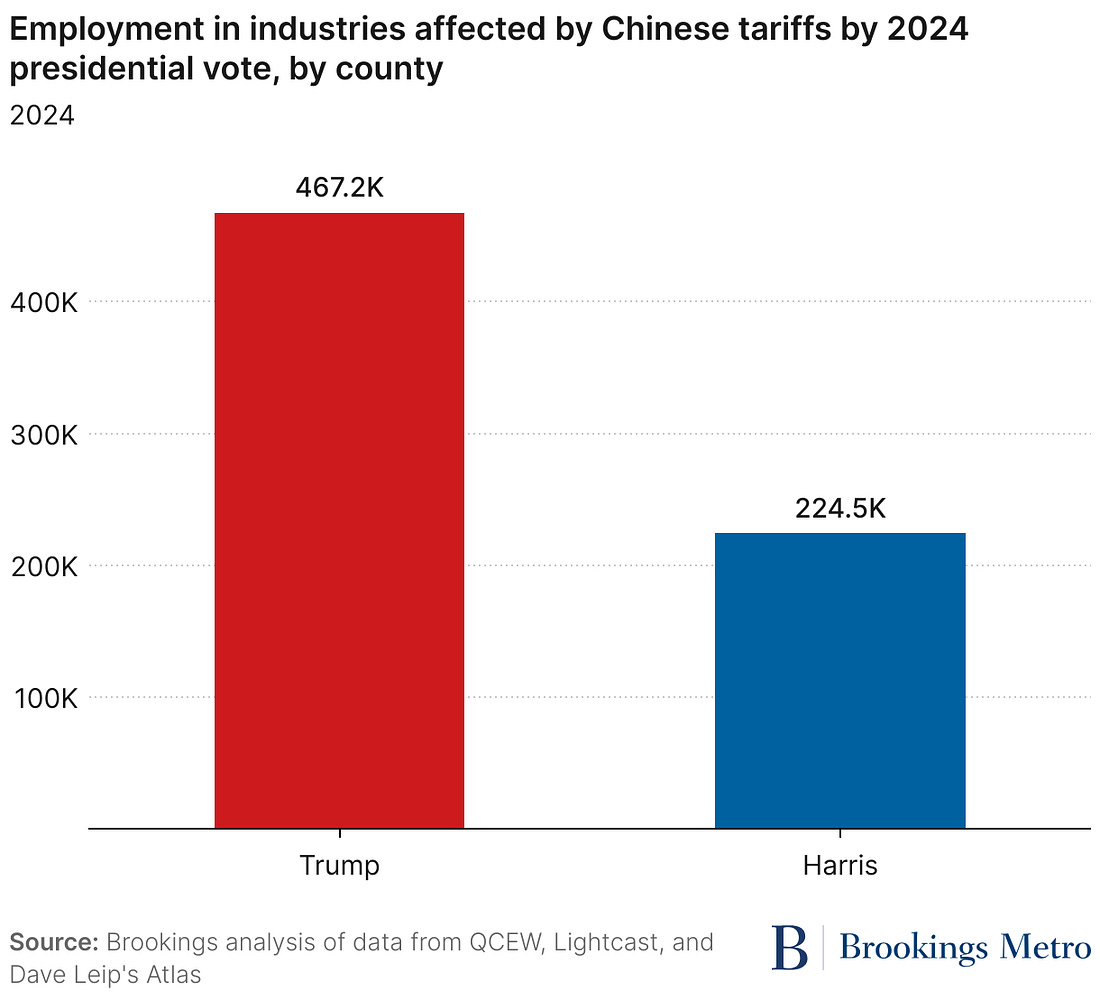
Ironically but perhaps unsurprisingly, Mark Muro’s team at Brookings discovered that the counties most likely to be negatively impacted by the tariffs are also the highest Trump voting counties. The regions that are about to be hit hardest by Chinese retaliatory tariffs voted for Trump over Harris by a margin of 2-to-1. Mark writes, “Many of the most tariff-exposed counties are found in the industrial heartland and Southeast regions, which formed Trump’s electoral base in 2024, including Elkhart and Gibson counties in Indiana; Macomb County, Michigan; Irion County, Texas; and Spartanburg County, South Carolina. Of the 2,010 counties with employment in tariff-affected industries, 1,722 of them voted for Trump compared to just 288 for Harris.”
Victor Fettes lives in one of those areas that swung towards Trump and he is seeing his 401K disappear. “I looked at my 401(k) this morning and in the last two days that’s lost $58,000. We’re down $70,000 since February. That’s stressful,” Victor said, who retired last week as a senior director of risk management and compliance at Verizon. “If that continues, I can’t stay retired.” Victor has been calling his representatives nonstop to make sure they understand that this is not the type of change that he wanted. Although Trump had been talking about tariffs consistently on the campaign trail and during his last presidency, many Americans did not understand what this would really entail. “This is money that I now can’t count on later.” The Path ForwardThe Trump administration is largely of the belief that tariffs may hurt Wall Street but benefit Main Street. We’ve heard this consistently in talking points, but it is far from the truth. Not only do lower income or middle class Americans also own stock typically through their 401K plans, but they will also suffer higher prices for all goods because tariffs don’t happen in a vacuum — other countries respond, high walls means goods need to go somewhere else, and tariffs are effectively a consumption tax, which disproportionately impacts low-income Americans who spend a larger share of their earnings on consumption. The path forward is fairly obvious.
Trump has the perfect 3 step formula for bringing on a recession and spiking inequality. Step 1: Tariffs. Step 2: Inflation. Step 3: Job Losses in the Heartland. But the path forward are 3 steps that America would be much better off following. You’re on the free list for American Inequality. Thanks so much for being part of our community! Please share with others and don’t forget to subscribe. Most sincerely, Jeremy
|
среда, 23 апреля 2025 г.
Why Tariffs are a Tax on the Poor








Подписаться на:
Комментарии к сообщению (Atom)
Комментариев нет:
Отправить комментарий
Примечание. Отправлять комментарии могут только участники этого блога.