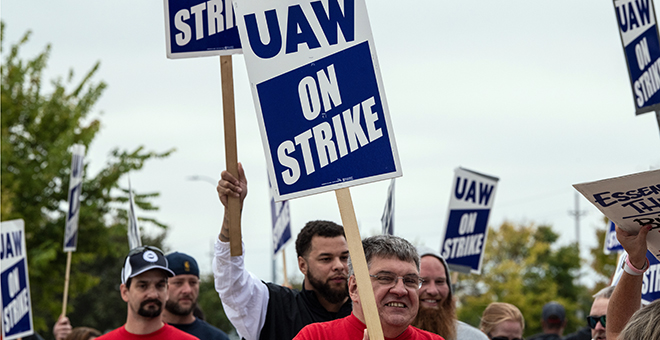
| | Rewrite the rules While summer may have officially ended last week in the US, we're still enjoying a few more weeks of "hot labor summer," as the high-profile strikes in the auto and entertainment industries continue. David Leonhardt sums up the situation in the New York Times: In the past few decades, "executive pay and corporate profits have grown faster than the American economy—and much faster than wages for rank-and-file workers. The current burst of labor activism. . .is an attempt to reverse these trends ." (And Americans are supportive: Gallup found in August that more than two-thirds of them approve of unions.) One of the United Auto Workers' key arguments is that autoworker pay at the Big Three automakers (GM, Stellantis, and Ford) has only risen 6% in the past four years, while those companies' CEOs have seen increases of up to 40%. Business Insider investigated the numbers and found them a little imprecise—but only because " executive pay is notoriously complicated to calculate because so much of it comes in the form of stock grants or stock options." (When defending her own $29 million package, GM CEO Mary Barra infamously argued that 92% of her compensation was "based on performance.") It's clear that CEOs and autoworkers are living in two different economies, playing by different rules. As labor organizer David Rolf once told me (and as I recounted in WTF?: What's the Future and Why It's Up to Us), "God did not make being an autoworker a good job." A long legacy of activism and, yes, strikes made it possible. The UAW strike is a forceful reminder that we need to "rewrite the rules" that place shareholder value above all else. | | | | | Rethink public policy Another key facet of the UAW strike: the transition to EVs. As Ronald Brownstein points out in the Atlantic, the crux of the issue lies in the EV plants popping up all over the South , few of which are unionized and all paying much lower wages than unionized plants in the Midwest. "Even if the union succeeds at winning a favorable contract," Brownstein notes, "that could just increase the incentive for the auto industry to shift more jobs to nonunion plants across the South." And while the Inflation Reduction Act is directing a tremendous amount of money to private companies like automakers to boost EV production and sales, it doesn't require the positions created with those funds to be union jobs. But it should have. (And could have—as Brownstein mentions, West Virginia senator Joe Manchin forced the removal of a tax credit promoting union-made EVs.) In "Auto Strikes and Climate Change," Mariana Mazzucato and Damon Silvers argue that the UAW strike underscores the need to rethink public policy—specifically policy aimed at fighting climate change—to ensure that it benefits workers, not just the economy at large. If governments want to fight climate change effectively, they must set a clear direction for growth, with a sustainable and inclusive economy as the ultimate goal. Public funding and partnerships with business all must be structured to share the rewards—rather than just the risks—of the transition with both workers and the public more widely. . . . To drive innovation at the scale and speed required to avoid a climate catastrophe, governments must establish a new social contract with businesses and labor. As long as good jobs and workers' rights are seen as optional add-ons in the fight against climate change, we will be waging a losing battle. | | | | | Augment workers rather than replace them The Writers Guild of America and studios have reached a tentative deal in what's been the longest strike in Hollywood history. (The strike by SAG-AFTRA, the actors' union, is ongoing.) The WGA membership will still have to vote the deal through, but it looks like most of their demands were met . Like their compatriots in the auto industry, striking writers and actors wanted fairer wages and better working conditions to redress past inequities—but they're also looking to the future, and that means grappling with artificial intelligence. Striking actors have similar demands and concerns. While apprehensive about how AI may affect entertainment jobs, writers and actors aren't necessarily afraid of being replaced by AI today. But they can read the writing on the wall and want to be sure they have a seat at the table with studio execs determining the role AI will play in the entertainment industry. Significantly, writers aren't trying to enact a ban on the technology. As Andrew Dalton and the Associated Press write in Fortune, the WGA "would allow for the use of AI—but only insofar as it was a tool for them to use in their own work ," and "they would be willing, potentially, to shape stories with help from AI software. But they do not want it to affect the credits that are essential to their prestige and pay." In short, they see AI technologies as productive tools that augment workers, and want to be sure that those who use these tools are recognized and compensated for the work they create with them. As I say in WTF?, workers augmented with new technology have the potential to do things that were previously impossible. But that technology must be deployed correctly, and in a way that values people over short-term results. For now, it seems Hollywood agrees. | | | | | | —Tim O’Reilly and Peyton Joyce | | | |



Комментариев нет:
Отправить комментарий
Примечание. Отправлять комментарии могут только участники этого блога.