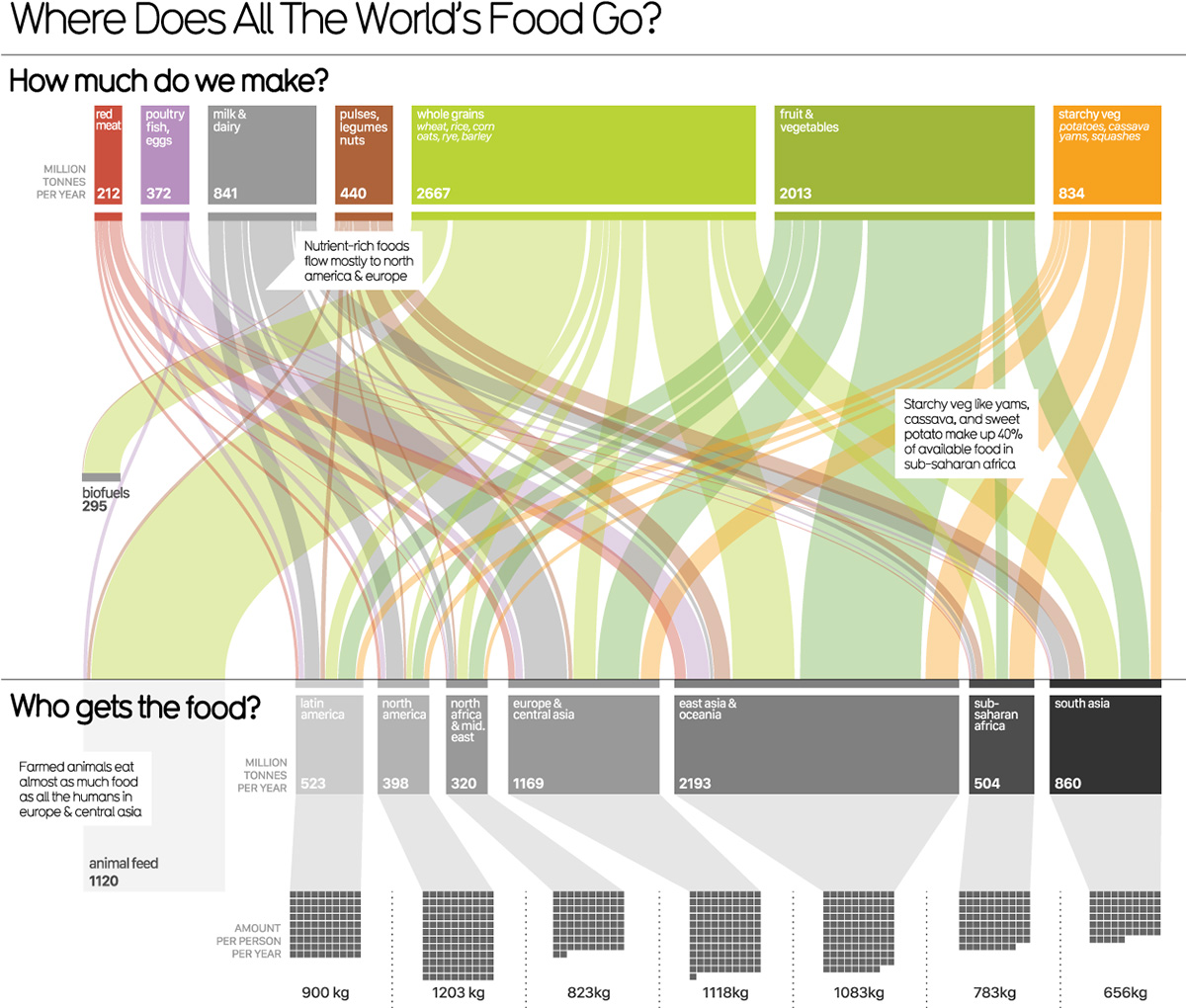
| | We need a food system that doesn't "devour the planet" A drought—made worse by climate change and the influence of the El Niño weather pattern—has propelled enormous wildfires across South America in recent weeks. And besides the destruction they've caused to civic centers, the wildfires have also ravaged the continent's agricultural sector—$15 billion in losses in Argentina and another $1.1 billion in Uruguay so far, according to Foreign Policy. Extreme weather events, like last year's floods in Pakistan or this week's floods across California, have displaced communities and disrupted farming throughout the world. And things are only likely to get worse. The recent Fifth National Climate Assessment explains that "as the climate changes, increased instabilities in US and global food production and distribution systems are projected to make food less available and more expensive." Add to this the alimentary demands of a growing population and the implications appear increasingly dire. All of which makes grappling with "how we might feed the world without devouring the planet" of the utmost importance—as George Monbiot argues, it's "one of the key questions of our time." In "The Cruel Fantasies of Well-Fed People," Monbiot examines "the marvel of the past 50 years of falling hunger during a time of rising population," made possible through increasing agricultural yields and globalizing the industry (which, he notes, is not without its own problems): There are three things upon which I think we can all agree. First, that this marvel came at a great environmental cost. It was delivered through hungry and thirsty new crop varieties, reliant for their survival on lashings of agrochemicals, unsustainable water use and practices that can accelerate soil degradation. Second, that it also involved severe social and political dislocations, including land-grabbing, enclosures and rising corporate power and concentration. Third, that it might now be running out of road: the prevalence of global undernourishment rose from 613 million (median estimate) in 2019 to 735 million in 2022. Monbiot contends that addressing the flaws of our current system will require "replacing the destructive economic models with systems in which everyone's needs are met without breaching planetary boundaries"—which isn't to say that these new systems will be perfect. But as he makes clear, they will need to be designed to feed the entirety of our global population. (He disagrees with those arguing for a food system that's smaller, more local, and more rural, something he finds unworkable on a large scale.) Ultimately his conclusion is one of shared responsibility: Given that rich nations and wealthy people are primarily responsible for the planetary dysbiosis we all face, including the massive burdens the food system imposes on the living world, we all have a duty to engage. Engaging means valuing the lives of others as we value our own. Living on this planet, especially as a member of a privileged society, our lives are intimately bound with the lives of others, including those who live thousands of miles away. We cannot excuse ourselves from the responsibilities we owe to each other. Our aim should be not to use societal collapse as a tool to shape the world to our tastes, but to seek to avert societal collapse. + Regenesis: Feeding the World Without Devouring the Planet, by George Monbiot + From the Guardian: "UN Sets Out Roadmap to Combat Global Hunger amid Climate Crisis." | | | | | Step 1: Make food production greener Solving the burgeoning food crisis will require action on a number of fronts, but a key tactic will be to make agriculture more sustainable. After all, food production accounts for a huge portion of global emissions (31% in 2019, says Reuters, which includes "21% of all the world's carbon dioxide, 53% of all methane and 78% of all nitrous oxide emissions globally"). Bloomberg concedes that "agriculture has attracted very little climate finance" in recent years, but last year's COP28 summit may have turned things in the right direction, with countries pledging " more than $3 billion. . .for food and agriculture." Transforming our food system provides the opportunity to "avert societal collapse" (per Monbiot) while still offering a massive return on investment, according to a recent report by the Food System Economics Commission. As The Economics of the Food System Transformation illustrates, "The net benefits of achieving a food system transformation are worth 5 to 10 trillion USD a year, equivalent to between 4 and 8 percent of global GDP in 2020." Getting there will take government support (and incentives), new technologies to increase productivity, and rethinking individual consumption patterns. But as the Verge's Justine Calma points out , if we follow the commission's recommendations, "undernutrition could be eradicated by 2050. The world could avoid 174 million premature deaths from diet-related chronic disease. Nations might even have a better shot at reaching the ambitious Paris climate goals, which, in turn, would spur its own health benefits." + From the LA Times: "Looking for the Next California Tech Boom? You'll Find It in Our Farmlands." + From Scientific American: "How to Make Urban Agriculture More Climate-Friendly" + From Bloomberg: "King Arthur Flour Brings Climate-Friendly Farming to the Kitchen." + More from Bloomberg: "Don't Kill Community Composting in New York City." | | | | | The trouble with cows About those individual consumption patterns. . . A key thing we need to rethink (particularly in the United States) is the role meat plays in our diet. Cattle, the Grist's Naoki Nitta notes, are "the single largest agricultural source of methane," and "the world's 940 million cows spew nearly 10 percent of all greenhouse gas emissions—much of it through belches and droppings." While companies are frantically searching for breakthroughs that might mitigate the damage (one off-the-wall idea: a cow "gas mask"!), Nitta asks, "Wouldn't it be easier to ditch milk, cheese, and beef for plant-based alternatives?" Maybe not. As he explains, for now the complexities of our interconnected food production system make removing the beef and dairy industries a structural impossibility. Still, says Nitta, your decision to pass on that hamburger or steak makes a small difference: "meatless Mondays, vegan Fridays, and less polluting cows all have their place in mitigating the role cattle play in warming the world." + From Bloomberg: "Canada Tackles Methane Emissions from Cow Burps with Credit Plan." | | | | | Don't forget the farmers Farmers will play an integral part in any widespread transformation, so getting their buy-in will go a long way toward ensuring the success of new programs. But right now, they're not happy. Across Europe, farmers and other agricultural workers have taken to the streets to protest regulations and free trade agreements that are eating into their already low incomes. (American farmers share many of the same concerns.) In response to these demonstrations, Politico reports, "the European Commission has dropped key passages in a proposal for a new 2040 goal for cutting greenhouse gas pollution." It's an issue that cuts across political persuasions and one that needs to be solved if we're to make the food system more sustainable. And that might mean spreading the costs around. As the Financial Times' editorial board recently argued, As with other parts of the green transition, Brussels and EU states need to find ways to hold firm to the overall goals while offsetting the impact on the most vulnerable groups — by phasing in measures over time, exempting smaller farms, or offering targeted support. Given the importance of food security, moreover, a broader debate is needed on where in the supply chain the costs of going green should fall: on farmers, on taxpayers through even higher subsidies, or on consumers and the food and retail industry. There is one curious omission in the FT's list of those who might be asked to bear the burden of the transition. As is so often the case, farmers are asked to accept lower prices and consumers higher prices, and governments to provide subsidies, while the large and powerful corporate middlemen expect to preserve or even expand their profits. The primacy of shareholder value once again rears its ugly head, much as it does in the energy transition. | | | | | Our food system, visualized While we'll need to overhaul our food system to account for our changing climate, we may already be producing enough to feed the world—if we could only direct food to where it's actually needed. Here's a striking data visualization conceptualized by New Internationalist's Hazel Healy and Christina Hicks and designed by Information is Beautiful's David McCandless that tracks the global flow of food. As the New Internationalist submits, "There's more than enough to go round—if food is distributed evenly." Sometimes seeing is believing. (The data viz was created in 2021, but we came across it more recently when Lawrence Wilkinson shared it on his blog, (Roughly) Daily. Although some of the figures may be different today, it remains a great top-down look demystifying a very complex system.) | | | | | | —Tim O’Reilly and Peyton Joyce | | | |




Комментариев нет:
Отправить комментарий
Примечание. Отправлять комментарии могут только участники этого блога.