"How will we shape our society as we face the future?" Generated with Adobe Firefly. | | | | | Abundance can stave off collapse It's a holiday week here at Next Economy so we'll keep things short. That said, US Independence Day is the perfect time to ruminate on how nations rise—and how they might fall. In his Substack newsletter back in May, the Abundance Institute's Eli Dourado put forward a "beginner's guide to sociopolitical collapse " with the goal of sketching out the policies that might help us avoid it. As Dourado observes, avoiding catastrophe will be determined by how well we manage complexity. Societies grow increasingly complex over time, and that complexity itself is unavoidable: it's what results when societies endeavor "to address [their] problems and stresses." (As Dourado points out, this situation is regrettably relatable to anyone keeping an eye on US public policy.) However, as that "complexity accumulates as a system," it can eventually become too much to handle, and the society collapses, moving backward "from a relatively high level of sociopolitical complexity to a much lower one—rapidly, within the span of a few decades." The good news is that there's time to address the complexity that threatens to undermine our nation. And the abundance movement, which we highlighted here a few weeks ago, is a good place to start. Dourado explains: We need earnest culling of net-harmful social complexity. We need new resource subsidies to become available through deploying new technology. We need to make it easier to deploy and iterate at scale. We need the government to act effectively and earn societal trust. We must eliminate low-value bureaucracy and procedure. We need to make sure that prosperity is widely shared, not only through transfers but in a primary income sort of way. The no-collapse agenda effectively is the abundance agenda. + Analyzing how other societies have fallen can help us better understand our present moment. And new technologies like AI can shed more light on the things we thought we knew. From Ars Technica: "We Now Have Even More Evidence Against the 'Ecocide' Theory of Easter Island." + From Bloomberg: "Economic Insecurity Roils Politics From Kenya to France." | | | | | Deeper reading: After 1177 B.C.—The Survival of Civilizations 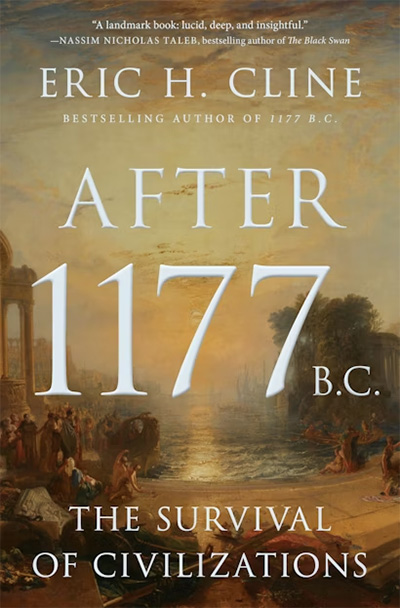 In 2021, Eric Cline, a professor at the George Washington University and the director of the GWU Capitol Archaeological Institute, published 1177 B.C.: The Year Civilization Collapsed, tracing the "multiple interconnected failures" that led to the fall of societies at the end of the Late Bronze Age. Now Cline is back with After 1177 B.C.: The Survival of Civilizations, a more hopeful book that explores how certain societies were able to persevere while others failed. Here's a review in Science News, and another in The Wall Street Journal. And you can watch Cline's lecture to PSW Science here . As he contends at the conclusion of the talk, we could learn from those societies that survived—especially those that thrived, creating technologies like iron-working and the alphabet that transformed the world—as we confront the many challenges we're currently facing, from climate change to economic disruption to political upheaval. Whether we're able to overcome them will depend on the plans we put in place to stay resilient, innovative, and self-sufficient. | | | | | Deeper reading: Icehenge 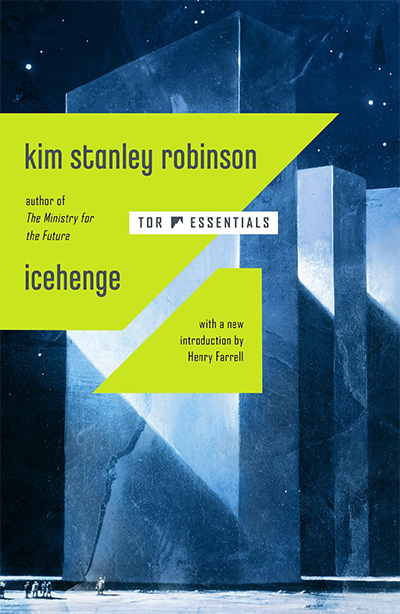 As we've mentioned before, science fiction too can help us make sense of our present. Kim Stanley Robinson has been grappling with how civilizations rise and fall for 40 years, in novels like the Three Californias trilogy, the Mars trilogy, and 2020's masterful The Ministry for the Future . Now Tor Essentials has released a new edition of Robinson's 1984 novel Icehenge, with an introduction by Johns Hopkins political scientist Henry Farrell. A story in three parts, Icehenge contemplates the long reverberations of a failed revolution on Mars. But as Farrell notes, it's also a "novel about the gaps and misunderstandings that isolate our personal worlds from each other. We cannot bridge those gaps, however desperately we try, but we cannot stop trying either." Kim Stanley Robinson has a unique gift for writing novels that capture the immense beauty of the world, the long arc of time, and how humans shape ourselves and our society in response to those two primal powers. I've never actually read Icehenge, though I've read most of Stan's other books. But now that I've read Henry Farrell's beautiful introduction to the new edition, I know that I have to put it at the very top of my queue. + From Jacobin: "Kim Stanley Robinson—We Need Democratic Socialism." | | | | | | —Tim O’Reilly and Peyton Joyce | | | |





Комментариев нет:
Отправить комментарий
Примечание. Отправлять комментарии могут только участники этого блога.