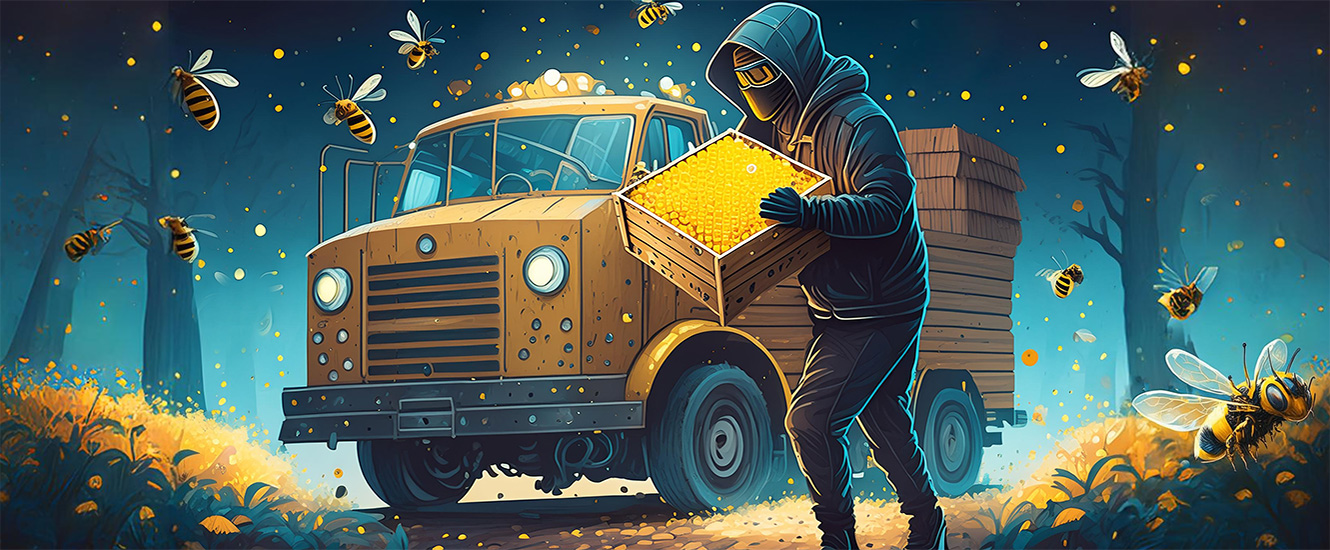
"What the plight of bees tells us about capitalism and conservation." Generated with Adobe Firefly. | | | | | The truth about bees We've spent years worrying about colony collapse disorder and the fate of bees. So recent numbers from the USDA's Census of Agriculture showing a sharp upswing in bee colonies were a bit of a surprise, particularly since bees are still dying in large numbers. But as Vox's Bryan Walsh explains, what success there's been is more a matter of capitalism than conservation: " Honeybees are so valuable that even as they continue to die in large numbers, it's economically viable to keep replacing them." Honeybees are essentially being factory farmed, with all the attendant problems of that industry. Not to mention that a rise in honeybees threatens native bee species forced to compete with them. And of course, when money is sloshing around, someone's bound to be thinking about how to make it their own: Noema 's Oliver Milman covers gangs of bee thieves in California's Central Valley, where last year some 2,300 hives were stolen. The plight of bees—honeybees and native bees alike—reflects some hard truths about the intersection of our economy and our environment. + All Things Considered's Scott Detrow recently sat down with conservationist Rich Hatfield to explore where we should actually direct our efforts: If you are really interested in helping to save the bees, we should really be focusing on putting flowers on the ground, reducing the use of insecticides and choosing where we buy our agriculture from and supporting farmers that are—that have habitats that support both wild bees and native bees. | | | | | Crab is king, but for how long? Here's another example of the tangled relationship between invasive species and the agricultural economy, with a dash of geopolitics to boot. Once-lucrative Alaskan king crab fisheries have been pummeled by climate change, as rising ocean waters decimate crab populations. (The snow crab population in the same waters has also collapsed.) Russian crab fishers were filling the gap until the US banned Russian imports in the wake of that country's invasion of Ukraine. And this set of circumstances changed the fortunes of a few hardscrabble Norwegian fishing villages on the Barents Sea, as Bloomberg 's Andrew Lewis reports. The king crab was introduced to the Barents Sea by Russian researchers, and it soon began laying waste to the local marine life. But Norway recognized that the invasive species, strictly controlled, might be a boon to the struggling fisheries in the far north of the country. And it’s been proven right: "While Russia is still catching vastly more red king crab (a quota of 28 million pounds last year) than Norway, the latter exported just about all its haul of 5.4 million pounds in 2023, a 42% annual increase worth $110 million." But, Lewis points out, Alaska may prove a "cautionary tale": As our oceans heat up, the good times are unlikely to last. | | | | | Animal-borne disease is a growing risk Climate change is also abetting the spread of disease, and the H5N1 "bird flu" virus is an alarming example of how. The University of Guelph's Nitish Boodhoo and Shayan Sharif explain in The Conversation: In North America, the warmer winters and earlier onset of spring which global warming is causing could allow some moisture-reliant pathogens to survive and spread more easily. Meanwhile, cooler and wetter conditions can enhance the survival of influenza viruses in bird droppings and contaminated water. Birds are also shifting their migratory patterns in response to our changing world. As a result, infected birds are spreading disease among animal populations they may previously have had no contact with. A massive loss of bird species would be bad enough, but H5N1 has also made the jump to mammals. The New York Times' Apoorva Mandavilli and Emily Anthes trace the path of destruction H5N1 has wreaked across the whole of the Western Hemisphere, asking, "What does that mean for us?" As the ongoing COVID pandemic has shown, good public policy and trust in the government institutions implementing it are critical to addressing global outbreaks. Unfortunately, those have lately been in short supply. + From The Atlantic: "How Much Worse Would a Bird-Flu Pandemic Be?" | | | | | Names that definitely won't be forgotten Let's end on a brighter note. It turns out that elephants give each other names: They're not just imitating the sounds other elephants make—they invent individual vocalizations for specific individuals, making them the only animals besides humans to do so. This groundbreaking finding came out of research aided by AI: The researchers sifted through elephant "rumbles" recorded at Kenya's Samburu national reserve and Amboseli national park between 1986 and 2022. Using a machine-learning algorithm, they identified 469 distinct calls, which included 101 elephants issuing a call and 117 receiving one. . . . Names were not always used in the elephant calls. But when names were called out, it was often over a long distance, and when adults were addressing young elephants. . . . When the researchers played a recording to an elephant of their friend or family member calling out their name, the animal responded positively and "energetically", the researchers said. This seems like just the beginning of a reevaluation of our relationship with animals, as AI makes it easier for us to understand how complex their cognition is. | | | | | | —Tim O’Reilly and Peyton Joyce | | | |




Комментариев нет:
Отправить комментарий
Примечание. Отправлять комментарии могут только участники этого блога.