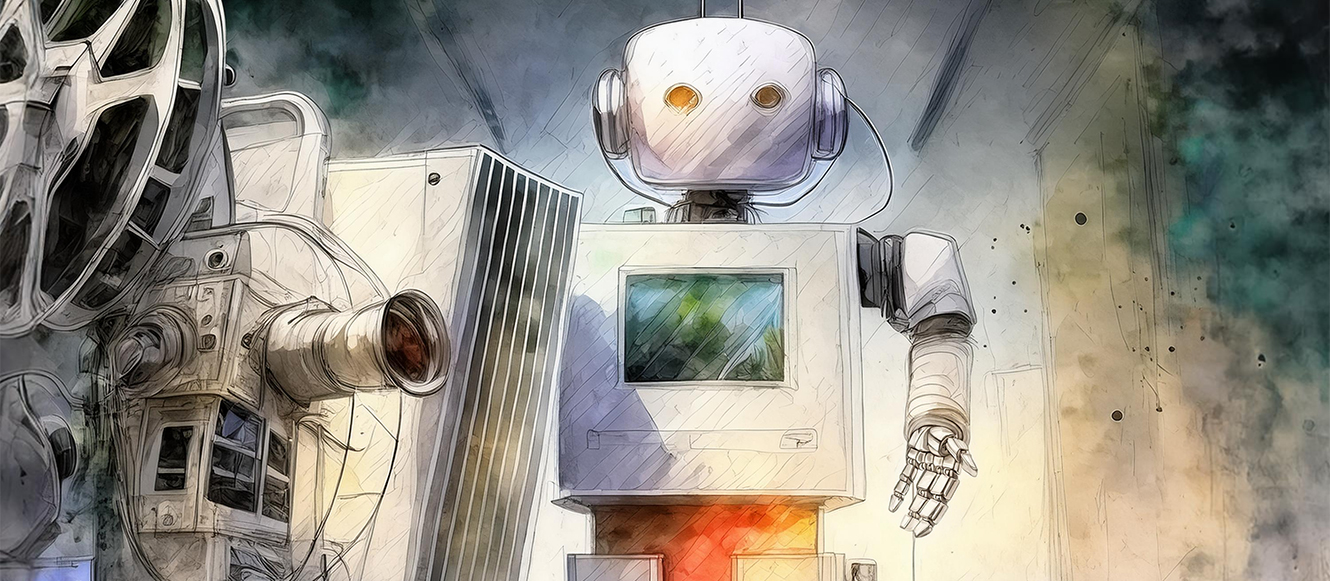
"How will AI change Hollywood?" Generated with Adobe Firefly. | | | | | Like AI from the movies Things aren't going so great at OpenAI this month. On May 13, the company announced its new model, GPT-4o, with a number of incremental improvements. But the feature that got everyone talking was a voice mode—and many thought it sounded a little too much like actress Scarlet Johansson, who famously voiced an AI in Spike Jonze's film Her. Sam Altman called attention to the similarity in a post on X, and although OpenAI's assistant was voiced by a different actress, now the company may be in legal trouble. In comments shared with NPR's Bobby Allyn, Johansson said she twice refused an offer from Altman to voice OpenAI's assistant , so the "eerily similar" voice came as a shock. And as she pointed out, this questionable implementation of AI is exactly why Hollywood actors went on strike last year: In a time when we are all grappling with deepfakes and the protection of our own likeness, our own work, our own identities, I believe these are questions that deserve absolute clarity. . . .I look forward to resolution in the form of transparency and the passage of appropriate legislation to help ensure that individual rights are protected. | | | | | The future isn't set What happens in Hollywood may be a sign of things to come. This illuminating report from the Brookings Institution explores the recent writers strike in great detail , explaining how technology has already impacted the livelihoods of screenwriters, how generative AI may make it worse, and why it matters for other industries. As author Molly Kinder stresses, how harmful generative AI ends up being comes down to whether the technology is used to augment workers or whether it's used to replace them. And in Hollywood—as well as in every field where AI takes the place of workers—the damage won't just be to those who can no longer find jobs. It will undermine the entire industry through the human capital that's lost, in this case by producing mediocre stories that will likely reinforce biases represented in training data. But as the success of the Hollywood strikes makes clear, the direction generative AI will take is still being contested. Here's Kinder: Whether AI will augment or automate—and whether and how much workers benefit from those gains—is not preordained. It depends on the choices of consumers, investors, employers, and technologists; the capabilities of the technology; the demand for workers' skills; and the existence—or lack—of guardrails to protect workers. + In Harper's, Daniel Bessner goes deeper into both the history and the economic forces that have shaped Hollywood and contributed to this moment of "existential crisis." + And Max Read has a "weird trick" that might just fix Tinseltown: unionize YouTube. | | | | | Hollywood's already using AI—and it's a little boring Tech companies including OpenAI and Google are pitching Hollywood their AI-generated video products as the future of production. However, as Ryan Broderick argues, where generative AI has actually been used, "so far, it's been deployed in pretty boring ways ." Despite executives' excitement, studios are finding that even generating "cheap filler. . .to speed up production or quickly fill in gaps" requires human expertise. As graphic designer Rob Sheridan puts it to Broderick, "It's already obvious that AI technology will never work without people who know how to integrate it into existing forms of art, whether it's a poster or a feature film." But at the moment, the idea that AI may just be another tool in a designer's toolbox runs counter to the hype Big Tech companies are whipping up about their products. A tool that helps you do your job faster sounds boring, especially when compared to the so-far unfulfilled promise of a technology that performs your entire job for you (or without you, as the case may be). But as I argue in WTF? What's the Future and Why It's Up to Us, when implemented with a focus on human-centered values, tools that augment workers can help them "do things that were previously impossible." And that's not boring at all. + Sky Kids, the production company that created the Air Head short showcasing Sora's capabilities, highlights how much work went into creating the less-than-two-minute film. + TV manufacturer TCL is teasing a 100%-AI generated original film developed and written by the company's chief content officer and chief technology officer. The initial response to the trailer has been harsh. + From IGN: "George Lucas Thinks Artificial Intelligence in Filmmaking Is 'Inevitable.'" | | | | | | —Tim O’Reilly and Peyton Joyce | | | |




Комментариев нет:
Отправить комментарий
Примечание. Отправлять комментарии могут только участники этого блога.