Inequality in wiretaps? The judges and regions that authorize trackingWiretaps: Judges generally seem to be pretty even-handed, but there are some massive outliers
INTERESTING ON THE WEB
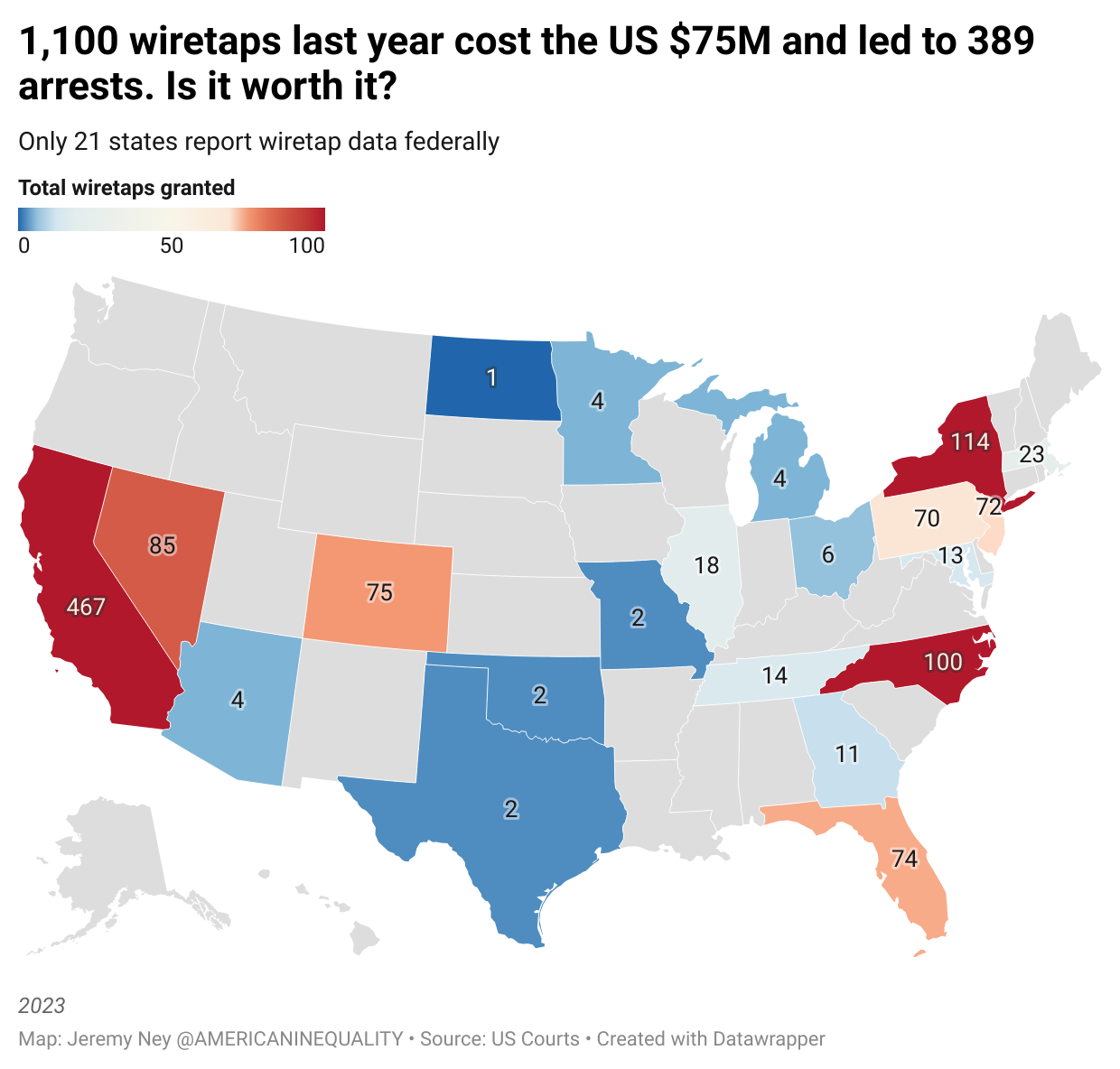
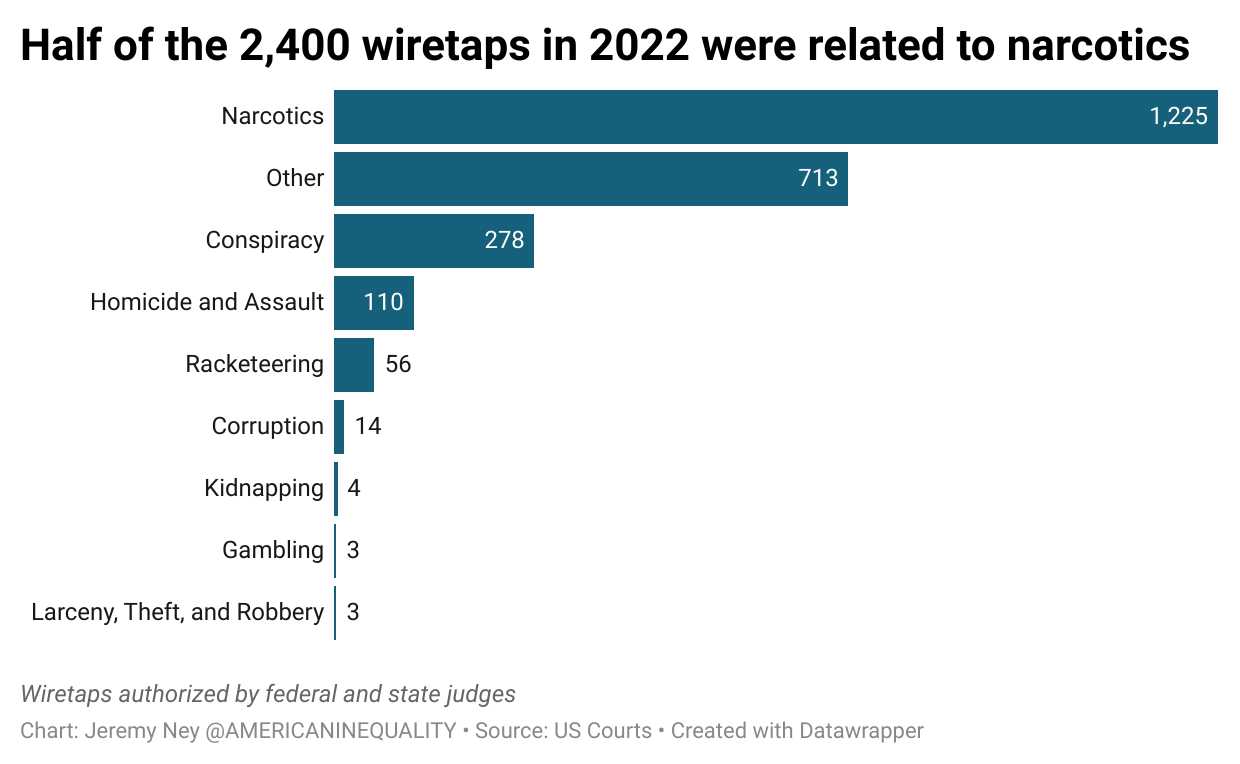
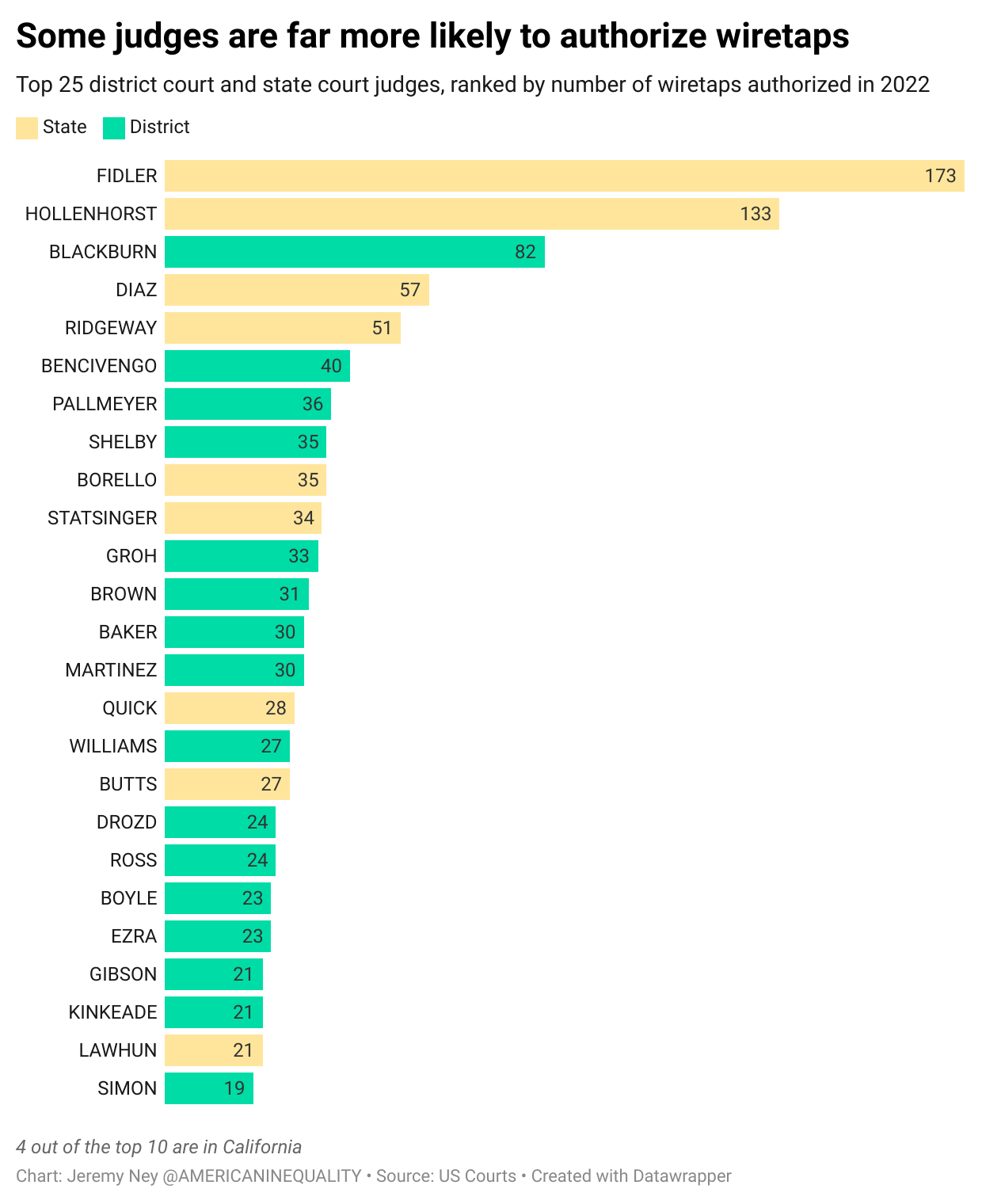
I generally hate writing pieces where I (a) don’t have county level data and (b) have incomplete data, but this one was too interesting to skip. On April 20, Congress renewed a law that approved an extension of a warrantless surveillance law. The law, known as Section 702 of the Foreign Intelligence Surveillance Act, or FISA, has been praised by national security officials, while privacy advocates argue that it is a threat to Americans’ civil liberties. While FISA is largely focused on foreign actors, The Brennan Center for Justice explains, “Section 702 has become a rich source of warrantless government access to Americans’ phone calls, texts, and emails.” The passage of this law and newly released data sent me down a rabbit hole to understand — Is there inequality in wiretaps in America? Generally what I found is – No, there does not appear to be meaningful inequality occurring from America’s wiretap system. Here are the facts. Wiretaps are increasing, but don’t seem to be impacting at-risk communitiesThe number of federal and state wiretaps in 2022 increased 7% from 2021. A total of 2,406 wiretaps were authorized in 2022, with 1,274 coming from federal judges and 1,132 from state judges. The total cost of these wiretaps was more than a quarter billion dollars and they lasted for a combined total of 133,000 days, meaning that each individual wiretap lasted roughly 38 days. Despite this wide ranging coverage, these wiretaps only resulted in 548 convictions. This means that each conviction effectively cost $257,000. The reason that I still wanted to dig into this topic is because there are a few judges who are remarkable outliers when it comes to issuing wiretaps. Judge Blackburn in Colorado issued 82 wiretaps, twice as many wiretaps as his next closest judge at the District Level. All of these were related to drugs and narcotics. None of these wiretaps resulted in convictions. Judge Fidler and Judge Hollenhurst in California both issued more than 130 wiretaps, triple as many wiretaps as the next closest judges at the State Level. These covered a range of issues from murder to narcotics to gang violence. None of these wiretaps resulted in convictions. These judges though all have very respectable, thoughtful, and even-handed careers. While one does seem to have a more conservative interpretation of the Constitution, this by no means has led to greater inequality in the wiretaps he has issued. While the US Court system does not reveal information about the demographics of people whose phones were tapped, we can see where those wiretaps occurred. The data does not show that there are more wiretaps in minority communities. While it can be hard to disaggregate some of the court districts, the location may matter less depending on how local the crime is. For example, someone may be manufacturing fentanyl in Virginia but selling it in Mississippi. Cherry-picking of judges may create some inequalityWiretaps are different from other searches for physical evidence in that they require a highly specific probable cause standard and authorization from the Department of Justice before seeking judicial approval. As researchers at the University of Pennsylvania explain,
When it comes to wiretaps and inequality, the strongest factor is the race of the judge. African American judges receive 20% fewer wiretap applications per day than their White colleagues. Judges with more seniority are more likely to receive wiretap applications. Political ideology, views of the criminal justice system, years in private practice, type of education (i.e. Ivy league or not), had no effect. Unsurprisingly, White judges tend to give more lenient sentences to White defendants and harsher sentences to Black defendants. The same holds true for in-group bias with Black judges. Given the tremendous over-policing of Black communities, the consistent over-selection of White judges for wiretaps continues to engender this inequity. Judges that are appointed by Republican presidents also tend to be harsher on Black defendants, and the vast majority of the judges with the most wiretaps given were appointed under both Bush presidents. What do we know about the judges that authorize the most wiretaps?Judge Larry Fidler is a big deal. The Criminal Justice Center at Loyola Law School is named after him. Described by colleagues as a “no-nonsense jurist” and having a “strong B.S. detector”, Justice Fidler presided over the trial of Marlon Brando's son, Christian, who was charged in a fatal shooting as well as the preliminary hearings in the Reginald Denny beating case stemming from the 1992 riots in Los Angeles. He handled in Municipal Court hearing for several white supremacists--including a former Ku Klux Klan Grand Dragon. Judge Blackburn has his fair share of interesting takes. He has ruled that there is a constitutional right to lie about getting a Purple Heart, one of the highest military honors. He has also said that the Fifth Amendment, which says that nobody may be "compelled in any criminal case to be a witness against himself," does not apply to computer passwords and has compelled witnesses to unlock passwords to be used in trials. But again, he seems to have a fairly balanced career. Judge Hollenhurst has had the fewest high profile cases, but had a humble upbringing that seems to have stuck with him when making rulings. He likes to tell a story of growing up in Minnesota and carrying fish filets that his dad cooked out into the street for people in need. Nothing about him seems to indicate any propensity for engendering inequality. The Path ForwardIt’s hard to know what we can’t see. Given the lack of detailed information on wiretaps, the solutions for understanding this space better first revolve around better reporting.
On October 10, 1963 the FBI began its wiretapping program of Martin Luther King, Jr. When James Comey was director of the FBI, he displayed this memo on his desk to remind himself of the FBI’s overreach and negative impact on the civil rights movement. During the War on Drugs in the 1980s, Black communities were most often subject to wiretaps. After 9/11 wiretaps were rampant under the PATRIOT Act to surveil Muslim communities across the US. Given America’s history of this type of surveillance, we need more detailed data to understand the relationship between wiretaps and inequality. Special thanks to Jeremy Singer-Vine for bringing this data to my attention through his absolutely fantastic newsletter Data is Plural. You’re on the free list for American Inequality. Thanks so much for being part of our community! Please share with others and don’t forget to subscribe. Most sincerely, Jeremy
|
среда, 1 мая 2024 г.
Inequality in wiretaps? The judges and regions that authorize tracking







Подписаться на:
Комментарии к сообщению (Atom)
Комментариев нет:
Отправить комментарий
Примечание. Отправлять комментарии могут только участники этого блога.