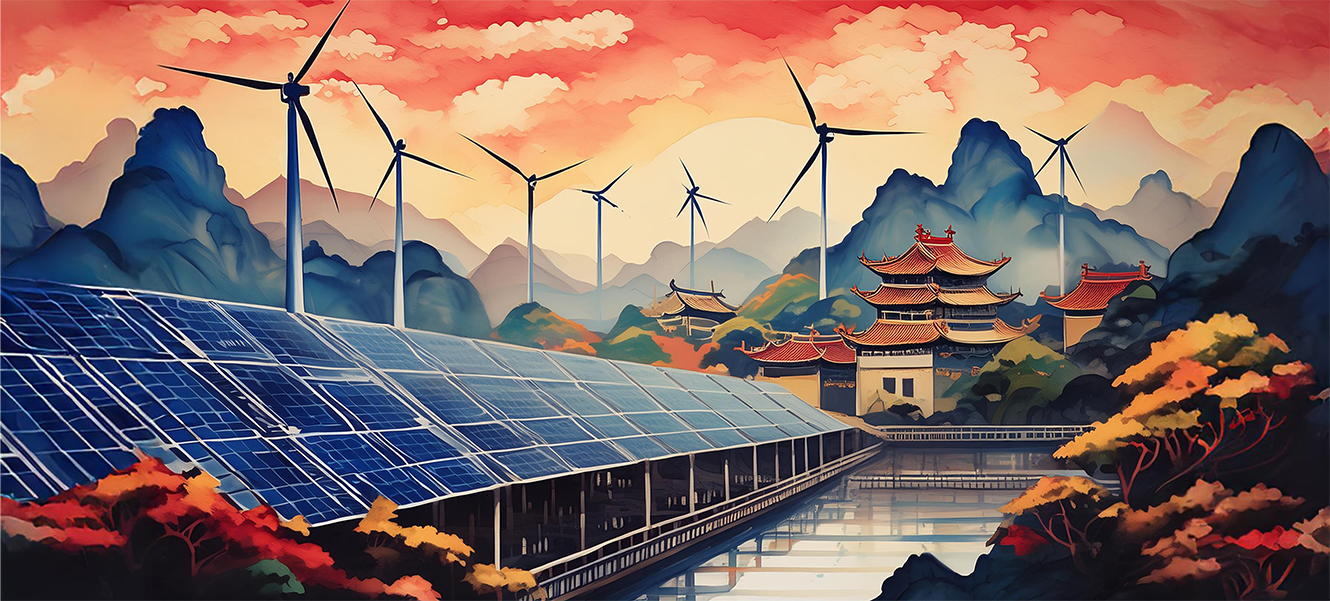
"China is leading the global energy transition." Generated with Adobe Firefly. | | | | | Balancing national interests with global responsibility Last week we touched on China's dominance of the affordable EV sector. But Chinese companies are also leading the global transition to clean energy. In fact, as Adam Tooze points out in his Chartbook newsletter , China is so far ahead in green electrification that despite the West's "painfully slow" energy transition, the country has single-handedly "pu[t] us within striking distance of achieving a net zero path." Drawing from a recent report from clean energy think tank Ember, Tooze highlights the fact that global demand, while still growing, is increasingly being offset by clean energy generation. And much of it is the product of China's huge investments in renewable energy—last year the country "accounted for more than half of the new global additions in wind and solar." It's great news, but there's a catch. China's dominance of clean energy has upset the delicate balance between the global responsibility to mitigate the emissions driving climate change, on the one hand, and the economic and geopolitical machinations of various countries and alliances on the other. And so far, energy transition appears to be losing out, says Tooze: The response of Western politicians? Protectionism. Of course there are complex motives. They need to build coalitions to sustain the energy transition. They are worried about the CCP regime in China. They want to escape extreme dependence on imported sources of energy (though of course in the renewable space it is capital equipment not energy they are importing). But the more basic question is simply this. Are Western governments and societies willing to prioritize the energy transition if it is not their drama, not their success story? Or, if the PV panels and the electric vehicles are from China, do other interests take priority? . . .In the case of the United States it seems increasingly clear that the energy transition as such is a second order concern and geopolitical confrontation and the struggle to form domestic coalitions, takes precedence. That is depressing. And it matters. But, as Ember's data make clear, it is far from being a decisive obstacle. The global energy transition will go on anyway. | | | | | The green case for tariffs Western countries are turning to protectionary measures in part because they're looking toward an uncertain future and planning for scenarios that may play out as part of the worsening polycrisis. One possibility they're watching closely: a "second China Shock." Both Noah Smith and Paul Krugman have recently thought through the implications of a Chinese trade surplus on the US labor market—and why tariffs are in the United States' best interests. As Krugman argues, protectionist measures may be the only way to keep the country's green energy transition on track: The Biden administration was able to get large subsidies for renewable energy only by tying those subsidies to the creation of domestic manufacturing jobs. If those subsidies are seen as creating jobs in China instead, our last, best hope of avoiding climate catastrophe will be lost—a consideration that easily outweighs all the usual arguments against tariffs. + More from Noah Smith: "Why Is China Producing So Many Export Goods, Anyway?" He offers six theories, including economic stimulus, overcapacity, and, most ominously, preparation for war. (More on that below.) + From Bloomberg: "US Efforts to Reshape Global Supply Chains Gather Pace in Asia." + From The New York Times: "US Seeks to Join Forces With Europe to Combat Excess Chinese Goods." + Here's a slightly more optimistic take on Biden's tariffs in the Financial Times: "Are the US and Chinese Economies Really About to Start 'Decoupling'?" + Matthew Klein argues in The Overshoot that "Chinese 'Overcapacity' Is Not the Problem. Underconsumption Is." + Stratechery's Ben Thompson sat down with Sinocism and Sharp China's Bill Bishop and his Sharp China cohost Andrew Sharp last November to discuss AI, US protectionism, and more. | | | | | Mesoeconomics can help countries achieve their goals So how do you develop a "robust strategy" for the current moment of geopolitical risk? In a recent article in Project Syndicate, Bill Janeway makes the case that mesoeconomics can extend our understanding of both our economic and national security systems. Rather than dealing with the behaviors of individuals (microeconomics) or of statistical aggregates (macroeconomics), mesoeconomics explores "the dynamic context in which economic policies play out" by analyzing the "existing relationships between firms within and across markets, supply chains, and financial networks." And the insights gleaned through mesoeconomics can "inform policy in new ways and in new domains." (Janeway's examples include semiconductors and clean energy: two areas where US national security is colliding with China's economic ambitions.) Here's Janeway's pitch: What mesoeconomics offers to policymakers is the information needed to guide targeted interventions designed either to increase the resilience of the economic system on the supply side, or to enable effective responses to legitimate extra-market demands. That information necessarily includes a mapping of economic networks to identify potential vulnerabilities and bottlenecks. Armed with such insights, those designing industrial policies will have a better chance of achieving their overlapping economic- and national-security goals. | | | | | | —Tim O’Reilly and Peyton Joyce | | | |




Комментариев нет:
Отправить комментарий
Примечание. Отправлять комментарии могут только участники этого блога.