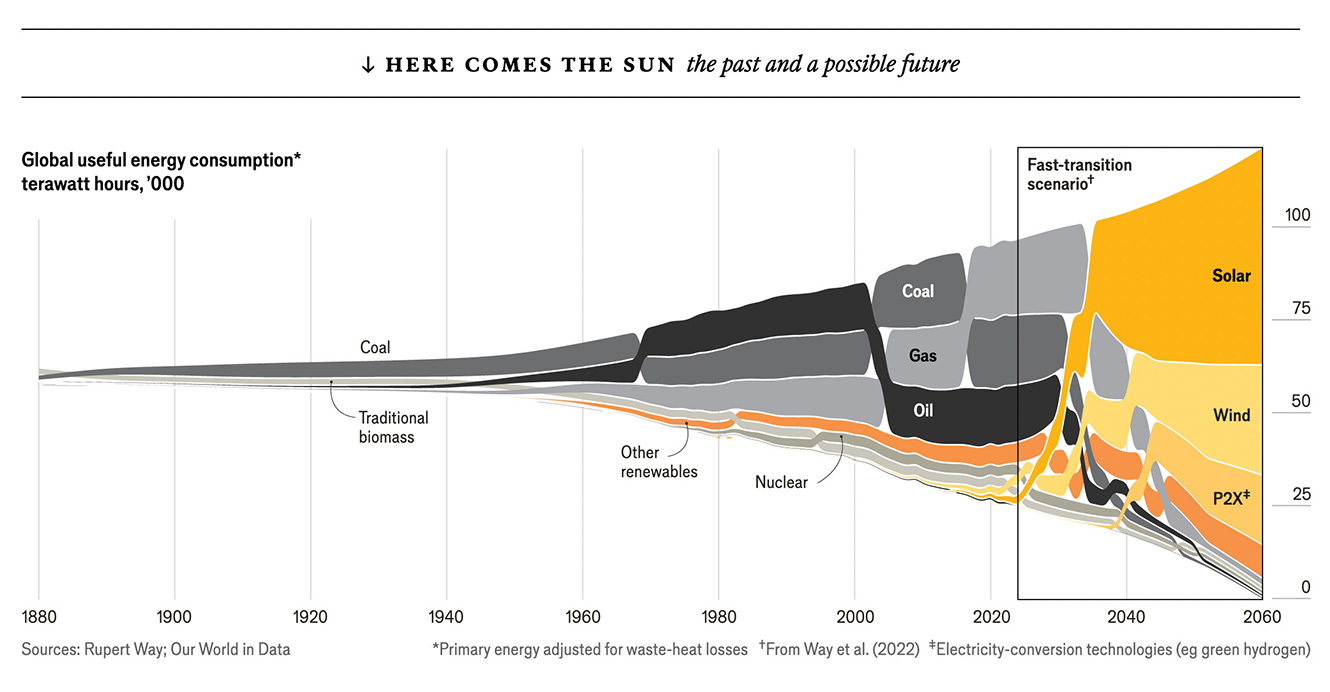
"Solar could bring about an abundant future." Generated with Adobe Firefly. | | | | | "The biggest investment opportunity in history" Widespread innovation over the past 200 years has lifted much of the world from extreme poverty. And as Casey Handmer, founder of atmospheric hydrocarbon synthesis company Terraform Industries, explains, that progress was "underwritten by the consumption of copious quantities of cheap energy, almost all of it from fossil coal, oil, and gas." But now we have solar power. "Solar PV is not just a partial substitute for oil," Handmer insists. "It's a cheaper and better energy source in every way that matters ." And just as oil did, cheap solar power will supercharge the economy: Our techno-capital machine is a thermodynamic mechanism that systematically hunts for and then maximally exploits the cheapest energy it can find. When it unlocks cheaper energy, first coal, then oil, then gas, and now solar, it drives up the rate of economic growth, due to an expanded spread between energy cost and application value. In other words, we're now about a decade into a three decade process (the ~sixth industrial revolution) where the entire world economy and its industrial stack is eagerly switching to solar PV as its preferred source of cheap energy, creating enormous value. We're still in the early stages of this transition. But according to Handmer, the potential to spur lucrative applications including cement production, desalination, environmental and ecological restoration, aviation, mining, and many more makes solar the "biggest investment opportunity in history." We mentioned a few weeks ago that green infrastructure was a cornerstone of the nascent abundance movement. It turns out that to power an abundant future, Handmer suggests, "solar is all you need." + In this post from 2021 (which he recently revisited), Matthew Yglesias complicates that 200-year narrative of progress slightly. While the sweeping progress humanity has made since the Industrial Revolution is evident, Yglesias points out that "a lot of the things we 'know'—a steady pace of technological progress that is rapid enough to generate consistently rising living standards—actually come from a surprisingly small and local sample of the broad sweep of human existence." So when looking to the future, we should also be "more attendant to downside risks." + Here's a reminder that many other new “green”-related industries are hiding in plain sight. From Bloomberg: "Buried Fortune of Old Copper Wire Is Worth Billions to Telcos." + Recycling e-waste is another. | | | | | We just need to reform the utility system In the US, progress on clean energy has been hindered by political grandstanding but also by utilities keenly interested in protecting their bottom lines . So "even though unprecedented sums of money are flowing into clean energy, our current electricity system is failing to meet Americans' demand for clean power," says The Atlantic 's Brian Deese. "Part of the problem," Deese maintains, "is our antiquated system for permitting and siting transmission projects, which takes too long and costs too much. . . .But the deeper issue is the system in which our utilities themselves operate." The solution as Deese sees it is comprehensive utility reform—long and difficult though it may be. But it could be the only way to ensure that the clean energy transition remains the top priority. + Matthew Yglesias highlighted one "pretty radical" implication of Deese's argument: "If addressing regulatory barriers is more important than fighting Big Oil and addressing regulatory barriers requires bipartisanship, it follows that you need to be willing to make a deal on energy regulation that includes meaningful concessions to the fossil fuel industry." + In "The Utility of Utilities," from Damage magazine, Matt Huber and Fred Stafford contend that we might chart a "path to 'clean growth' via the utility model without the capitalists." + From Mother Jones: "Utility Fraud and Corruption Are Threatening the Clean Energy Transition." | | | | | And challenge fossil fuel-sponsored talking points Of course, Big Oil is doing its part to slow-walk clean energy. In The New York Times, Andrew Dessler, a professor and the director of the Texas Center for Climate Studies at Texas A&M University, explains just how "oil and gas companies are trying to rig the marketplace" in their favor: Similar to other industries from tobacco to banking to pharmaceuticals, oil and gas interests use tactics like lobbying and manufacturing "grass-roots" support to maximize profits. They also spread misinformation. . . But as renewables have become a more formidable competitor, we are now seeing something different: a large-scale effort to deceive the public into thinking that the alternative products are harmful, unreliable and worse for consumers. As Dessler points out, "One of the most pervasive pieces of misinformation being spread by fossil fuel interests is that we cannot run our society on renewable energy." We can, and the case for doing so gets clearer by the day. + From The Guardian: "Most People in Petrostates Want Quick Switch to Clean Energy, UN Poll Finds." | | | | | But if we get it right. . . Here's a fascinating graph from Our World in Data by way of Adam Tooze, who in turn got it from The Economist. The future is still speculative, but our history is such a useful reminder that our dependency on oil was simply a moment in time. | | | | | | | | —Tim O’Reilly and Peyton Joyce | | | |




Комментариев нет:
Отправить комментарий
Примечание. Отправлять комментарии могут только участники этого блога.