The Rise of India's Sovereign AI |
|
|
|---|
|
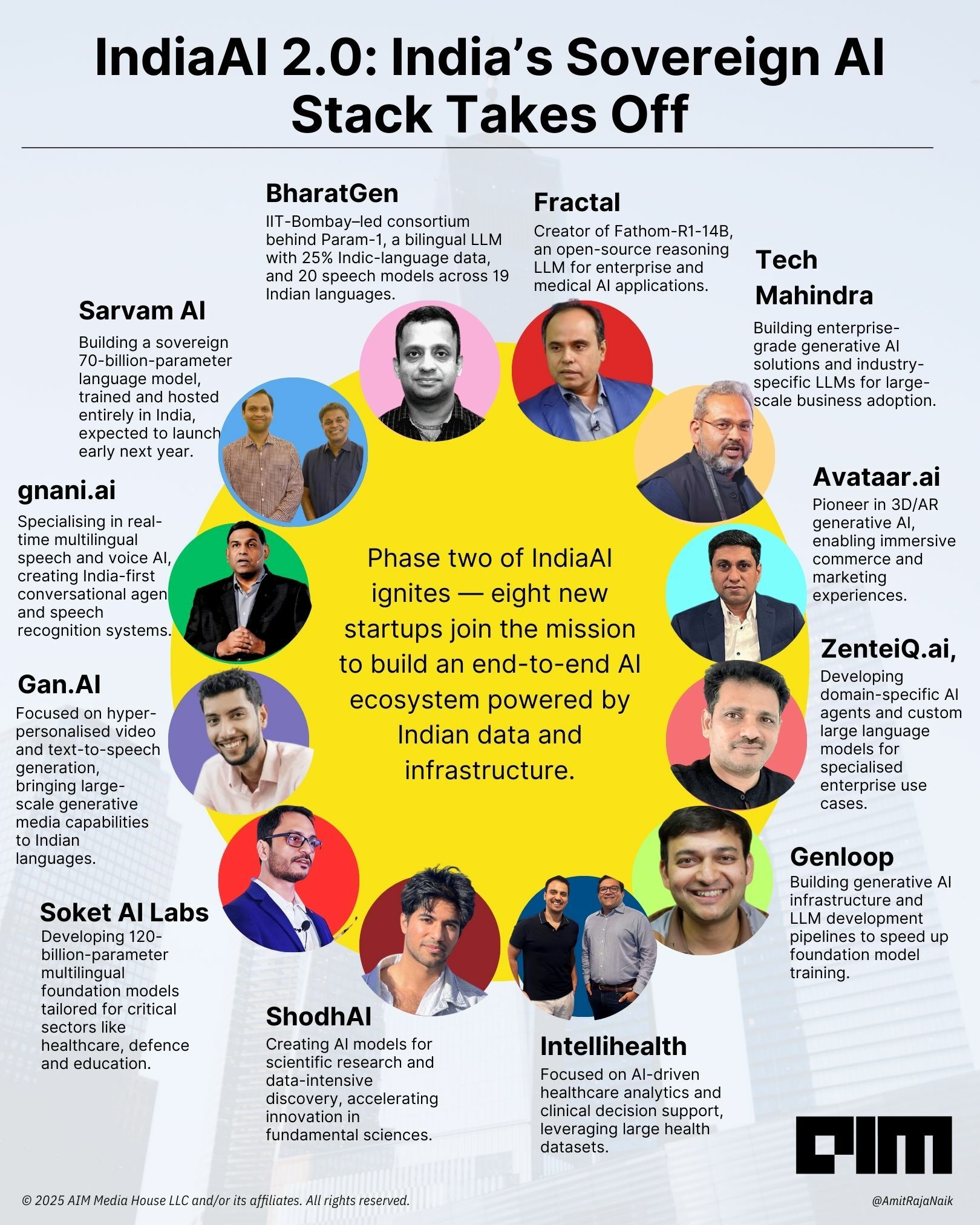
A few years ago, the idea of India building its own end-to-end AI stack seemed like a distant dream. Fast forward to today, and that dream is crystallising into policy and infrastructure. The IndiaAI Mission, the government's flagship programme to seed home-grown AI, has entered its next chapter. The mission is signalling that India wants to own the entire AI value chain: from chips and compute to models and applications. This week, the Indian govt. unveiled its second phase of foundational model startups, bringing the total number to 12. The exciting move sets the stage for a truly sovereign AI stack, built, run and powered in India, for India and the world! |
|
|
|---|
|
IndiaAI Mission: Phase Two The Indian government is gearing up to onboard eight new players into its ecosystem, namely BharatGen, Fractal, Tech Mahindra, Avataar.ai, ZenteiQ.ai, Genloop, Intellihealth and ShodhAI, to join the original four: Soket AI Labs, Gnani.ai, Gan.AI and Sarvam AI. Each of these players is mandated to become a global top-five leader in their niche, whether that's in multilingual foundation models, speech AI or multimodal applications. Among the standouts, BharatGen has already launched Param-1, a 2.9-billion-parameter bilingual model with 25% Indic-language data, dwarfing Meta's Llama, which only has 0.01%. The IIT-led consortium has also released 20 speech models across 19 Indian languages on AIKosha. Meanwhile, Sarvam, one of the earliest grantees, has already trained its 24-billion-parameter Sarvam-M and is building a 70-billion-parameter sovereign language model, trained and hosted entirely in India and expected to roll out early next year.
[Must Watch] To learn more, check out this exclusive interview with Sarvam AI, which launched Samvaad, voice and chat AI agents on WhatsApp across 11 Indian languages, letting users switch seamlessly between text and live voice calls, exclusively on Front Page by AIM Network. |
|
The Compute BackboneModels at this scale need serious muscle. IndiaAI's compute pillar is already flexing with 40,000 GPUs, but the real horsepower is coming from private heavyweights. Take the case of Yotta. Once a quiet operator in the data centre sector, is now the country's largest GPU landlord. After deploying 8,000 NVIDIA H100s, it has already ordered 8,000 Blackwell B200 GPUs for early 2026. Yotta's ambitions are limited to renting out GPUs; it is building a sovereign GPU cloud, matching hyperscaler quality while staying Indian-owned and operated. This ensures that India's most critical models are trained on infrastructure governed by Indian law, keeping everything firmly between the nation's borders. Then there's NxtGen, proving what sovereignty looks like in action. It runs the Election Commission's national-scale IT systems entirely on open-source, government-controlled cloud infrastructure. By air-gapping open-source models such as DeepSeek on its own GPUs, NxtGen ensures data never leaves the country, even while leveraging global breakthroughs. Why It MattersA new Gartner report predicts that AI agents will dominate government adoption within the next five years. That means the next wave of public services, healthcare, education and citizen engagement, will run on AI agents. For India, sovereignty in this place isn't a matter of pride alone; it's about policy independence and data security in a world where AI is already a geopolitical weapon. Beyond Chips And RacksIndia's semiconductor mission has begun pilot production of GPUs, with commercial output expected within this financial year. But hardware is only one layer. The real test lies in mass adoption, getting enterprises, startups and government departments to embed Indian models in real-world workflows. For now, the foundation is solid: models rooted in Indian languages and culture, compute capacity growing by the month and a government-industry alliance that has few global parallels.
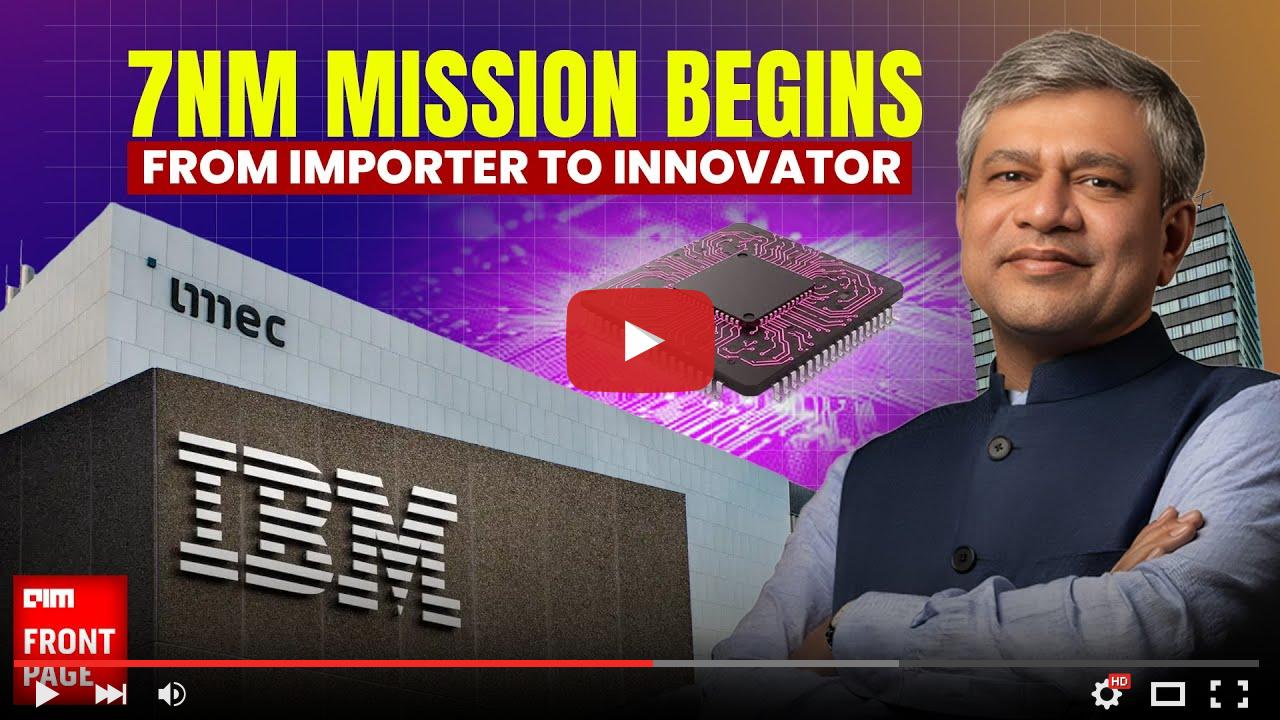
[Must Watch] India is racing to catch up in chip manufacturing with $18 billion worth of projects approved and 7 nm production targeted by the early 2030s, a move that underscores the geopolitical stakes of becoming a true chip power. |
|
The Bigger PictureIndia isn't closing itself off. As Yotta's Sunil Gupta puts it, sovereignty means "defining our own destiny while productively engaging with the world". India's sovereign AI stack will likely mix homegrown innovation with global collaboration, but the control and the narrative will remain in Indian hands. If you are not keeping a close eye on this shift, you are missing the making of India's next great technological revolution. Liked what you read? Share it with colleagues, friends, budding entrepreneurs, influencers, investors and everyone helping shape India's AI future. If you haven't subscribed to AIM Network (formerly AIM Tv) yet, now's the time. We break down the world of AI in real time, crisp, clear and always ahead of the curve.
While you are at it, here's a quick look at some of the top stories of the week. - AI is hollowing out Indian IT's middle layer: TCS's plan to cut 12,000 jobs, mainly mid-senior managers, as it shifts from waterfall delivery to agile, AI-driven workflows highlights a wider industry shake-up: coordination-heavy roles are disappearing while GCCs and IT giants hunt for deep product, data and architecture talent.
- Cash-rich but idea-poor, Indian IT faces its biggest reckoning yet: With the US HIRE Act threatening a 25% tax on outsourced services and AI automating traditional projects, India's $250-billion IT giants sit on over $20 billion in idle cash. But even experts warn that without bold product bets and deep-tech R&D, the services-led model and India's tech sovereignty could slip away.
- Groq's newfound obsession with MoE: By storing model weights directly in on-chip SRAM, Groq's Language Processing Units sidestep the memory bottlenecks that slow GPUs, making mixture-of-experts models, from DeepSeek to OpenAI's gpt-oss series, cheaper and faster to serve while delivering ultra-low-latency inference at scale.
Now, let's explore some exciting collaborations and exclusive insights from the AIM ecosystem, brought to you with a unique twist that goes beyond our standard editorial content. [Webinar Alert] Engineering Careers in the Age of AI & GenAI |
|
Join AIM and HCLTech on September 15, 2025 to discover how AI and GenAI are reshaping engineering roles, the new skills in demand, and why responsible AI will define the next decade, featuring insights from Ananth Subramanya (EVP, digital business), Prince Jayakumar (EVP and global head of talent acquisition) and Heather Domin (VP and head of responsible AI). Register now!
India's biggest AI summit and expo is almost here, Cypher 2025, September 17-19 at KTPO, Whitefield, Bengaluru! I'll be there all three days, see you all at Cypher. Come meet me to catch the latest AI breakthroughs and network with 5,000+ leaders shaping India's AI future. More details here. |
|
|
|---|
|
You received this email because you signed up to the updates from AIM. Click here to unsubscribe if you do not want to receive emails from us. |
|
|
|---|
|
|
|





Комментариев нет:
Отправить комментарий
Примечание. Отправлять комментарии могут только участники этого блога.