Let’s Make Every Vote CountAn analytical view on who gets to vote in America and what that means for our democracy
Welcome to our 4th installment of The Dividing Line. Today, we’re digging into voting and inequality. With the midterms just 12 months away, we’re about to see a massive rise in efforts to both expand and suppress the vote. Inequality in voting is one of the greatest threats to our democracy. While some states are pushing to give citizens their full right to vote — like Connecticut, Colorado, and Virginia — it seems like far more is being done to cut eligible voters out of the process. As states pass different laws that inhibit Americans’ to vote, we lose the ability to reflect the needs of our communities. The Supreme Court is currently reviewing the Voting Rights Act of 1965, which bans discrimination based on race when creating electoral maps. The growing divide in voting access and political ideology along geographic lines isn’t just a policy issue—it undermines the fairness and legitimacy of our electoral system.
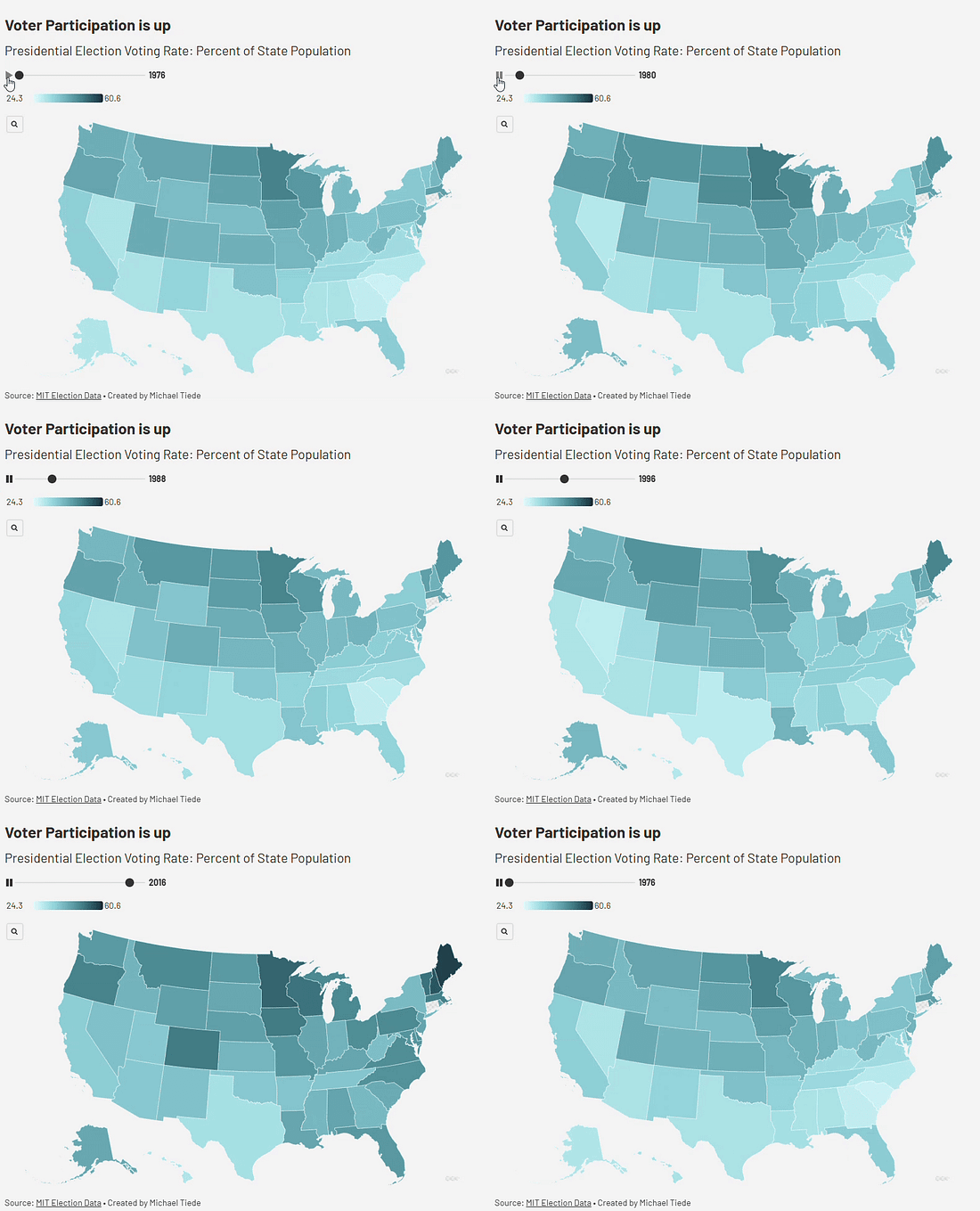
More People Are Voting, So We’re Happy About ThatSince 1976, voting participation has increased across the US, but not in every state. Minnesota and Maine are the only states to have an average voting participation rate above 50%. Hawaii (32.4%) Texas (32.7) and Nevada (34.5%) have the lowest average voting rates.
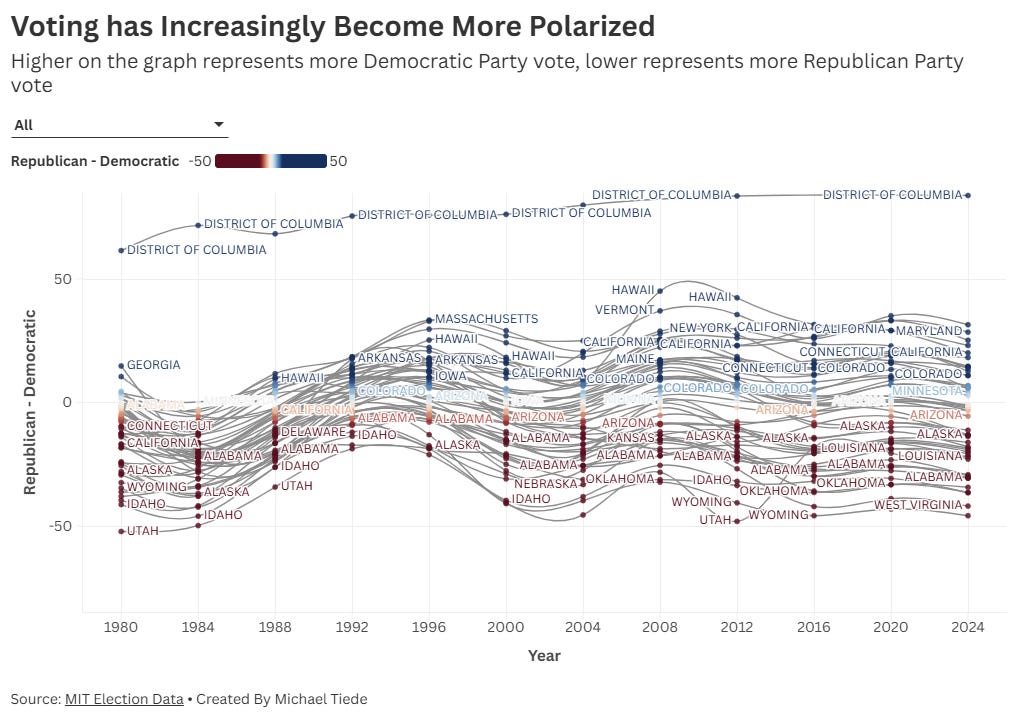
Though Voter’s Views within States are Becoming More PolarizedWhen examining voting trends by state over time, there is a distinct trend towards the extremes. In 1980 (Carter vs Reagan) states had a relatively similar voting margin (i.e. most states were 60/40). Compare that to more recent years and states have pulled further apart—red states are getting redder, and blue states bluer (i.e. more states are now 70/30).
For example Iowa — historically known as a swing state, has increasingly become more Republican – voting red the last 3 elections. Independent voters turned Republican as they felt the pain from deindustrialization that they blamed on Democrats. Gun laws and cultural messaging also seemed to resonate more with Iowa voters. But perhaps most importantly, The number of Republican registered voters has steadily grown in Iowa in the past 12 years while the number of Democrats has shrunk. California— known for its liberal policies, has an increasing percent of Democratic voters every year up until the 2024 election. This issue also highlights problems with the Electoral College—when fewer electorally pivotal, or “battleground,” states remain, a smaller portion of the U.S. population ends up having a disproportionate impact on the election outcome.
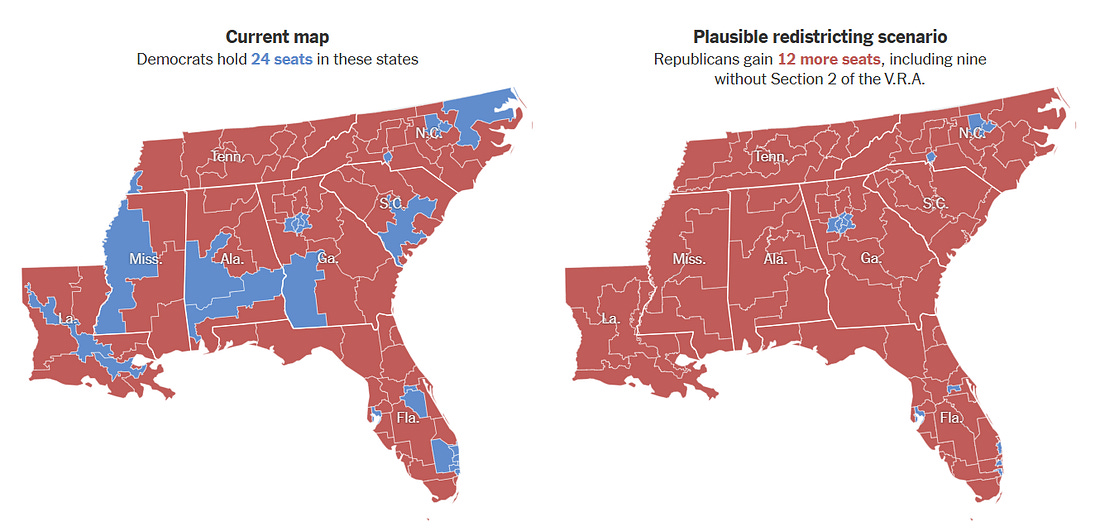
The Voting Rights Act is Under AttackThe Supreme Court seems prepared to strip a key provision of the Voting Rights Act, which banned discrimination based on race when creating electoral maps. Removing this provision would erase steps given to help minority voters choose a candidate of their choice, and expand electoral diversity and opinion. This comes at a time of electoral confusion, with Texas gerrymandering mid-cycle, and California responding with its own remapping with Prop 50. The Voting Rights Act has been a key limitation on gerrymandering, particularly in the South, as it bans voting practices that racially discriminate. The map below illustrates what could happen without Section 2 of the Voting Rights Act. At the End of the Day, it is Unclear How Well the System WorksDespite this polarization, our political system is still dominated by a two party system. Since 1976, only a few third-party candidates have received a meaningful share of the vote. How would our political ideologies shift if there was a strong third option to choose from? Would polarization decrease if people had more choices?
How has your state changed in voting? Examine the trends and see how each state’s political identity has shifted. Has your state flipped? Drifted? Stayed the same?
Closing ThoughtsA political system dominated by two parties naturally fuels polarization. While this is evident in presidential elections, it’s often even more pronounced at the state level. To maintain the support of their most loyal voters, politicians are rewarded for embracing extreme, polarizing positions. Reforms like ranked-choice voting and expanded ballot access help realign incentives toward mainstream voters. We must vote for leaders who prioritize unity, equity, and a future that improves the lives of all Americans. 5 Great Organizations to Connect with!
You’re on the free list for American Inequality. Consider upgrading to support this work, get access to the community chat, and doing your part to reduce inequality in America. Most sincerely, Jeremy
|
среда, 22 октября 2025 г.
Let’s Make Every Vote Count







Подписаться на:
Комментарии к сообщению (Atom)
Комментариев нет:
Отправить комментарий
Примечание. Отправлять комментарии могут только участники этого блога.