Поиск по этому блогу

Search1

123

среда, 7 января 2026 г.

AI, Lego & NVIDIA Take Over CES 2026

  -  
aim_new_logo-1-12
aim_new_logo-1-12

Sector6 
Jan 7, 2026

The bi-weekly newsletter by AIM that brings the biggest shifts shaping IT, AI, and GCCs.

AI, Lego & NVIDIA Take Over CES 2026

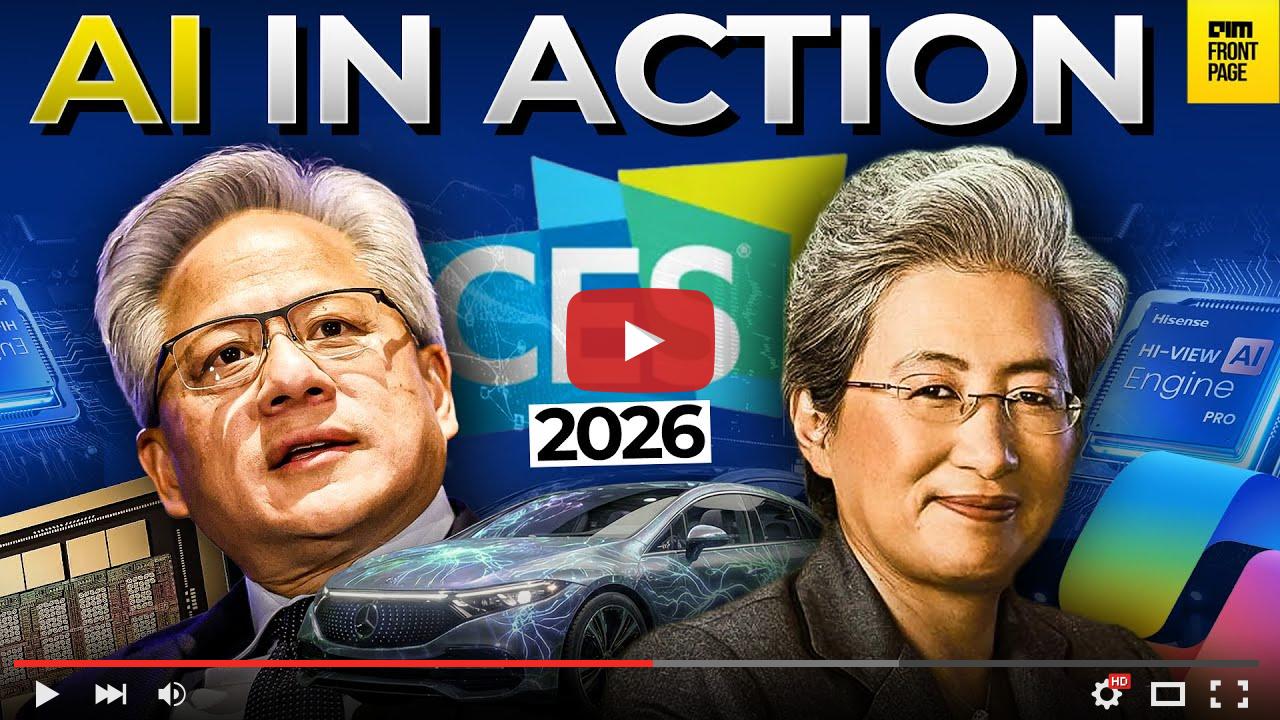
The event made one thing clear. AI has moved beyond being a feature added to products and has become the product itself. Across Las Vegas, almost every major announcement framed AI as core infrastructure, quietly embedded into screens, homes, cars, factories and chips rather than pitched as a futuristic add-on. 

By Mohit Pandey

CdpWuTjEC8A-HD
CdpWuTjEC8A-HD

NVIDIA entered CES with a level of confidence few technology companies can convincingly project. 

The company argued that models and infrastructure can no longer be treated as separate challenges. CEO Jensen Huang framed the moment as a genuine turning point for physical AI. "The ChatGPT moment for physical AI is here, when machines begin to understand, reason and act in the real world," he said.

To make that case, the company introduced open physical AI models designed for action, not just perception or language. 

Central to this was Alpamayo, an open vision-language-action model for autonomous driving that reasons through complex situations rather than reacting to patterns. "It allows autonomous vehicles to really think," Ali Kani, VP and general manager of the automotive platform at NVIDIA, said.

NVIDIA also released large driving datasets and simulation tools to accelerate deployment.

Hardware anchored the strategy. The new Vera Rubin platform was unveiled as a rack-scale system built for inference-heavy AI workloads. "AI is no longer about one-shot chatbots but intelligent collaborators," Huang said.

Intel wasn't far behind. It unveiled its Core Ultra Series 3 processors, or Panther Lake, introducing what it called its first AI PC platform built on the Intel 18A manufacturing process

The processors will power more than 200 PC designs and will begin shipping in consumer laptops later this month.

On AMD's part, Lisa Su opened her CES 2026 keynote address with a clear message: AI should be accessible to everyone. Backing that claim, the company unveiled the Ryzen AI 400 Series, the latest upgrade to its AI-powered PC chips. 

The processors deliver 1.3x faster multitasking capabilities and 1.7x faster content creation than competing chips. Each processor includes 12 CPU cores and 24 threads, positioning AI performance as a default feature rather than an add-on.

Meanwhile, a quieter but telling signal came from Lego.

AT CES, Lego explored how far physical play can stretch towards AI without breaking. The company unveiled Smart Bricks, Lego blocks filled with sensors that detect motion, distance and position, responding with sound and light as children build and play. The first Smart Play sets launch in March, starting with Star Wars. 

Lego described the launch as its most revolutionary innovation in nearly 50 years.

video_preview_eeb5df06ad6827f0d0c5869ce6da23b9.jpg

AWS AI Conclave 2026 in Bengaluru

Mohit_2026-The-Year-Software-Engineering-Will-Become-AI-Native

Amazon Web Services is gearing up to host the AWS AI Conclave 2026 on January 22 at the Sheraton Grand, Whitefield, Bengaluru, bringing together the brightest minds shaping the next era of AI. 

This edition will spotlight breakthroughs in agentic AI, autonomous systems, data strategies and enterprise-scale AI adoption, offering a front-row seat to the technologies redefining global innovation. Click Here to Register Now.


All of Consumer Tech

Consumer tech set the tone at CES 2026, and nowhere was this more evident than on the biggest screens in the room. 

Samsung showed a new generation of television displays in which AI works quietly in the background, handling image processing, colour accuracy and personalisation. These screens learn what people watch, when they watch and how they interact, then optimise themselves without ever asking.

Google took the idea a step further by embedding Gemini deeper into Google TV. Televisions are evolving into creative devices, turning the living room into an interactive space by default.

That logic flowed naturally into the smart home. Appliances are being rebuilt as AI systems that communicate with each other. 

  • Refrigerators that summarise food habits. 
  • Washing machines that adjust cycles on their own. 
  • Vacuum robots that map homes with increasing autonomy. 
  • Voice assistants shifting away from command-and-response towards ambient systems that remember context across devices.

Amazon offered a glimpse of just how far that idea is spreading. Alexa is no longer just a speaker. It is expanding into browsers, cars, wearables and security systems. Assistants are starting to look less like apps and more like operating layers.

Robotics was where AI clearly crossed from promise into deployment. Humanoid robots were presented as near-term workers.

LG introduced its home robot as a household coordinator that handles chores and manages appliances with minimal supervision

On the industrial end, Boston Dynamics confirmed production timelines for humanoids designed to work inside factory environments, with AI models focused on perception, balance and manipulation rather than scripted movement.

Automotive announcements echoed the same shift. Cars were discussed less as vehicles and more as software platforms on wheels. Sony Honda Mobility showed how AI is being woven into the cabin experience, sensing, entertainment and driver interaction.

CES 2026 didn't feel like a showcase of distant future tech. It felt like a preview of products ready to think, coordinate and act.


The Future of Work 2026: Empowering People with AI 

Snowflake-Webinar-banner-copy

Snowflake and AIM invite you to an exclusive webinar exploring key trends in human-AI collaboration in 2026. The session will dive into real-world business impact, from faster approvals and improved sales efficiency to strategies for workforce upskilling in an AI-driven era. Click here to register now.

This thought-provoking discussion will feature insights from Sridevi Vadapalli, chief data scientist at Daimler Trucks Innovation Center India; Sudhakaran Selvaraj, delivery head for data engineering and data science at Ecolab; and Monika Kapoor, executive director, and head of data and analytics at AstraZeneca.


Best Firm for Data Scientists – Showcase your leadership in data science and build a thriving workplace. Apply Now

Join AIM Leaders Council – Connect with top data leaders and shape the future of AI. Check Eligibility

Our Events – Be part of an exclusive event uniting North America's top data leaders. More Details

AIM PeMa Quadrant – Discover the best in AI and data services with AIM's PeMa Quadrant. Explore Now

GCC Explorer Unlock Exclusive Insights into 1400+ Global Capability Centers (GCCs) in India with AIM Research's Comprehensive Database.  Access GCC Explorer


Stay ahead with these insights, and join us in driving the future of data science and technology. Your active engagement and participation are what make our community thrive.


For Brand Collaborations, Contact us at info@aim.media

To unsubscribe from future emails, simply click the "unsubscribe" link AIM. Unsubscribe

© Copyright, 2026, AIM • 1st Floor, Sakti Statesman, Marathahalli – Sarjapur Outer Ring Rd, Green Glen Layout, Bellandur, Bengaluru – 560103

AIM-logo-black
AIM-logo-black
  -  

Комментариев нет:

Отправить комментарий

Примечание. Отправлять комментарии могут только участники этого блога.