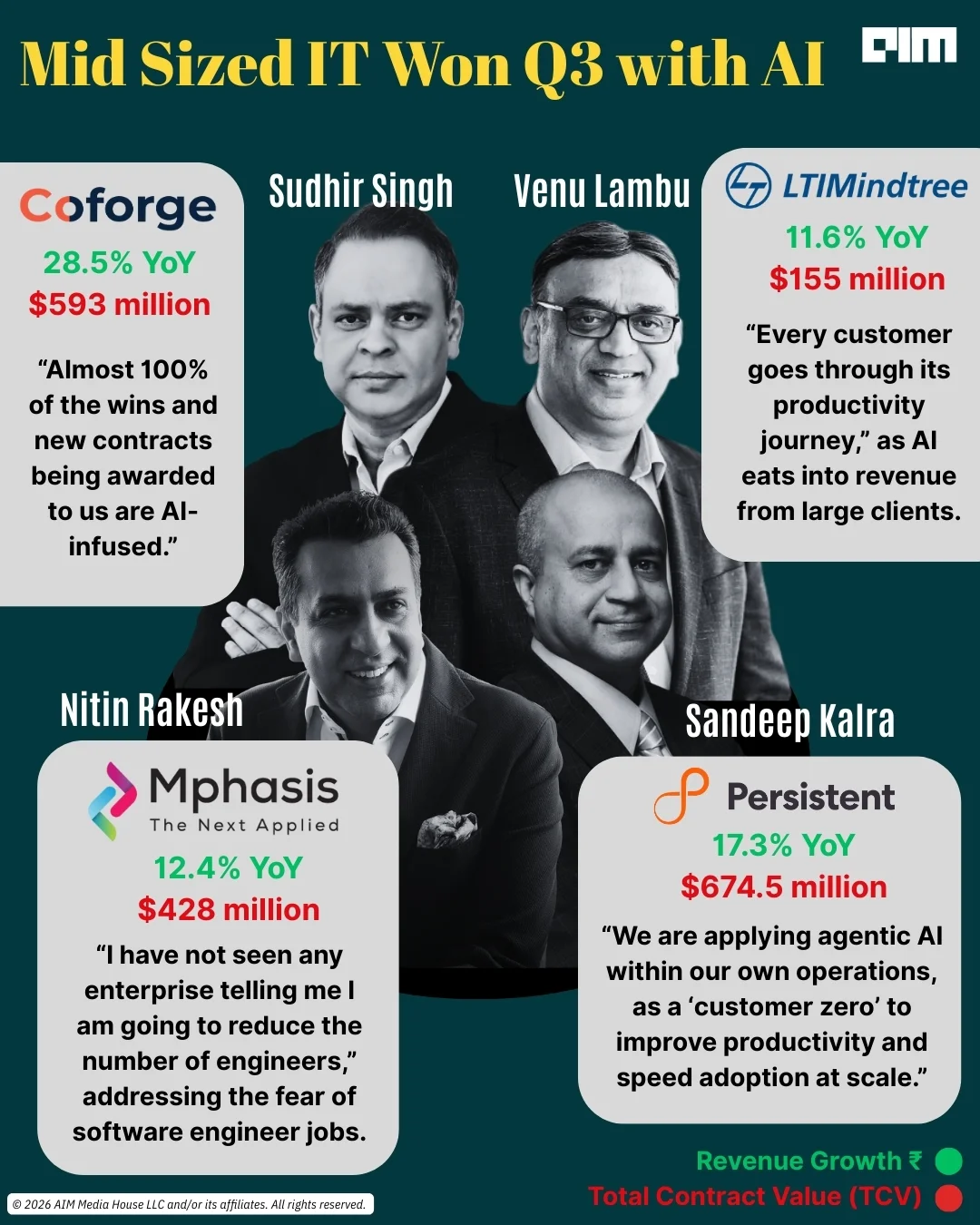
Mphasis and the Fight Against Cheap AI If Coforge projected confidence, Mphasis projected caution. Revenue rose 2.6% sequentially and 12.4% year on year to a little over ₹4,000 crore. The growth was not the real story. Pricing was. "The race to the bottom is a very risky race," chief executive Nitin Rakesh said after the results. "'Let's cut the price' is a very discreet conversation. You have to fundamentally go after redoing how you deliver the service itself." Rakesh's warning cuts to the core of AI's impact on IT services. Clients are no longer satisfied with optimising people's costs. They want to reduce effort, especially in run operations. There is a limit to how much cost can be cut through optimisation alone, he said. The real question, according to him, is whether 30-40% of the roles required to do this work can be eliminated altogether. Mphasis, however, still bills largely through traditional models. Time and material contracts make up 46.8% of revenue, fixed-price contracts contribute 44.8%, and transaction-based work makes up 8.4%. There is still little clarity on the exact AI work that these firms are doing, but that is a story for another time. Yet, clients are already measuring productivity. One customer set GitHub metrics for contractors. They still pay by the hour, Rakesh said, but expect outcomes powered by AI. He also pushed back against fears that software demand would collapse. Legacy systems, he argued, still represent a hundred billion-dollar opportunity. "I have not seen any enterprise telling me I am going to reduce the number of engineers," he said. "What they are telling us is I have a backlog that goes out two years." Persistent and LTIMindtree Run Ahead Persistent and LTIMindtree delivered the clearest growth surprises of the quarter. Persistent closed with $422.5 million in revenue, up 4.01% sequentially and 17.3% year on year. LTIMindtree reached $1.2 billion, growing 2.4% sequentially and 6.1% from last year. More quietly, both outpaced four of the Big Five. TCS grew 0.6%, Infosys 0.5%, Wipro 1.2%, and Tech Mahindra 1.5%. Only HCLTech moved faster. For once, mid-caps were the growth story. "This confidence is supported by our execution discipline, improved deal momentum, and the traction we are seeing across our AI-led offerings," LTIMindtree chief executive Venu Lambu said. Persistent flagged strong demand from banks and healthcare, where data modernisation and application revamps are finally turning into contracts. "We are also applying agentic AI within our own operations, as a 'customer zero' to improve productivity and accelerate adoption at scale," CEO Sandeep Kalra said. The tone stood in contrast to the large firms, which continue to warn of weak demand and low single-digit growth for a third straight year. But this growth came with a regulatory bill attached. Persistent's operating margin fell 190 basis points to 14.4% after a one-time ₹89 crore labour code charge. LTIMindtree took a much heavier hit: labour codes wiped out ₹590 crore. Margins crashed to 10.6%. Without the charge, they would have risen to 16.1%. | 





Комментариев нет:
Отправить комментарий
Примечание. Отправлять комментарии могут только участники этого блога.