Поиск по этому блогу

Search1

123

понедельник, 2 июня 2025 г.

Why NO Stargate in India?

  -  
AIM-logo-black
AIM-logo-black

Why NO Stargate in India?

THE BELAMY

WEEKLY NEWSLETTER OF AIM

Monday, Jun 02, 2025 | By Siddharth Jindal


Big moves are happening in the world of AI infrastructure. While India pushes ahead with its sovereign AI stack under the IndiaAI Mission, OpenAI is exploring data centre deals across Asia under its new initiative called OpenAI for Countries.

This isn't just about APIs or models anymore. It's about owning the full AI stack—compute, chips, data, and influence. So, what does this mean for India's AI plans? Is it a threat or a boost?

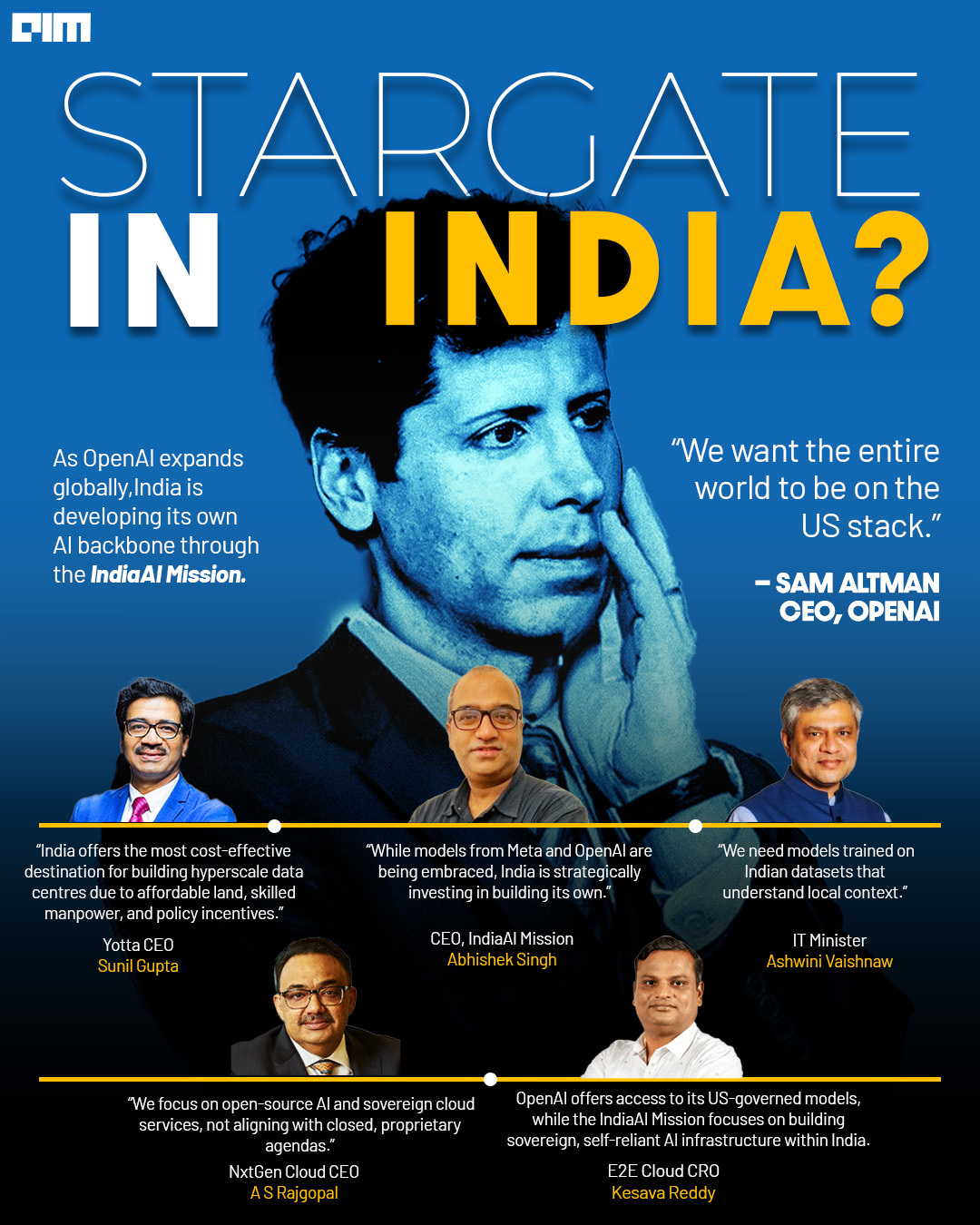
stargate_infographioc

OpenAI Wants the World on the US Stack

OpenAI is no longer just a research lab. With initiatives like Stargate UAE, it's laying down some serious infrastructure. In Abu Dhabi, it's already building a 1-gigawatt AI compute cluster with G42, Oracle, NVIDIA, SoftBank, and Cisco, hosted at the UAE–US AI Campus.

This is part of a broader plan, in which OpenAI is also exploring data centre opportunities across Asia, including India, South Korea, Singapore, and Japan. Its data residency option allows organisations to store customer content locally when using its enterprise APIs and ChatGPT services.

Sam Altman has been clear: he wants the entire world to be on the US stack, running on US chips and tools like ChatGPT. His vision is a unified AI system governed by US tech infrastructure.

Before we discuss India's AI efforts, let's review some of the week's top stories.

  • Google is ramping up support for India's AI startup ecosystem through its Google for Startups Accelerator and a partnership with MeitY Startup Hub to train 10,000 AI startups. In an exclusive AIM interview, Google India leaders Paul Ravindranath and Karthik Padmanabhan shared how the company selects and supports startups, why depth of expertise matters more than ever, and what it means to build with or around Google in India. Click here to read the full story.
  • NVIDIA risks losing $8 billion next quarter as US chip export restrictions cut it off from China's booming AI market. CEO Jensen Huang warned that the move boosts rivals like Huawei, which is rapidly advancing its AI chips. Read the full story here.
  • Infosys, Wipro, HCLTech, Tech Mahindra, and Cognizant have appointed dedicated leaders for their GCC businesses, moving from quiet execution to strategic focus. With India projected to host over 2,400 GCCs by 2030, IT firms are positioning themselves as partners, co-building innovation hubs and large-scale transformation deals rather than viewing GCCs as rivals. Read the story here.

India Builds Its Own AI Stack

India isn't waiting around while the world builds foundational AI. Through the IndiaAI Mission, the government is investing INR 10,372 crore to create a sovereign AI compute cluster. Our current capacity includes 18,000 GPUs through public-private partnerships. As announced by IT minister Ashwini Vaishnaw, the plan is to scale up to 34,000 GPUs soon. 

The mission goes beyond building infrastructure alone—it's about the ownership of models, data, and deployment. India is placing its bets on open-weight models, publicly funded datasets, and sovereign cloud deployments.

Under the IndiaAI Mission, three more startups, namely Soket AI, Gnani.ai, and Gan.AI, have been selected to develop indigenous foundation models. This brings the total to four (including the previously announced Sarvam AI).

Also, seven companies just cleared the second round of GPU tenders. Names like Yotta, Netmagic, Sify, and Cyfuture are in the mix.

openAI-stargaten-india-

OpenAI Divides India's Cloud Ecosystem

Indian cloud firms split on OpenAI partnerships amid push for AI sovereignty.

Yotta CEO Sunil Gupta told AIM he is open to working with OpenAI, but made it clear that the IndiaAI Mission is rooted in sovereignty. Yotta is already running over 8,000 NVIDIA H100 GPUs, with B200 and GB200 Blackwell chips on the way, and offers subsidised rates of under INR 100 per hour.

In contrast, NxtGen Cloud is not interested in partnering with OpenAI. CEO Rajgopal A S said the company is committed to sovereign cloud and AI. He believes the future of AI lies in open source, and the company is not interested in aligning with closed, proprietary agendas.

E2E Cloud's Kesava Reddy draws a clear line. He said that OpenAI for Countries offers access to proprietary tools governed under US jurisdiction. IndiaAI is building for Indian laws, languages, and local needs. Still, if OpenAI sets up Stargate in India, E2E is open to engaging with them.

The sentiment is mixed—some are ready to engage, others see OpenAI's stack as a risk to independence.

Before moving ahead, let's explore some exciting collaborations from the AIM ecosystem.

[Webinar Alert] The Rise of AI Agents: Explore OPEA with Intel

Intel-Webinar-June-2025

Join us on June 5, 2025, for a live webinar led by Dr Shriram Vasudevan, titled 'Building and Deploying AI Agents with OPEA'. This session will offer a hands-on introduction to OPEA's open-source, enterprise-ready architecture and unique approach to intelligent AI agents. Click here to register.

Tackling GenAI's performance and cost challenges, AIM and Intel present a session on full-stack optimisation—hardware to software—with AI expert Anish Kumar on June 26. Click here to register. 

Coming back to our discussion…

Reliance Could Tip the Scale

There's one Indian player that could change the entire game, and it's none other than Reliance Jio.

With deep pockets and infrastructure muscle, Reliance is already developing a massive 3 GW data centre in Jamnagar. OpenAI and Meta are reportedly in talks with Reliance. If a deal is signed, ChatGPT could become far cheaper and more accessible in India.

Analytics-India-Magazine-banners-2024-10-26T131537

Sounds good for users, but it raises a question: What happens to IndiaAI?

SarvamAI received backlash for building its latest model, Sarvam M, on top of Mistral. If OpenAI's stack goes mainstream, will local models stand a chance?

The Bigger Picture

In an earlier conversation with AIM, IndiaAI CEO Abhishek Singh said that while models from Meta and OpenAI are being embraced, India is also strategically investing in building its own foundational models trained on Indian datasets. 

Moreover, in a panel discussion, IT minister Ashwini Vaishnaw made a pointed remark, saying that OpenAI went closed-source after GPT-2 and others might do the same. "We should also change [OpenAI's] name," he joked. 

Control or Convenience?

India now stands at a crossroads. On one side is the OpenAI promise—fast access, powerful tools, and global partnerships. On the other is a long-term bet—build at home, stay sovereign, and control your stack.

Choosing OpenAI may plug today's compute gap, but it could also lock India out of the driver's seat tomorrow. The question isn't just who runs the best models, it's who gets to decide the future of AI for 1.4 billion people.


For Brand collaborations, write to info@aimmediahouse.com

You received this email because you signed up to the updates from AIM. Click here to unsubscribe if you do not want to receive emails from us.

  -  

Комментариев нет:

Отправить комментарий

Примечание. Отправлять комментарии могут только участники этого блога.