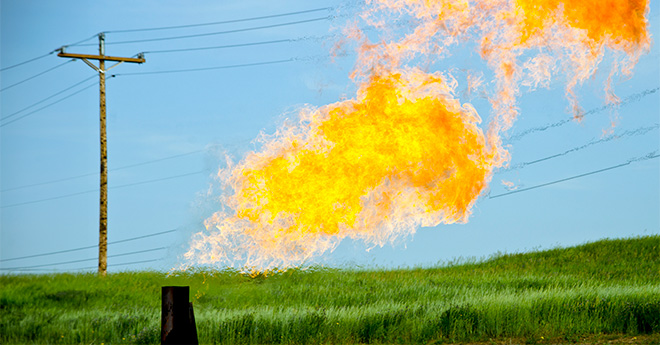
| | What Americans think about climate change As global warming accelerates, it's beginning to impact even those who haven't yet given climate change much thought. And that may be changing some minds. A recent report from the Pew Research Center examines how Americans think climate change will affect their communities in the coming decades, and the outlook isn't great. While opinions differ according to age, geography, and political affiliation, almost three-quarters of those surveyed (71%) believe climate change is already causing at least some harm to people in the US. And 41% think their communities will be worse in 30 years, with majorities citing risks of heatwaves, rising sea levels, and drought as key hazards. Per the survey, Americans aren't particularly optimistic that we'll be able to ease the harms of climate change (perhaps because 79% of respondents are frustrated "that there's so much political disagreement on the issue"). But they do expect they'll need to make "major changes to everyday life," including major (23%) or minor (48%) sacrifices. Still, it's not all bad: while skeptical that new technologies will be able to solve most problems associated with climate change, a "majority (57%) expects that renewable sources will produce most of the country's energy in 30 years," and larger minorities think that tech like geoengineering and carbon capture will also likely play a role. But one of the biggest takeaways is how powerless Americans feel: only about a quarter think that individuals can do "a lot" to mitigate climate change. Most believe the real agents for change will be the energy companies, big businesses, government agencies, and cities and communities—and as we've seen, getting them to support and implement greener practices will be a true endeavor. + A new study has found that "damage caused by the climate crisis through extreme weather has cost $16m (£13m) an hour for the past 20 years." That devastation is also fueling "a booming, and dangerous, disaster-restoration industry." + Here's the US government's Fifth National Climate Assessment. + From TIME: "Beyond the Hockey Stick—What We're Missing When We Talk About Climate Change" | | | | | Harnessing tipping points to our advantage Climate tipping points—those pivotal moments when a critical mass is reached, sweeping in inescapable change—are usually cause for dismay: today scientists, activists, and other concerned observers are watching the melting of the Antarctic ice sheet and Greenland's glaciers, the slow collapse of the North Atlantic current, and the destabilization of the Amazon rainforest with shock and horror. But other tipping points, like the 5% "new sales" rate for EVs, show that we're on the right path. As Katarina Zimmer explains in Noema: In the same way that melting begets melting for Greenland's Jakobshavn Glacier, green technologies can also spread in a self-reinforcing manner. And once they pass that tipping point where they're more attractive than their fossil fuel incumbents, they can take over the market. . .Governments can accelerate these tipping points with policies that make greener options more viable. In her insightful piece, which draws from the work of climate scientist Tim Lenton, Zimmer explores some of these "positive" tipping points and discusses how governments might harness them to both meet their climate goals and address some of the more pernicious social issues that climate change is exacerbating. It's an interesting read that shows how consumption, policy, and incentives interact in a range of sectors to produce the outcomes that will help our world weather the climate crisis. + From SciTechDaily: "New Research—The World May Have Crossed a Solar 'Tipping Point.'" + From the Washington Post: "How Soon Do You Have to Buy Heat Pumps and EVs to Avoid Climate Catastrophe?" + From the Verge: "Clean Energy Is Officially 'Unstoppable' Now." + Here's Nick Hedley on "how Portugal got to 75% renewable electricity." | | | | | Will we ever get a small EV truck in the US? "Bad vibes" aside, there's a lot going right in the car industry at the moment. The UAW has reached tentative deals with each of the Big Three car manufacturers, ensuring that EV jobs will remain good jobs for the time being. (And those jobs, while different, will still likely require just as many, if not more, workers .) Although EV sales are slowing as early adopters have all adopted, demand is still high. Unfortunately, so are prices, particularly for the huge cars and trucks that top the sales charts in the US. Heatmap's Andrew Moseman is more interested in a small electric pickup , the kind they don't seem to make anymore—at least for the US market. He found it in the Toyota Hilux REVO EV, but that model (at the moment just a one-off demo) is unlikely to ever make it to US shores, clashing as it does with what people want, or more accurately, with what car companies think people want. But as Moseman asks, "Are we really sure a smaller EV truck can't succeed here?" In fact, as he argues, a pint-size EV pickup might just help us rethink what it is we really need from our cars: The EV market—at least for now—doesn't look a lot like the overall American auto market. And maybe that's an opportunity for the forsaken car shapes to stage a comeback. Chevrolet looked like it would kill off the plucky Bolt to make way for electrified SUVs and trucks. Amid steep headwinds in that effort, the brand says the Bolt is coming back. A reasonably sized pickup truck could be just the ticket for the urban dwellers who are actually interested in buying EVs. + As we transition to a majority EV world, we need to be sure that EV growth doesn't come at the expense of other greener, more equitable options. Like high-speed rail, which Spain is putting to great use. + One hiccup: the growing demand for clean energy to power all those EVs means we're going to need a lot more utility poles, and right now, that means old-growth trees. | | | | | Less regulation means more emissions At least that's what new satellite data gathered by French climate tech company Kayrros suggests. The imagery, shared with the Guardian, shows that "oil and gas production in Texas is spewing out double the rate of methane, a powerful greenhouse gas, than in the more regulated state of New Mexico." As the Guardian 's Oliver Milman notes in his write-up of the data, oil and gas production on the whole has contributed to a "surge in methane emissions in the past two decades, posing a major threat to efforts to contain dangerous global heating." The silver lining to all this is that the satellite images prove tighter regulations work—and in the case of New Mexico, they do so "without hurting business." Cutting methane emissions would have an immediate impact, equal to "removing all cars and trucks from the road," as Kayrros CEO Antoine Rostand explains. But in the US, better regulation may come down to whether an upcoming EPA proposal to reduce pollution in the oil and gas industry can sail through political headwinds. + Here's US Secretary of Energy Jennifer Granholm on "cleaning up 'clean' energy," in conversation with the Verge's Justine Calma. + The startup Graphyte is experimenting with a method to sequester carbon from plant waste through the creation of carbon bricks." | | | | | What Kiel can teach us about waste Kiel, Germany, has been certified a "zero waste" city by Zero Waste Europe. In the Guardian, Ajit Niranjan recaps some of the municipality's "weird and workable plans. . .to deal with its trash." Spoiler alert: they involve sorting (and recycling) a lot of waste. But as Niranjan shows, recycling is only one of many solutions, the primary among them being to just create less trash in the first place. | | | | | | —Tim O’Reilly and Peyton Joyce | | | |



Комментариев нет:
Отправить комментарий
Примечание. Отправлять комментарии могут только участники этого блога.