2025: The Year the Vibe Shifted |
|
|
|---|
|
Earlier this year, I attended a sprint review at a payments company, and the overall mood was noticeably calmer than in previous years. I watched a senior software engineer prototype complex fintech workflows in real time with AI assistance. He casually mentioned that 30% of his code is now written by AI. |
|
The engineer didn't seem worried about his job. Instead, he appeared confident. And the fintech company started to refer to its "coders" as "builders." Months later, this same "builder" energy was witnessed at the very top of the tech ecosystem. Microsoft chief Satya Nadella took to the stage in Bengaluru, not appearing as the CEO of a $3.5 trillion company, but rather as a developer who had been hacking all night. While the world was off for Thanksgiving, he was building an LLM Council, a multi-agent reasoning system in which models like GPT, Claude, and Gemini debate to reach a better answer. "It's just fun to be able to play with GitHub and just be constantly modifying," Nadella said. By 2025, vibe coding had entered the tech lexicon as casually as "googling" once did. A new wave of developers enjoys collaborating with AI, sketching out their intentions, steering the direction, fine-tuning the tone, and then trusting the system to complete the rest. With tools like Replit and Lovable, functional apps can be generated in minutes, collapsing the barrier to entry. We aren't just searching or chatting anymore; we are orchestrating. If 2024 focused on establishing multimodal foundations, 2025 marked the year when AI started to think, act, and plan alongside us. |
|
|
|---|
|
From Research to Reality In Big Tech, the spending told the story. OpenAI raised $40 billion in early 2025 and pushed out GPT-5.2 and a new image model. Google doubled down on infrastructure, investing roughly $15 billion in India to build data centres. The company also pushed the boundaries of visual synthesis with Nano Banana Pro, enabling hyper-realistic image generation and the rendering of long, clear text within visuals Apple moved the AI conversation closer to the edge with its M5 chip and a new C1 chipset. NVIDIA briefly touched historic market capitalisation levels, underlining just how central compute had become. Oracle and OpenAI signed a $300 billion cloud deal that made one thing clear: AI ambition without infrastructure was no longer credible. At some point in 2025, the debate moved away from model demos and benchmark theatrics and settled on data centres instead. Power, land, cooling, chips, and long-term contracts became the real talk points. The question was no longer who had the most innovative model, but who could actually run it at scale. While the "AI bubble" has yet to burst, its full and significant impact is only now becoming apparent, with consequences that will likely resonate throughout 2026. In boardrooms and earnings calls, AI ambitions moved beyond software narratives to infrastructure led executions and enterprise adoption where AI became embedded into how companies operate. As Anand Sahay, Global CEO at Xebia put it, "Xebia transformed AI into an enterprise operating layer. Software delivery, operations, and data access were rebuilt with AI at the center. What makes it unique is integration. AI runs across the lifecycle, acts autonomously, and operates on unified, trusted enterprise data." AWS AI Conclave Bengaluru |
|
Amazon Web Services (AWS) is gearing up to host the AWS AI Conclave 2026 in January at the Sheraton Grand in Bengaluru, bringing together the brightest minds shaping the next era of AI. This edition will spotlight breakthroughs in agentic AI, autonomous systems, data strategies and enterprise-scale AI adoption, offering front-row seats to the technologies redefining global innovation. Click Here to Register Now Simulated Reality >> |
|
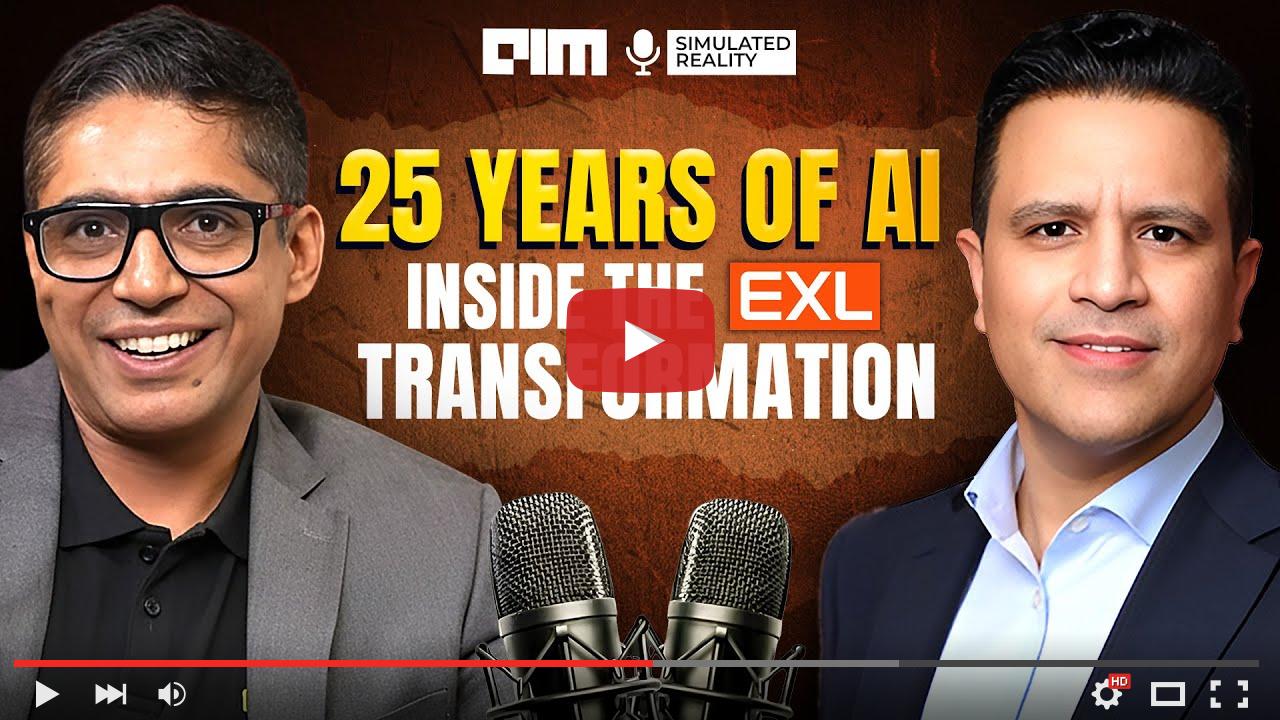
Join us for an exclusive interview with Andy Logani, executive vice-president and chief digital and AI officer at EXL, a global data and AI company. Andy details EXL's incredible 25-year journey from a business process operations company to a data and AI powerhouse, with 55% of its revenue now stemming from data and AI. |
|
Where AI Got Real In India, startups like Gnani.ai pushed into specialised voice models, while 12 AI startups were selected under the IndiaAI Mission. AWS picked three Indian startups for its GenAI accelerator. Karnataka approved a policy to seed 25,000 startups over five years. At the same time, deep tech edged closer to reality. TSMC crossed a $1 trillion market cap, India's Deep Tech Alliance committed ₹7,500 crore with NVIDIA onboard, ISRO and NASA launched SpaDex, QPiAI rolled out quantum systems, and India announced a ₹1 lakh crore Research and Development Initiative scheme, signalling a shift from experimentation to capacity-building. As 2025 comes to an end, it's clear that AI has already changed how we work and build. If this was the year the vibe shifted, looking ahead, 2026 will shape up to be the year AI moves from models that talk to systems that execute. Happy New Year, and keep building. |
|
As AI moves from experimentation to real-world deployment, developers are increasingly grappling with practical questions around infrastructure, performance and workflows. An invite-only Dell x NVIDIA Developer Meetup, in association with AIM, on January 23, 2026 in Hyderabad, will bring together AI engineers, data scientists, enterprise teams, and leaders from Dell and NVIDIA to share applied perspectives on building beyond proofs of concept. Click here to register. |
|
|
|---|
|
You received this email because you signed up to the updates from AIM. Click here to unsubscribe if you do not want to receive emails from us. |
|
|
|---|
|
|
|






Комментариев нет:
Отправить комментарий
Примечание. Отправлять комментарии могут только участники этого блога.