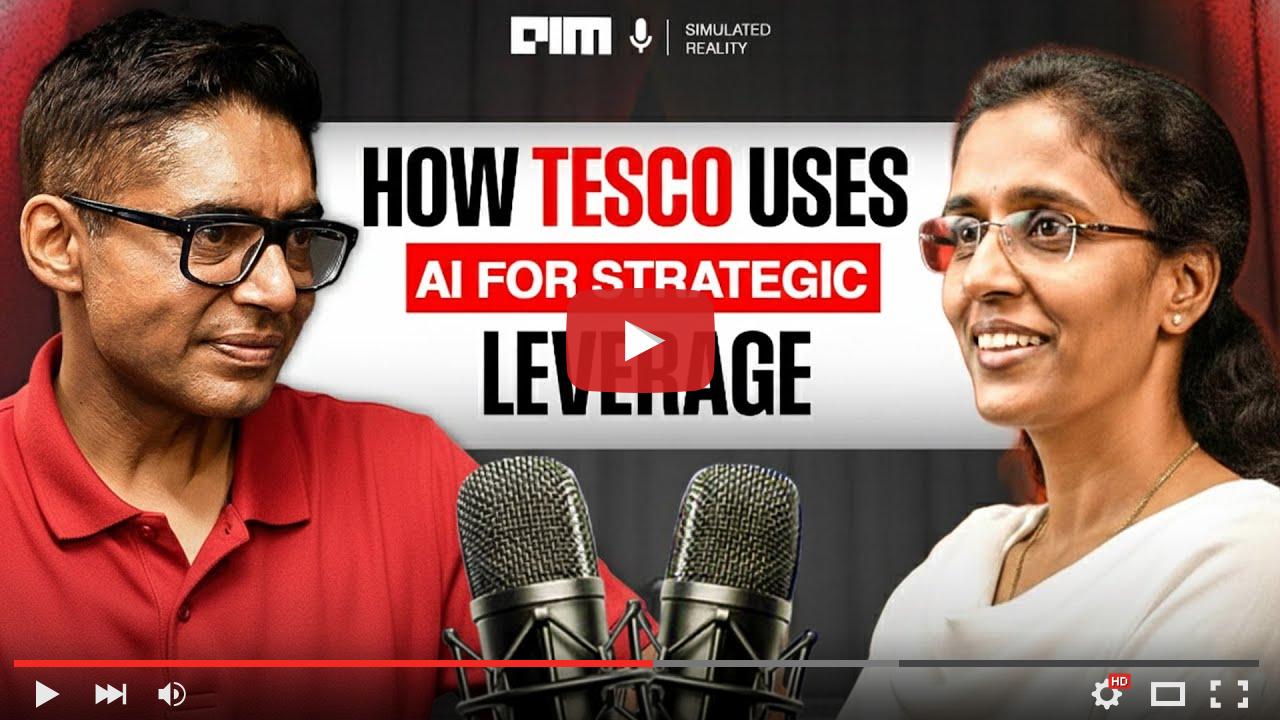
Priyadarsanie Ramasubramanian, director of engineering at Tesco, discusses the high-impact strategic journey of Tesco Business Solutions (TBS), exploring how it evolved from a traditional cost-saving back office into a global innovation engine that directly drives shareholder value. TBS has shifted from labour arbitrage to capability arbitrage, taking end-to-end accountability for core enterprise results. That reset has been most visible in the stock market. Recent headlines have painted a rather grim picture of SaaS company stocks. In early 2025, the SEG SaaS Index, which tracks a basket of public SaaS vendors, fell sharply while broader indexes moved higher. According to Finerva, investor enthusiasm has shifted decisively from 'vanilla' SaaS to AI startups and platforms. As the firm notes "the speculation and hype have migrated to AI". Companies lacking a compelling AI narrative or strong revenue acceleration have seen their valuations slip. Yet, the numbers tell a more nuanced storyA closer look at earnings reveal a different picture. At Oracle, cloud revenue reached $8.0 billion in Q2 FY2026, up 34% year-over-year (YoY). Infrastructure cloud surged 68%, while SaaS applications grew 11%. Oracle, once written off as a cloud laggard, is now benefiting from AI-driven demand for infrastructure and SaaS products. Salesforce, long the poster child of SaaS, has entered a more mature phase. In Q3 FY2026, subscription and support revenue rose 10% YoY to $9.7 billion. While the growth is slower, it is far from stagnant. More importantly, AI is beginning to matter. CEO Marc Benioff said Salesforce's AI portfolio, including Agentforce and Data 360, is nearing $1.4 billion in ARR, up 114% YoY. Agentforce alone crossed $500 million in ARR, growing 330% from last year. ServiceNow continues to deliver strong results. Subscription revenue hit $3.3 billion in Q3 2025, up 21.5% YoY, prompting the company to raise its full-year outlook and approve a five-for-one stock split. At Workday, Q3 FY2026 revenue reached $2.43 billion, up 12.6%, with subscription revenue growing nearly 15%. Workday is bundling AI agents into HR and finance workflows, betting on automation rather than experimentation. Then there's Zoho, the Indian bootstrapped outlier. The company now serves more than 100 million users and has crossed $1 billion in annual revenue. Public-market peer Freshworks is also showing steadier execution. In Q3 Fy25, the company reported $215 million in revenue, up 15% YoY, pointing to improving consistency after a volatile post-IPO period. Still, not everyone is convinced this success will be easy to replicate going forward. Y Combinator president Garry Tan has warned that the future of SaaS could look bleak, as vibe coding tools such as Replit can generate functional applications in minutes, lowering barriers to entry. That scepticism is already visible in the markets. Finerva data shows pure-play SaaS stocks underperforming the broader tech sector by late 2025. Industry analysts, however, see this as a reset rather than a reckoning. As IDC notes, SaaS is evolving toward AI-driven, outcome-based delivery models. Enterprises are already moving in this direction. Xebia measures AI success by outcomes, not deployments. Enterprise programmes have delivered two to four times faster innovation, three to five times productivity gains, and up to 40% cost reduction. Clients report multi-million savings, reduced workloads, revenue uplift and faster, more consistent customer experiences, Anand Sahay, Global CEO at Xebia, revealed. | 





Комментариев нет:
Отправить комментарий
Примечание. Отправлять комментарии могут только участники этого блога.