The Electricity Bills are Too Damn HighHow data centers and the decline of green energy are raising your utility bill
INTERESTING ON THE WEB
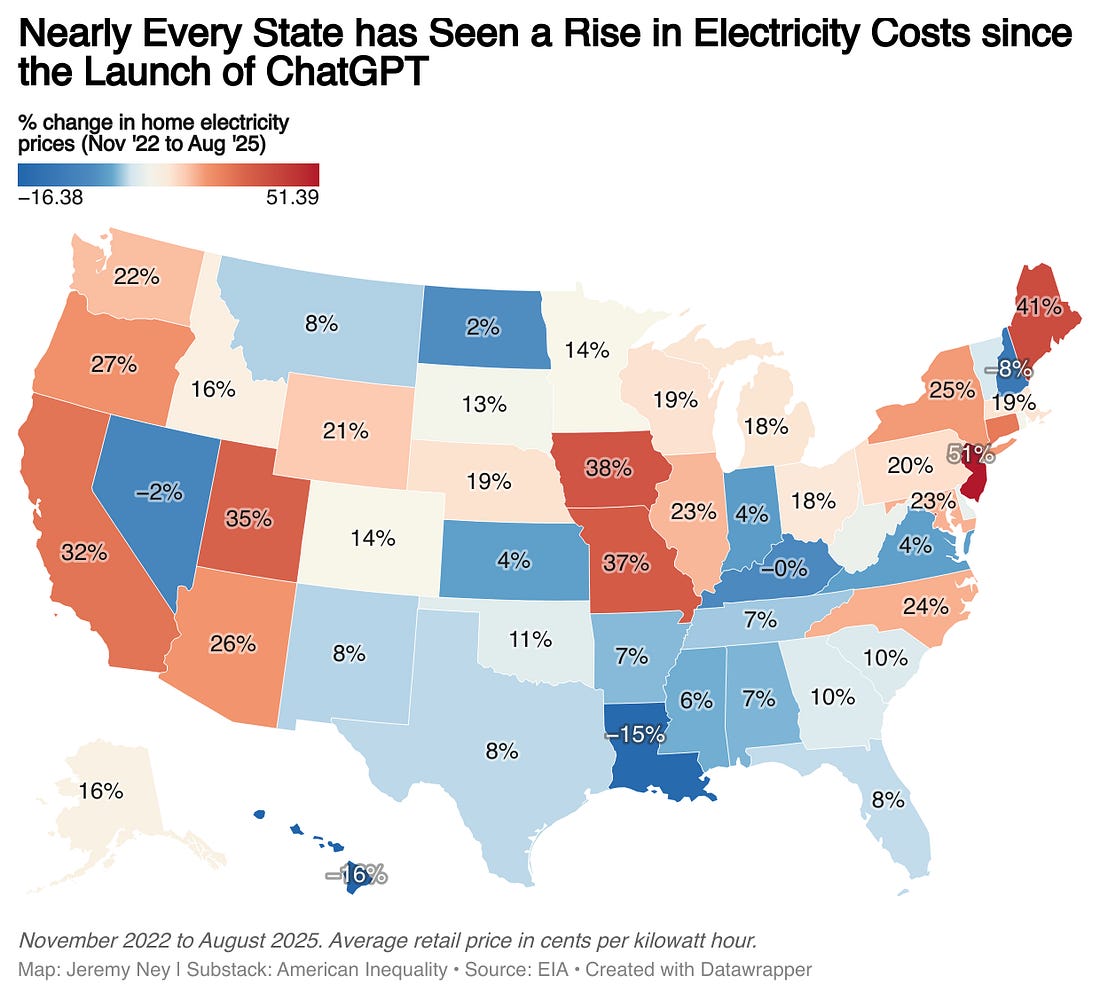
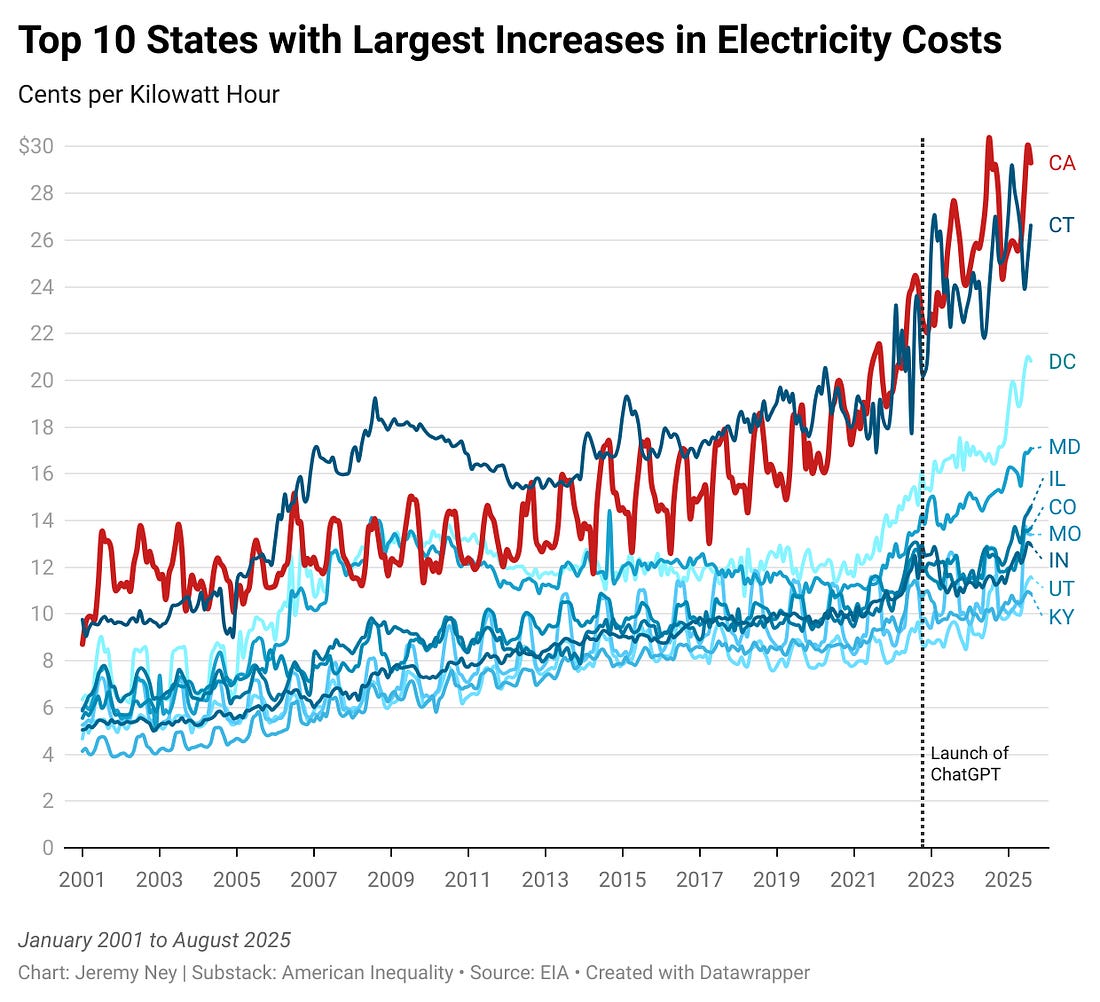
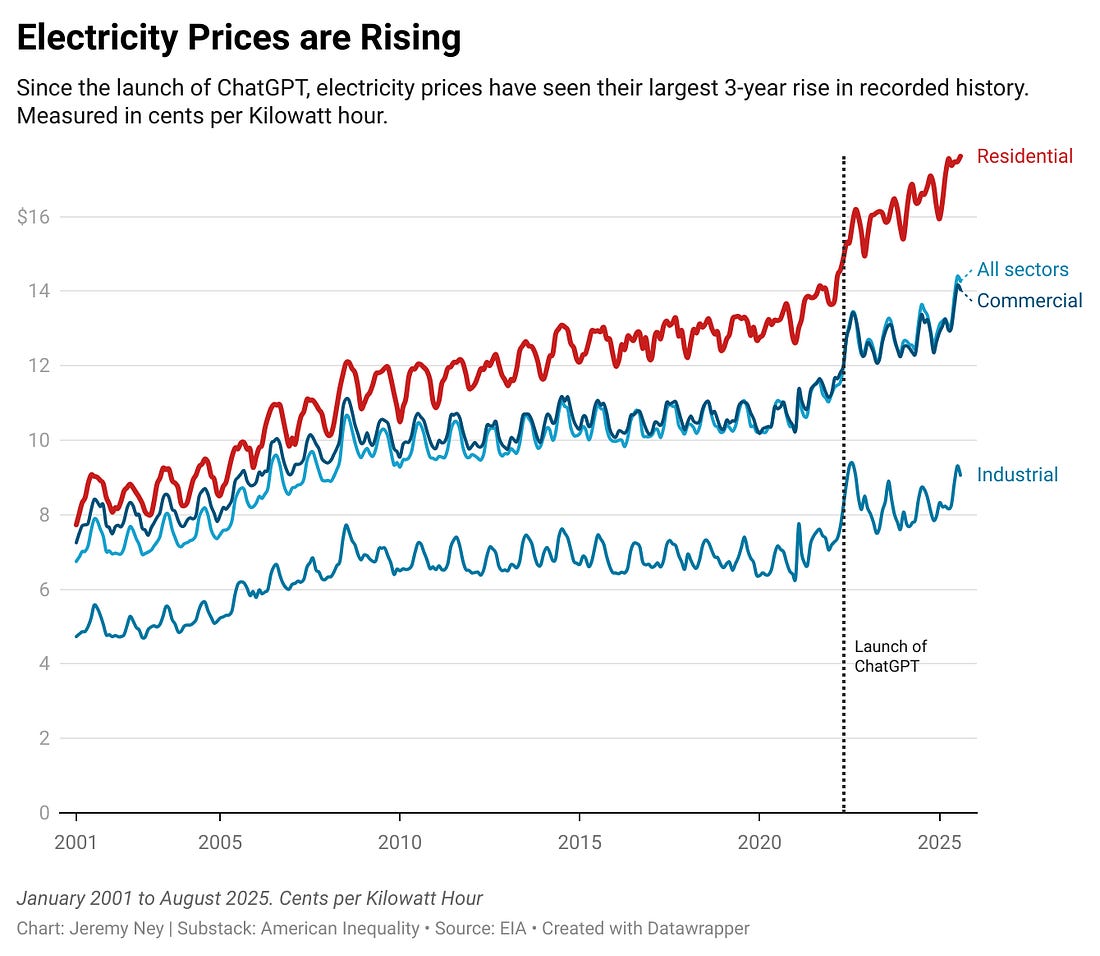
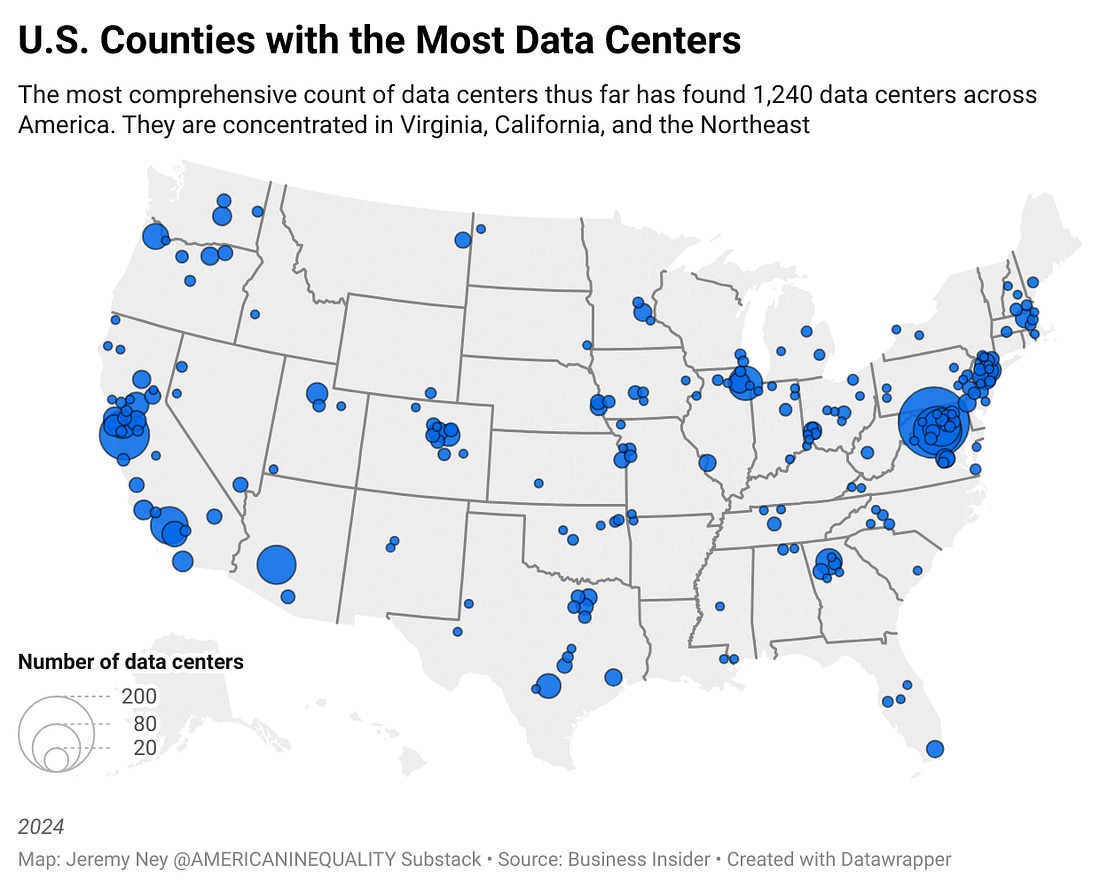
Utility companies are shutting off the power of more and more Americans as electricity prices are surging. Electricity bills are rising 3-times faster than inflation and it’s causing shutoffs to spike across the country. In New York City, disconnections are now five-times higher than they were at this point last year and 14 million households are in arrears or collections for utilities. The average overdue balance on utility bills is now $789, 32% higher than in 2022. As the U.S. braces for an especially cold winter, heating bills are expected to rise and this could spell disaster for households nationwide. Electricity prices have jumped 40% since February 2020, according to the Bureau of Labor Statistics. That’s a bigger jump than the 26% increase in the overall cost of living. On Monday, more than 200 organizations called on Congress to halt the construction of all data centers in America. They wrote, “this expansion is rapidly increasing demand for energy, driving more fossil fuel pollution, straining water resources and raising electricity prices across the country.” Data centers are expected to consume anywhere from 6.7% to 12% of total U.S. electricity by 2028, up from 4.4% in 2023, the U.S. Department of Energy estimated in December 2024. However, data centers are only one part of the equation, and depending on where you are in America, they may not be making that big of an impact. Are Data Centers Causing The Rise?One of the key reasons for the rise in electricity prices is the rise in the number of data centers. In more economic terms, demand is now outpacing supply, which is driving up prices. We now have enough data on data centers and utility bills to start drawing the connections clearly. The best analysis for this comes from Bloomberg, which analyzed utility bill data in relation to data center locations. The team of analysts found that electricity now costs as much as 267% more for a single month than it did five years ago in areas located near significant data center activity. The rapid development of data centers connected to the largest US electric grid (PJM Connection) raised costs by $9.4 billion, an expense that consumers from Illinois to Washington, D.C. are now seeing reflected in their utility bills. An independent monitor of PJM Connection said that overall costs rose for these users by 180% largely due to the demands from data centers raising overall costs. The data center boom is driving power demand on the grid toward levels not seen in 20 years. However, data centers only explain part of the rise in electricity prices. Many states like Virginia and Texas have seen monumental increases in data center production, but only modest increases in residential electricity prices. This is because of other factors, like how much those regions have been able to increase the supply of energy through green energy production, or how much environmental factors like cold spells or natural disasters have raised prices. For example, the states that have some of the smallest rises in electricity costs like Nevada and North Dakota largely due to their expansion of wind and solar power. California, on the other hand, which has also invested heavily in wind and solar, has seen some of the steepest rises in the nation as wildfires destroyed electricity lines and power stations, forcing utility companies to rebuild those and passing much of that costs onto consumers. New York, New Jersey, and other northeast states rely heavily on natural gas, and with rising important gas prices and few pipelines, consumers are feeling the cost of pricier fuel. In recent years, New York has blocked new pipelines and closed a nuclear power plant, which deepened the state’s reliance on gas. A June analysis from Carnegie Mellon University found that electricity bills are on track to rise as much as 25% by 2030 in places like Virginia because of data centers. In some places, it is happening already. Starting in June, the electricity bill for a typical household in Ohio increased at least $15 a month because of data centers. Why Large Companies Pay Less for ElectricityResidential electricity costs are rising faster than industrial costs primarily due to the higher cost of serving smaller, more dispersed customers and regulatory policies that favor industrial customers. Policymakers and utilities often provide special rate deals to large industrial customers to support economic growth and court data centers. These customers like some of the largest tech companies are powerful advocates for their own interests, much more so than highly distributed residential customers. This exact type of price-negotiation is going on right now in a first-of-its-kind case in Columbus, Ohio. Big tech companies were building so many data centers in Ohio that the utility company there projected it would need six times the electricity central Ohio was currently producing. As the NYTimes put it, “The hearing in Columbus was about power in the literal sense — the electrons that keep the lights on and fuel modern technology — and power in the political sense.” On one side, the utility company wanted to set prices that didn’t overburden its customers, and on the other side, were the tech companies that wanted lower upfront costs. The utility in Ohio has already committed to supplying electricity for 30 data centers in the region by 2030, reaching power consumption levels in the Columbus area as high as Manhattan’s. But the tech industry is making additional requests to power 90 more data centers, which could make consumption in Columbus comparable to the entire state of New York during a peak summer day. The most power hungry data center in America is found in Sarpy County, Nebraska. Meta built this behemoth just outside of Omaha which consumes an estimated 794,440 MWH/year on the high end. Meta broke ground on the site in 2017 and in 2018 it signed an agreement with Enel North America, one of the largest energy producers in the US, to purchase the entire output of its 320MW wind warm in Nebraska to power the Sarpy data center. Just months before the launch of ChatGPT announced it would be expanding the site by several million square feet in an area that was previously farmland. We live in a time when affordability has become a narrow uniting force amongst Democrats and Republicans alike. They have very different ideas about how to achieve greater affordability, and each side likes to blame a different cause, but the “cost of living” is found in countless speeches on both sides. Only 4 states have not seen a rise in electricity prices since the launch of ChatGPT in November 2022 (Louisiana, New Hampshire, Kentucky, and Nevada). There is significant room on the political and policy side drive these household costs down. Utilities are a concern that every person faces and in varying degrees (i.e. even though electricity prices are higher in California, people in Alabama have higher electricity bills because they have more intense weather and less efficient household appliances). Much of that opportunity for change involves building new infrastructure like wind, solar, or pipelines; it involves incentives to private sector companies to invent more efficient air conditioners, heaters, thermostats, and washer-dryers; and it involves public-private partnership between the various utility-monopolies that exist in most major American cities. The Path ForwardThere are 3 key ways to ensure that households don’t bear the brunt of rising electricity costs: increase supply, decrease demand, and improve efficiency.
We are heading towards a world, ideally, where we will need A LOT more electricity. The Green Energy movement has been trying to move people off of fossil fuels for years and trying to prepare people for this world. Electric cars, trucks, planes, and boats would massively decrease our carbon emissions. This is independent of how many more data centers America will need to maintain a strong foothold in AI leadership. Driving down electricity prices and creating more capacity isn’t only about meeting the current moment, it is about planning for the long-term. U.S. residential electricity prices were relatively flat for from 2008 to 2020 as solar and wind became cheaper to build and our reliance on external energy sources declined. Let’s power American ingenuity while improving our affordability. American Inequality raised over $4,000 in 2 days to fight global poverty. If you still want your donation matched, you have until the end of this week! You’re on the free list for American Inequality. Consider upgrading to support this work, get access to the community chat, and doing your part to reduce inequality in America. If you are interested in partnering on projects, reach out at helloamericaninequality@gmail.com
|
среда, 10 декабря 2025 г.
The Electricity Bills are Too Damn High





Подписаться на:
Комментарии к сообщению (Atom)
Комментариев нет:
Отправить комментарий
Примечание. Отправлять комментарии могут только участники этого блога.