Image generated using Microsoft Image Creator and Photoshop | | | | | What we need in a leader Jennifer Pahlka has a new newsletter, Eating Policy. In her inaugural post, she considers what the voting public is looking for in a leader. Her answer: "I-95-ness." Pahlka's neologism evokes the government response to (and extremely quick repair of) the deadly collapse of interstate 95 in Philadelphia last year. I-95-ness means stepping up and getting things done , putting state capacity into action—as Pennsylvania Governor Josh Shapiro did when he "used emergency powers to suspend a whole host of rules and regulations and get the highway reopened in under two weeks." And the results speak for themselves: The general public is not tracking IRA implementation like policy nerds do. But they do know when roads, bridges, subways, schools, and hospitals get built (or don't). They know when something takes longer than it should, even accounting for reasonable safeguards, whether it's fixing a pothole or getting a SNAP payment. They know I-95-ness when they see it. It's an attribute both that voters will be looking for and one that prospective (theoretical) candidates should be striving to cultivate. “Elites understand policy. The rest of us understand delivery,” Pahlka explains. But "the American public is still waiting on the delivery." And they're looking for leaders who can cut through red tape and produce tangible outcomes. (Then, Pahlka concludes, comes the more difficult challenge of straightening out our tangled bureaucracy.) + We've mentioned it before, but Pahlka's book Recoding America outlines the challenges the American government faces and the steps we'll need to take to truly address them. It's a must-read. (Disclosure: Jennifer Pahlka is married to O'Reilly founder and CEO Tim O'Reilly.) | | | | | Office conversions could use some I-95-ness of their own Here's another story out of Pennsylvania that underscores just how outdated policy can frustrate the delivery of desired outcomes. As Bloomberg's Kriston Capps reports, the Biden administration has unlocked $35 billion in financing to convert office space into housing. Here's the rub: the program, managed by USDOT, uses older "standards designed with interstate rail projects in mind," not office tower conversions. Developers for Pittsburgh's 44-story Gulf Tower hoped to tap these funds but have found the program "unworkable" due to protracted time lines, arduous environmental reviews, and other constraints. And the same is true of projects in Columbus and Cincinnati. For its part, Pittsburgh's City Council is hoping for a little I-95-ness from the Biden administration: "The city recommended amending the closing period from 18 months to six and dropping the NEPA review for a traditional environmental report, among other items." For now, developers will have to wait for USDOT to work out the kinks—but as Capps notes, the longer the process takes, the more damage it will cause and the harder it will be to fix. | | | | | Improving government at warp speed This week, the Washington Post's Josh Tyrangiel issued a cri de coeur on how AI might "remake the whole U.S. government (oh, and save the country)." Tyrangiel lauds the success of Operation Warp Speed—which spurred development of the first COVID-19 vaccines, thanks in part to technology partners like Palantir—as an example of how technological solutions implemented at speed can improve government outcomes. If you think this sounds a little like I-95-ness, you're not wrong. (Pahlka herself turns up in Tyrangiel's article, offering some background on how public servants are dealing with our convoluted bureaucracy.) While there are certainly challenges to embedding AI in government—the inherent risks of unproven technology and the tangled webs of policy that must be unsnarled among them—Tyrangiel argues that this "new era of AI has presented a once-in-a-century chance to. . .renew the mission" of the US government. And that's an endeavor worth undertaking. | | | | | A mission-oriented approach to government Achieving better outcomes (and taming bureaucracy) will require rethinking some of the fundamental assumptions about how government should work. In a post on the UCL Institute for Innovation and Public Purpose blog, University College London professor Mariana Mazzucato and Camden Council leader Georgia Gould argue that government should reorient itself toward missions: This "mission-oriented" approach turns social and environmental challenges into pathways for new forms of collaboration, and new market opportunities. By working with willing businesses to solve health, climate, food insecurity and other challenges, governments can spark innovation, crowd in private sector investment and generate spillovers. As they note, "The power of this approach comes from multiple actors pursuing the same goal. Given time and investment this creates new momentum for change that goes beyond what government could have imagined alone." It's an interesting proposal with some real-world examples drawn from the London Borough of Camden, which has already put mission-oriented practices to work. + Mariana Mazzucato dives deeper into these ideas in the recent UCL IPP report Governing the Economics of the Common Good. | | | | | Deeper reading: Seven Crashes 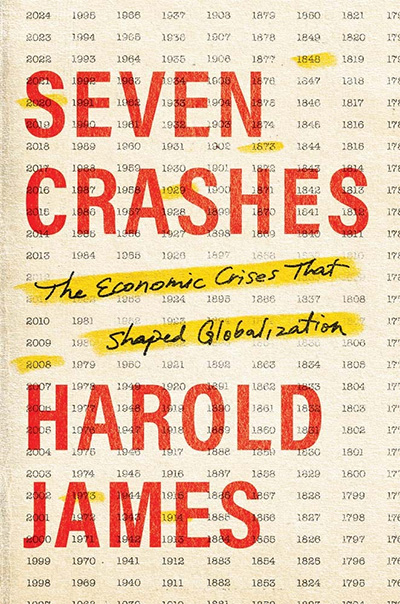 Financial crises can be devastating for those who live through them. But in last year's Seven Crashes: The Economic Crises That Shaped Globalization, Princeton historian Harold James explores moments of crisis to uncover how under certain circumstances—namely when they're the consequence of supply shocks—they can also lead to greater innovation that supports the project of globalization. In a review of Seven Crashes, which he shared in his Grasping Reality newsletter, Brad DeLong explains why James's tome is so valuable. Even though DeLong doesn't quite hold with its central thesis, he argues that James's scholarship illuminates moments of great transition and makes them accessible to those who want to understand (and perhaps avoid) similar crises in the future. The Financial Times' Martin Wolf named Seven Crashes one of the best books of 2023. Here's a brief review in Foreign Affairs and another from the London School of Economics. And you can get the gist straight from James himself in this recording of a talk he gave last November. | | | | | | —Tim O’Reilly and Peyton Joyce | | | |





Комментариев нет:
Отправить комментарий
Примечание. Отправлять комментарии могут только участники этого блога.