Despite all this, there is a struggle to find customers. There are hardly any adopters of the products built by Indian AI startups.
Sarvam AI hasn’t released a customer-facing product yet. Indian customers are still using products like ChatGPT, Meta’s Llama, or Perplexity AI.
ChatGPT has amassed over 180 million users globally, with India emerging as its second-largest market. India accounts for 9.08% of the total user base, approximately 14 million users.
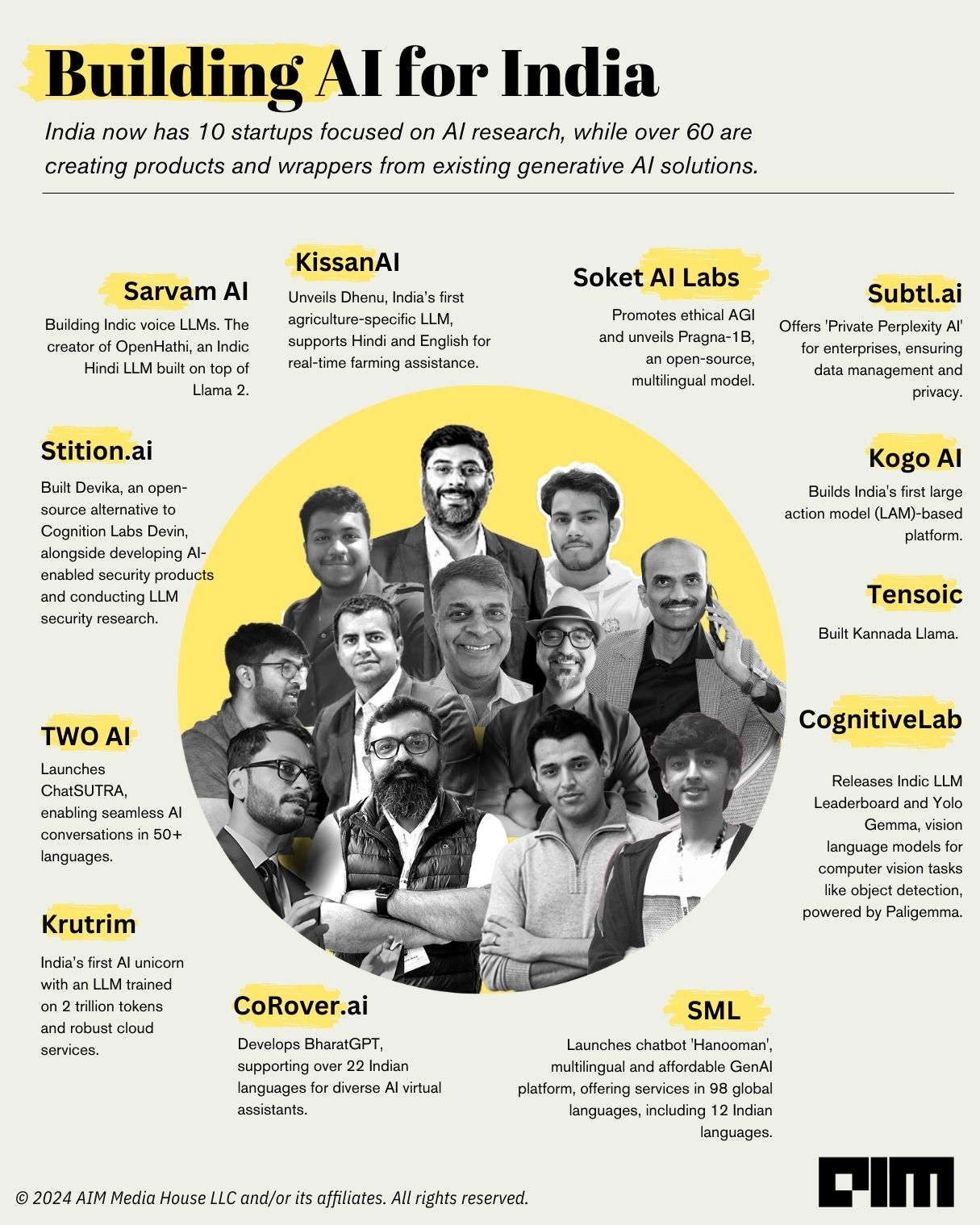
Take the case of KissanAI founded by Pratik Desai. Though the goal is solving the problems of the agricultural sector in India, assisting farmers by providing real-time, multilingual support and expert advice, not much adoption is visible in the sector.
The company launched Dhenu, the world's first agriculture-specific LLM, which supports both Hindi and English, and is now part of the prestigious NVIDIA Inception program and the JioGenNext Cohort. More is expected from the company now that the funding is rolling on.
Speaking of funding, TWO AI, a Reliance Jio-backed startup, recently launched SUTRA, a family of models. Their latest tool, ChatSUTRA, is similar to ChatGPT and allows users to converse in over 50 languages.
The tool is impressively fast and provides instant responses. However, the company and its product are still new and finding their footing.
On the other hand, the well established CoRover.ai, which built BharatGPT, is an exception. The company currently provides virtual AI assistants (chatbots, voicebots, and videobots) to hundreds of organisations, including IRCTC, LIC, IGL, KSRTC, the Indian Navy (GRSE), Max Life Insurance, NPCI, BHIM-UPI, Mahindra, the Government of India, and many more.
Still the funding isn’t enough when compared to the US. According to Rajan Anandan, managing director at Peak XV Partners, VCs are sitting on a total of $20 billion cash to invest in Indian startups, and the focus is currently on AI.
In 2023, the US invested over $25 billion in generative AI startups. On the other hand, the Indian AI startups ecosystem has cumulatively raised $700 million in the past three years.
On the contrary, only over $500 million in funding was raised by 24 generative AI startups in 2023. This year, the numbers are expected to increase significantly, given the rise in demand for generative AI services and products across industries, particularly in the areas of coding, healthcare and education.
Though the research is going strong. Soket AI Labs, India’s first startup focusing on building solutions to achieve ethical AGI, recently unveiled Pragna-1B, a foundational AI model, the first of its kind in the open source arena.
This multilingual AI model designed for 22 Indic languages achieves advanced linguistic inclusivity and efficient on-device performance. The startup partnered with Google Cloud to further enhance the model’s capabilities and reach.
That’s not all. Subtl.ai is building a ‘private Perplexity AI’ based on light models for enterprises. The company focuses on creating AI tools that help enterprises efficiently extract and manage information from vast amounts of text documents.
In its latest proof of concept, Subtl.ai showcased a demo to AIM about how State Bank of India is leveraging the company’s technology to save 90% of time discovering information from piles of documents using their tool.
In addition to these, significant research in generative AI is taking place in India. Young Indian students in higher education are actively experimenting with LLMs, founding companies like Tensoic , CognitiveLab, and Stition.ai.
Not just LLMs, Bengaluru-based startup Kogo AI is building India's first large action model (LAM)-based platform. Kogo acts as a universal AI agent capable of assuming roles such as customer service agent, booking agent, research agent, office assistant, and more.
A lot needs to be done. As Ola chief Bhavish Aggarwal said - “We can make India the most productive economy in the world by leveraging these future technologies! Become the new energy centre for the world. Become the largest AI exporter in the world.”
Don’t underestimate China. While the world awaits OpenAI’s Sora, Chinese TikTok competitor Kuaishou has released a similar model called Kling, which is exceptionally impressive. Kling is open access and, in many cases, produces videos that surpass Sora. No Indian AI startup has yet developed generative AI video generation tools.
Alibaba announced the release of the Qwen2 series, an advanced version of Qwen1.5. Qwen2-72B, the largest model in the series, outperforms leading competitors like Llama-3-70B in natural language understanding, coding proficiency, mathematical skills, and multilingual abilities.
.jpg)










Комментариев нет:
Отправить комментарий
Примечание. Отправлять комментарии могут только участники этого блога.