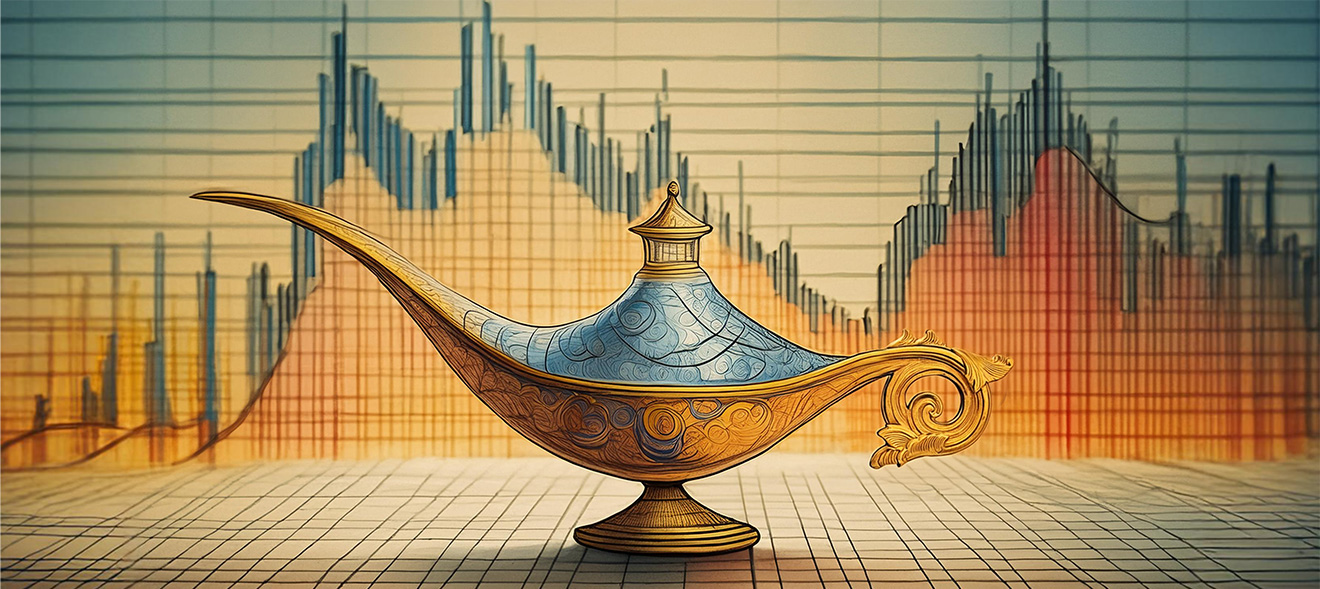
"Stock prices are disconnected from reality." Generated with Adobe Firefly. | | | | | What GameStop reveals about our financial markets (again) It's been a few years since Keith Gill kindled a retail investor-backed short squeeze of GameStop stock, ushering in the meme stock era before dropping out of sight. But now Gill has resurfaced. On May 12 he posted a picture of a man leaning forward in a chair. . .and ignited a new GameStop rally. As Bloomberg reported, "More than 175 million shares changed hands , almost 30 times the one-year average," and shares "closed higher by 74% at $30.45." All from a single picture with no accompanying information. In his posts since, Gill has revealed he remains bullish on GameStop and still holds a very large position, which includes call options that expire June 21. That's about it. But it's caused the share price to swing wildly. Most recently, anticipation for a livestream by Gill pushed prices up, then his "rambling" call sent them back down again. Now the SEC is looking into the matter, and E*TRADE is considering a ban. But it's unclear what, if any, rules Gill may have broken. It's a super interesting edge case that highlights how the ability of folks to make massive amounts of money in the financial markets is disconnected from the underlying reality. Bloomberg's Matt Levine has been tracking the situation from the get-go, and his columns underscore just how far afield we are from the way markets are "supposed" to work. Here's how Levine tried to make sense of the situation: If you had a magic lamp that allowed you to move up the price of a liquid publicly traded stock arbitrarily, by a large amount, a handful of times, what would you do with it? There's some stock that trades at $20, and you could rub the lamp and it would go to $30 for like a day or two: What do you do? I think there is a theoretically correct answer, though it is neither investing nor legal nor magical advice. It goes like this: - Spend all of your money on somewhat out-of-the-money short-dated call options on the stock.
- Rub the lamp.
- Sell the options.
But as Levine points out, we don't really know what's motivating Gill. Ultimately, what the latest episode in the GameStop saga might be teaching us is that "maybe nobody should have a magic lamp that can arbitrarily move stock prices." + More from Levine: The biggest winner might turn out to be GameStop itself, which took advantage of the moment to raise some cash. And fellow meme stock AMC saw a bump from Gill's post too. | | | | | We need better executive incentives Elon Musk is another person able to magically move share prices. Musk is currently embroiled in a battle with Tesla shareholders over his 2018 compensation plan. As Brad DeLong argued this week, the plan marked a turning point for Tesla and for Musk by prioritizing stock price over true value, and Musk's fight to get the package reinstated is exposing the flaws inherent in our financial system. DeLong explains: "A functional capitalism would create powerful incentives" for Musk to focus on creating a company that achieves its goals of "propelling the world towards a more sustainable future" while "reward[ing the company's] suppliers, workers, engineers, and customers." However, Musk's "unorthodox pay package" actually incentivized him to "focus every hour he spent on the company" catering to the "meme-stock enthusiasts pledging cultural allegiance" to Musk himself. It's a problem much bigger than Musk. It may seem self-evident that corporate leaders who are incentivized to boost stock price would do so by helping the company do better. But with today's ability to manipulate the stock market by meme engineering, that assumption no longer holds. We need executive incentives that are tied more to the actual performance of the business rather than to the performance of the stock. + Of course, as Matt Levine wryly points out, "Musk seems to have a lot of non-economic motivations" too. | | | | | Reining in the betting economy Both stories above underscore just how detached stock prices have become from the actual value those companies create. As I put it in 2021's "Two Economies. Two Sets of Rules. ," stock prices are now "subject to wild booms and busts that are unrelated to the underlying economics of the businesses that shares of stock are meant to represent." This disconnect allows companies to make massive amounts of money, but it's also "one of the biggest unacknowledged drivers of inequality in America." While most live in an economy based on dollars and cents, the rich are funded by what financial writer George Goodman calls "supermoney"—that is, their companies are "valued today as if they were already delivering the decades worth of future earnings that are reflected in their stock price." As I explained back in 2021, we "need to put a brake on the betting economy that is creating so much phantom wealth by essentially letting one segment of society borrow from the future while another is stuck in an increasingly impoverished present." And that's even more true today. While higher interest rates have tempered market expectations a bit, the S&P 500 and Nasdaq indexes still hit record highs this week. Tax policy may be a better means of intervention. A well-funded IRS will target those evading our current tax code. But we'll likely need to experiment with more agile tactics. If financial incentives aren't working, maybe a Pigouvian tax, like those levied on alcohol and cigarettes, could rein in the excesses of the betting economy and redirect profits toward investment in the real economy. + See my discussion of supermoney in WTF? What's the Future and Why It's Up to Us if you want to dive deeper. | | | | | | —Tim O’Reilly and Peyton Joyce | | | |




Комментариев нет:
Отправить комментарий
Примечание. Отправлять комментарии могут только участники этого блога.