Why Americans Most Vulnerable to Climate Change Don't Always CareGlobal warming is going to hit liberal cities the hardest: is the rest of the nation worried?
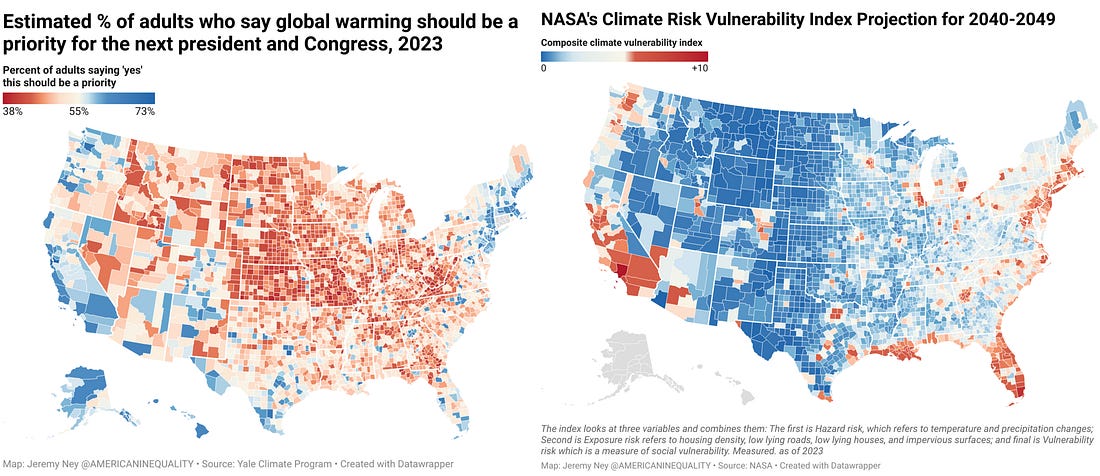
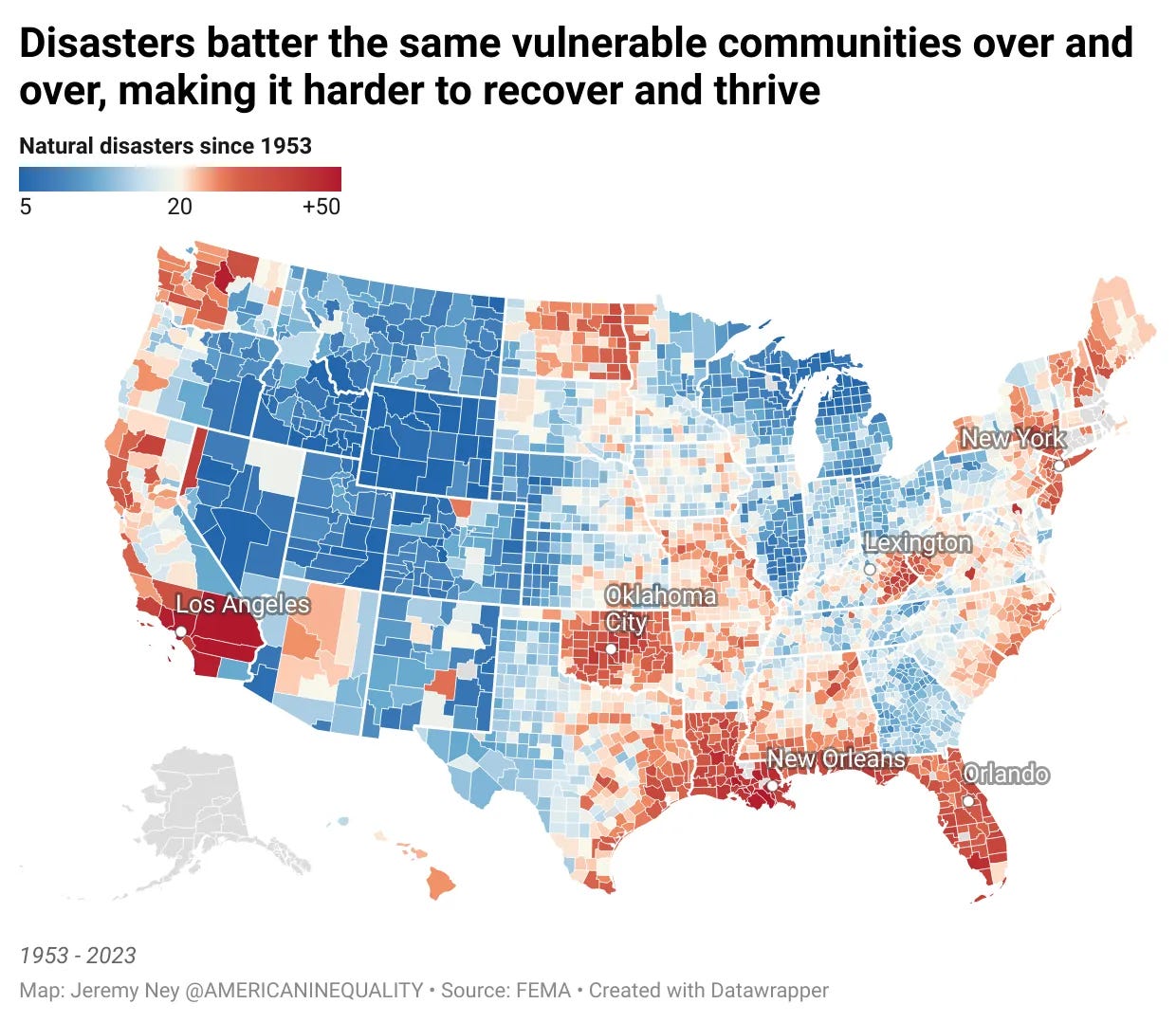
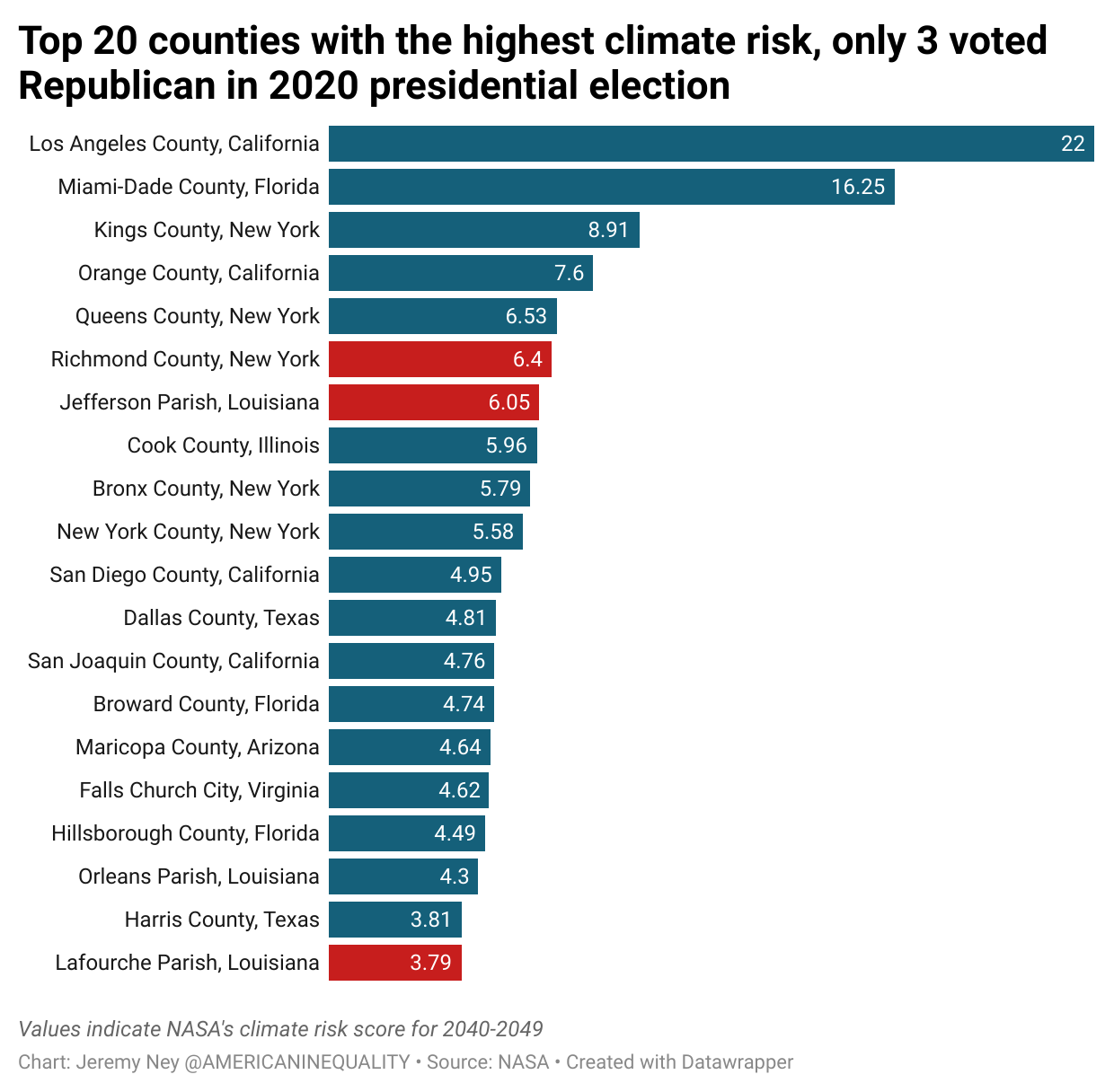
54% of adults say ‘Yes’ global warming should be a priority for the next president and Congress. In fact, the majority of people in every country in the world worry about climate change and support policies to tackle it. However, those global and national numbers mask the reality of what is happening on the ground in America. When looking at a county level, I found that the people who are most at risk of devastation from climate change tend to live in Democratic areas. These people generally believe that global warming should be a priority, but many of their more rural or suburban neighbors disagree. For those who disagree, this may be because these communities have concerns that feel more imminent, like housing affordability, food insecurity, and inaccessible healthcare. However, natural disasters ravage these communities at an increasingly destructive and frequent rate each year. Climate Opinions vs. Climate RiskClimate change can be a significant driver of inequality. Natural disasters can also decrease household incomes by 21.5% for years afterwards and they can also create “brain drains,” making it harder for regions to grow and attract or retain highly-educated civilians, like doctors, or scientists. Low-income families cannot afford to endure natural disasters because it takes them 2x - 3x longer to financially recover from natural disasters. Alameda County, California has the largest gap between climate risk and how important residents think the issue is. NASA says the region only scores a 2 on the scale (the highest county is 22) whereas 73% of residents think that this should be a priority. Alameda is where Oakland is, right across the Bay from San Francisco. Meanwhile, Los Angeles and Miami are the two counties with the greatest risk (scores of 22 and 16 respectively), but only 60% of residents there think that climate change should be a priority. As we’ve previously discussed in American Inequality, both the number and the magnitude of natural disasters has been increasing in America over the last decade. Floods, wildfires, tornadoes, and earthquakes are causing billions of dollars of damage as these events grow in size and occur more often. Miami-Dade has experienced two natural disasters per year for the last 20 years, a huge number in historical terms and much higher than any other region. The number of natural disasters that cost over a billion dollars in damage has increased more than 4x over the last 40 years. Calhoun County in West Virginia has the lowest percent of residents that think climate change should be a priority for the next president or Congress. 75 miles northwest of the state’s capitol, Calhoun had flooding and mudslides in August 2023 that FEMA declared a natural disaster and that President Biden issued federal funds for support. Nonprofits say that 1 in 4 homes in the region is also at high risk of destruction from climate change.
Brandon Denison, a West Virginia native explains the main reason: "You've got several families that have mined for generations," he added, "and everywhere you look, there's coal trains, coal trucks, coal barges on the river, ads on radio, TV.” West Virginia produces 12% of the nation’s coal, second only to Wyoming. "It's almost impossible to grow up in West Virginia and not be impacted by the coal industry. It's economically, culturally, politically and socially dominant," Brandon explains. The laser focus on economic interests seems to be overpower a focus on the climate. Coal brings in money, but it can also have a dangerously negative impact on the environment, as the EPA, Union of Concern Scientists, and European Union have all shared. Despite this focus on other interests beyond the climate like a focus on the financial benefits that coal can bring, Calhoun County has no mineable coal. When Zoe Siegel on the American Inequality team spoke with Dr. Jeffrey Shaman, Interim Dean of the Columbia Climate School, he shared why people might focus on other challenges:
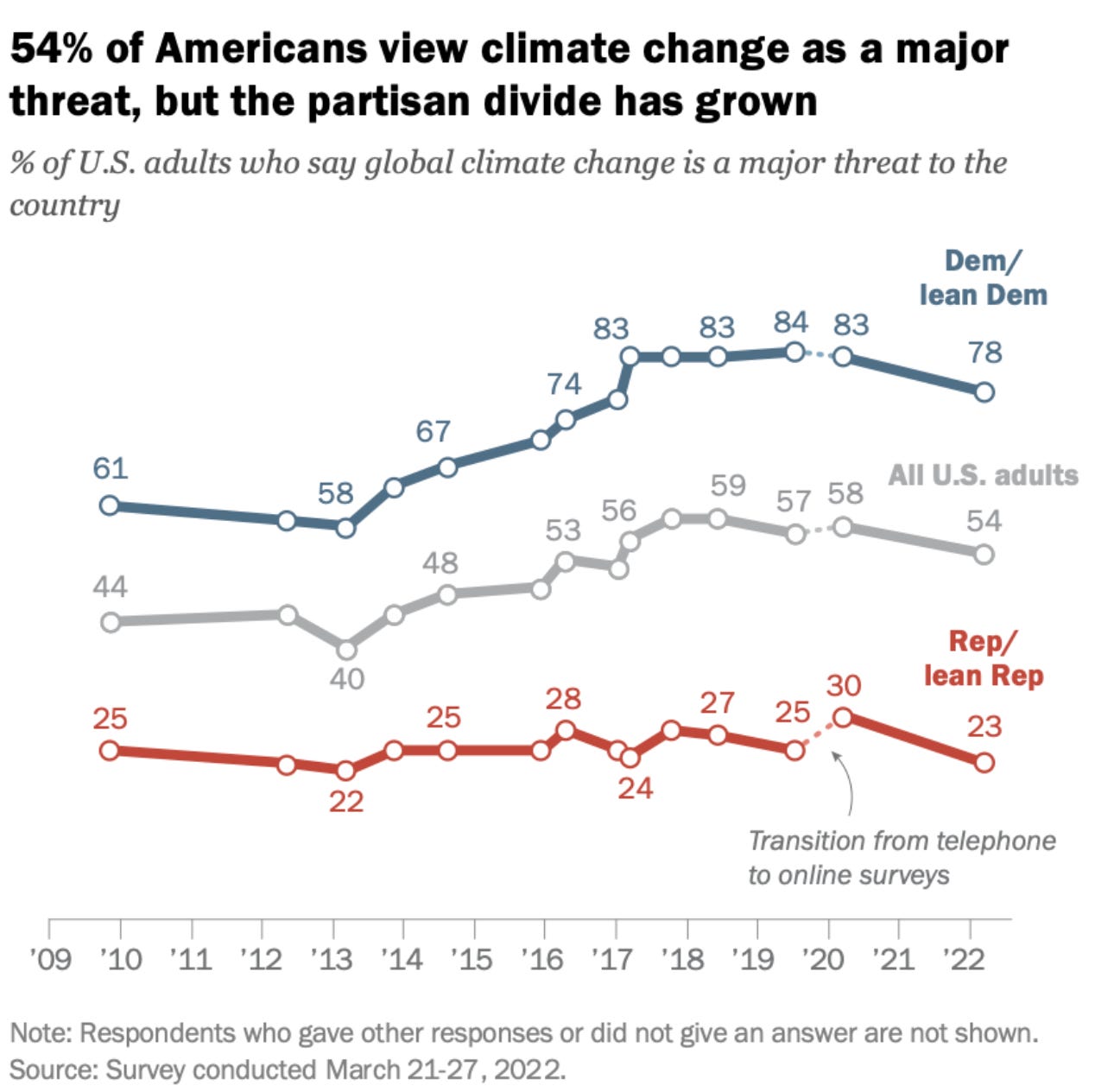
Why Don’t More Americans Care About Climate Change?The 10 warmest years in the 174-year record of keeping climate temperatures have all occurred during the last decade (2014–2023), but alas other issues take the spotlight. Views on climate change tend to fall along a partisan divide. While 78% of Democrats say that climate change is a major threat, only 23% of Republicans say the same.
As I dug deeper into the data about why voters might not want climate change to be a priority for the next president or Congress, three themes emerge. These explain why voters might either not care for this issue, or might find other issues more imminent.
Democrats are four times more likely to say that climate change is impacting their community ‘a great deal’ and this generally holds true in the data on areas that are most at risk. While the Gulf Coast area with Louisiana and Alabama has experienced more hurricanes each year, many of America’s liberal strongholds like New York City and Los Angeles have the greatest climate risks based on the NASA data. Floods and wildfires in these cities kill dozens each year. Only 3 of the top 20 counties with the great climate risk voted Republican in the 2020 presidential election.
The Path ForwardGlobal warming should unequivocally be a priority for the next president and Congress. We need to go beyond education. Knowing that smoking is bad for you does not necessarily stop people from smoking. But climate change is not a local issue. We need the entire US and the entire world to focus on it, because otherwise individual communities are left holding the bag. The first two recommendations are for what we can do as individuals, whereas the final recommendation is for the politicians and policymakers who follow along with this newsletter.
Ban Ki-Moon, the former Secretary General of the United Nations said it best, “Climate change is the single greatest threat to a sustainable future, but, at the same time, addressing the climate challenge presents a golden opportunity to promote prosperity, security and a brighter future for all.” Ban Ki-Moon knew that climate change was not only about saving the planet, but also about finding justice and opportunity for all communities. You’re on the free list for American Inequality. Thanks so much for being part of our community! Please share with others and don’t forget to subscribe. Most sincerely, Jeremy
|
среда, 12 июня 2024 г.
Why Americans Most Vulnerable to Climate Change Don't Always Care





Подписаться на:
Комментарии к сообщению (Atom)
Комментариев нет:
Отправить комментарий
Примечание. Отправлять комментарии могут только участники этого блога.