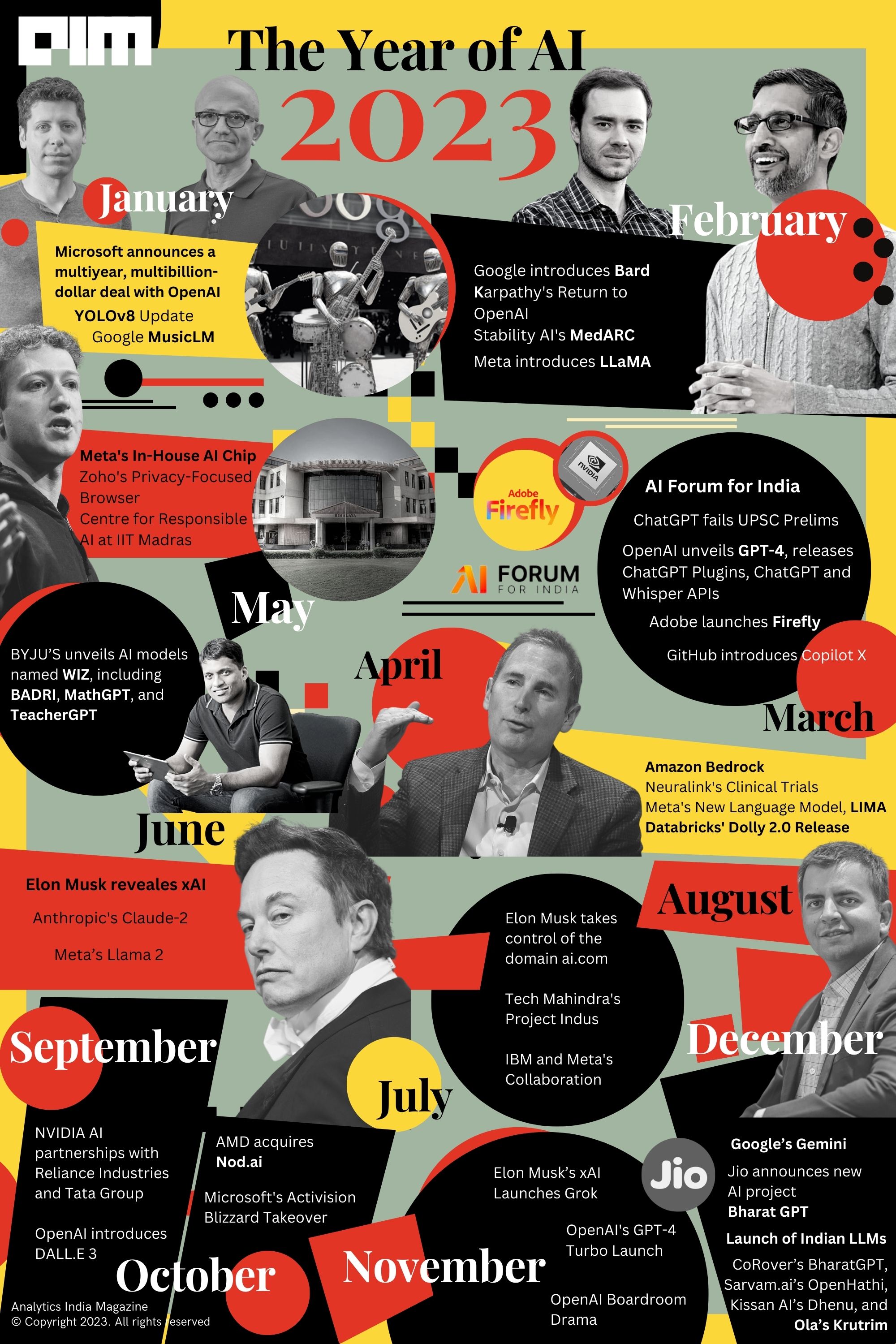
January: A major highlight was Microsoft's announcement of its third phase of partnership with OpenAI, involving a multiyear, multibillion-dollar investment. This collaboration – following previous investments in 2019 and 2021 – focused on AI supercomputing and research, with both entities independently commercialising the resulting advanced AI technologies.
Microsoft also announced its partnership with ISRO to support space technology startups in India. This collaboration falls under the Microsoft for Startups initiative, emphasising the role of AI and cloud computing in burgeoning space tech.
Besides this, Google’s MusicLM also marked a significant advance in AI-driven music production. The computer vision community also welcomed the latest update with YOLOv8, enhancing object detection capabilities. For the first time, ChatGPT was credited as an author in a peer-reviewed paper, demonstrating AI's expanding role in scholarly research.
February: Google began testing Bard, its conversational AI chatbot based on the LaMDA model. However, Google faced a significant setback during its "Live in Paris" event, resulting in a considerable market value drop.
Meanwhile, OpenAI welcomed back Andrej Karpathy, a notable figure in AI, enhancing its research and development strength. Stability AI set up a separate entity called MedARC to enable medical AI research.
In the corporate realm, Tredence announced a major ESOP buyback program, underscoring the economic impact of AI. Neal Mohan's rise to YouTube's CEO hinted at potential shifts towards greater AI integration in digital content.
OpenAI released an AGI roadmap outlining its vision for future AI development, focusing on responsible and beneficial advancements. Meta introduced LLaMA language models. Spotify unveiled an AI DJ.
March: ChatGPT failing UPSC Prelims was the highlight of the month. Soon, OpenAI released a slew of updates in the same month, including the release of the most awaited GPT-4, alongside ChatGPT Plugins, ChatGPT and Whispher APIs among others.
Adobe introduced Firefly, a generative AI-based editing tool. GitHub unveiled Copilot X, an upgraded version of Coplit, its AI code assistant.
AIM, in collaboration with NVIDIA, launched AI Forum for India, a collaborative platform for AI developers and practitioners in the country.
April: Amazon arrived late to the generative AI party with the release of Bedrock. Databricks released Dolly 2.0 for commercial purposes, democratising access to powerful AI tools without the need for API access or data sharing.
Elon Musk’s Neuralink gets approved by the US FDA for its first-in-human clinical trial. Meta unveiled LIMA, a 65 billion parameter Llama language model that is on par with GPT-4. Google also introduced UniPi, a new model that is capable of performing diverse tasks in various environments.
DeepLearning.AI, in partnership with OpenAI, introduced a new course on 'ChatGPT Prompt Engineering for Developers.'
OpenAI announced a new feature for ChatGPT to turn off chat history, highlighting a focus on user data privacy and control. Microsoft released Guidance, a tool to enhance the efficacy of language model control.
May: After Apple, Amazon, Google and Microsoft, Meta introduced its first in-house silicon chip designed for AI workloads, called MTIA (meta training and inference accelerator).
OpenAI unveiled Shap.E, a generative model for 3D assets. Zoho launched its privacy-focused Ulaa browser and the integration of AI engines with OpenAI's technology. Salesforce announced CodeT5+, expanding AI capabilities in business applications. Modular AI introduced Mojo, a new programming language blending Python's syntax with C's performance.
IIT Madras established a Centre for Responsible AI.
June: OpenAI Chief Sam Altman visited India emphasising ChatGPT's adoption and regulatory discussions. BYJU’S launched WIZ, a suite of AI models for personalised learning..jpg)
.jpg)









Комментариев нет:
Отправить комментарий
Примечание. Отправлять комментарии могут только участники этого блога.