Why homelessness just hit a 15-year high, rising 12% from last yearRising rents and low housing inventory spur an unprecedented level of homelessness in America
We’ve now hit more than 9,000 subscribers for American Inequality! Thank you all for being part of this incredible community and don’t forget to forward along. 🎉
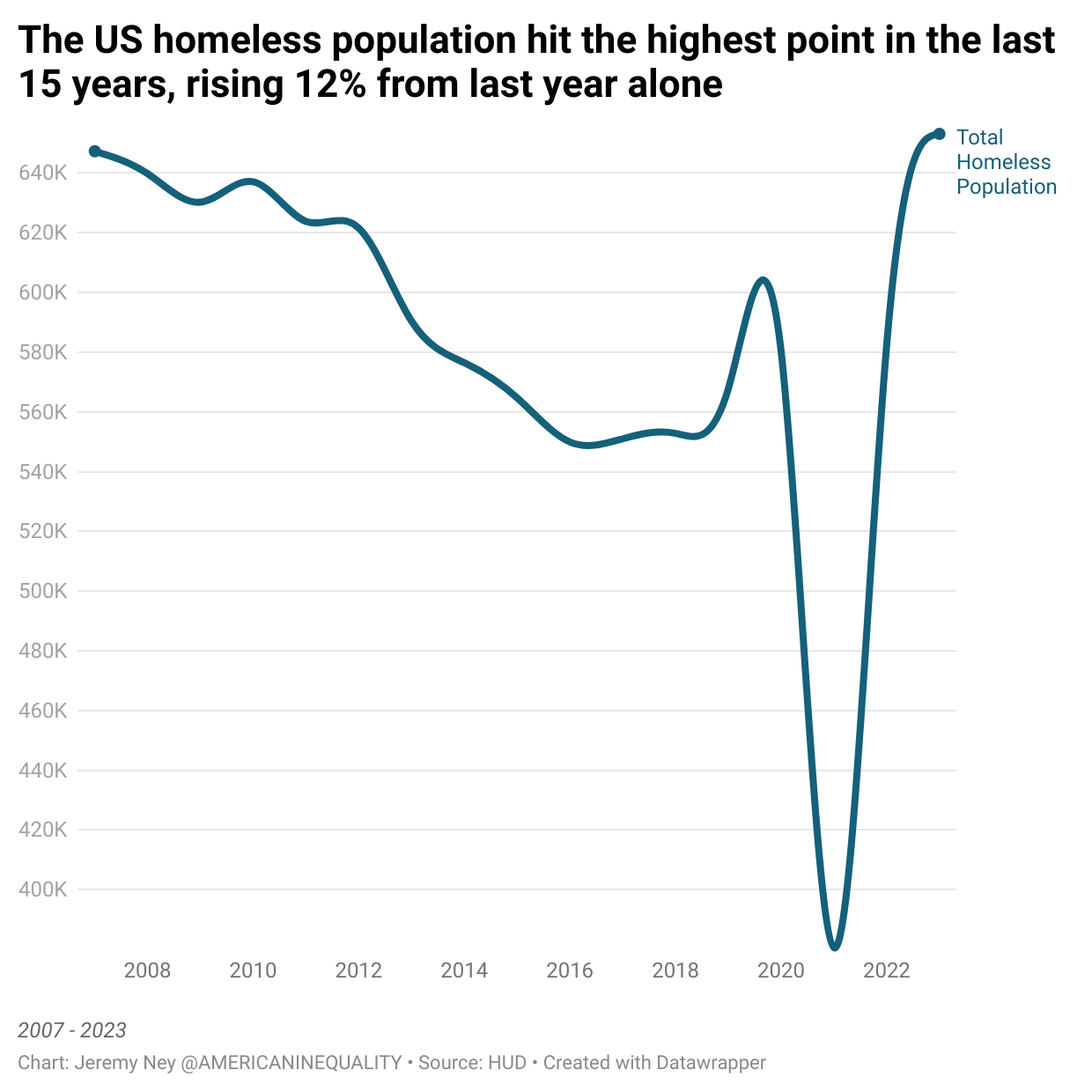
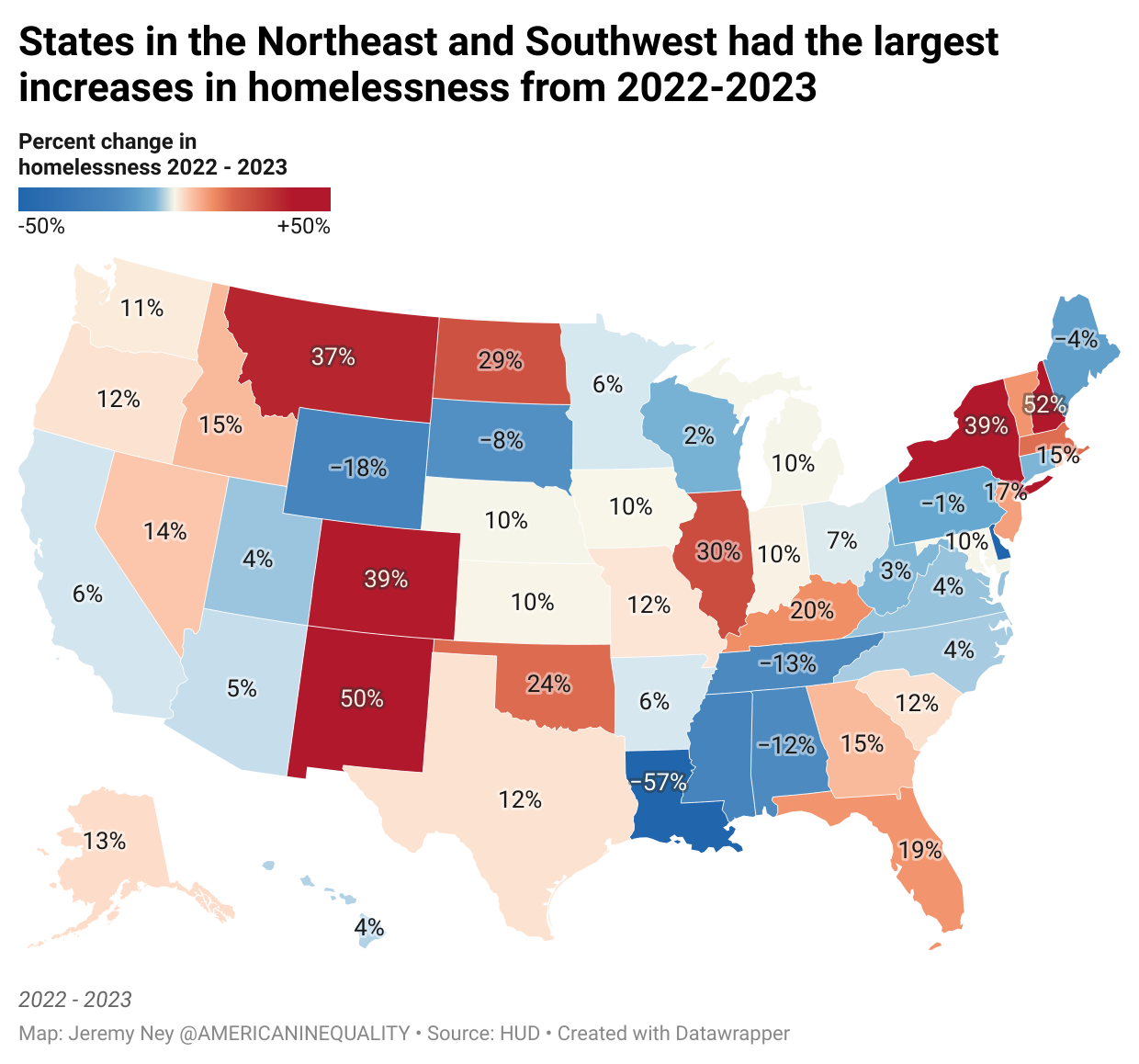
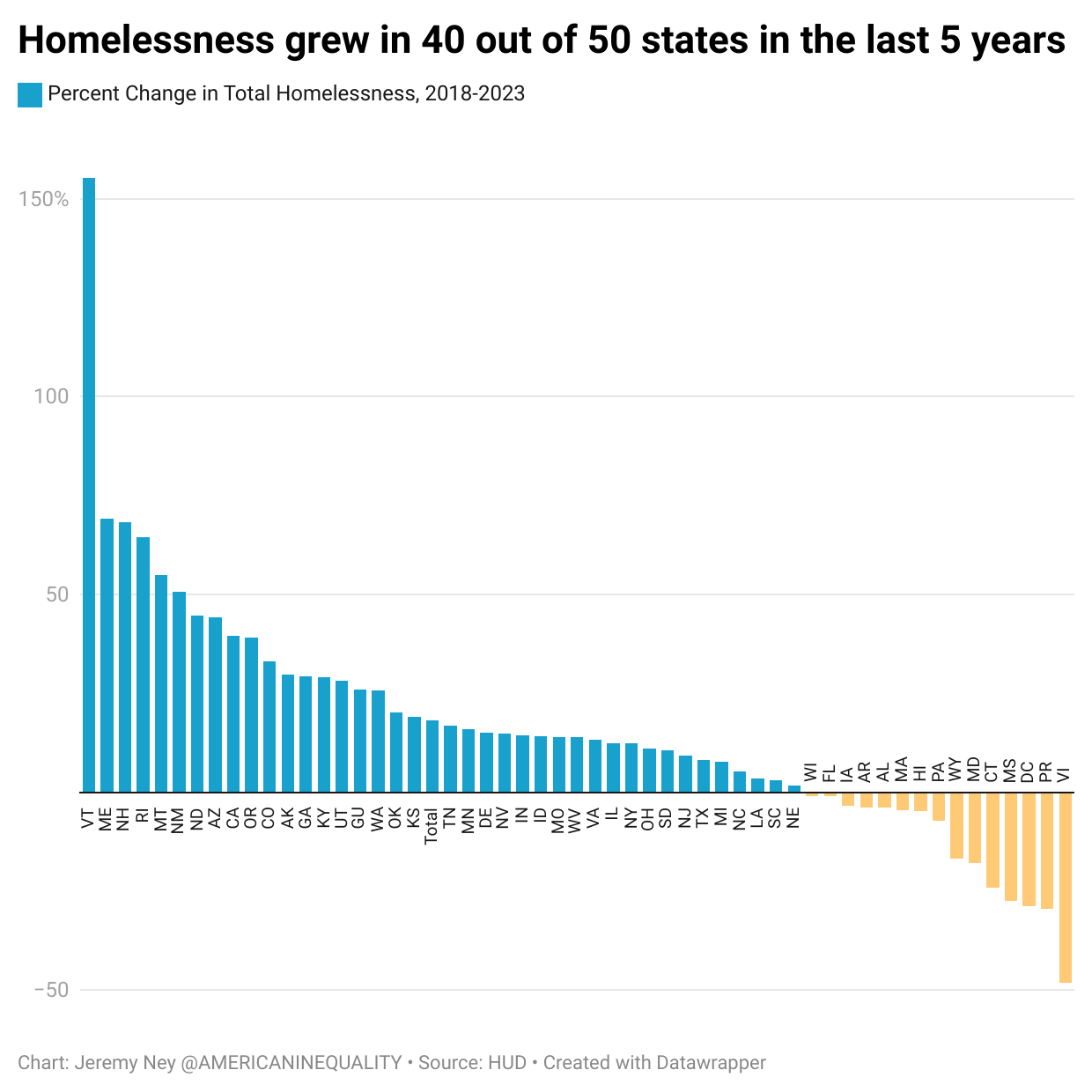
Homelessness in America increased 12% from last year, now reaching the highest point since 2007. At the same time, housing assistance has reached the lowest point in 25 years. 653,104 people were considered homeless in 2023, or roughly 1 in 5,000 Americans, according to newly released data from the Department of Housing and Urban Development (HUD). Black Americans were disproportionately more likely to be homeless, representing 37% of the homeless population despite being 13% of the overall US population. In the past 5 years, only 10 states have been able to reduce their homeless populations. As America’s housing crisis worsens with rising rents, falling inventory, and inadequate safety-net services, millions are left suffering with no roof over their heads. While the influx of immigrants has led to some of the increase in homelessness, it has not been a leading cause as many pundits would lead us to believe. Instead, researchers at UC San Francisco conducted the largest survey of homeless people in the last 25 years and found that the leading cause was housing affordability. The overwhelming majority of the homeless population in California, for example, consisted of locals, with 90% of them losing their homes in the regions where they had already resided. America is currently seeing an unprecedented housing crisis. Shaun Donovan, who served as HUD secretary from 2009 to 2014, shared that he had “never seen availability problems this bad. Housing has always been a top-three issue in New York and San Francisco. What is changing now is that it is a crisis in red parts of the country, rural parts of the country - in places where it’s never been an issue.” We dug into the newly released HUD report and found exactly that. Low housing inventory and high rents push people into homelessnessSince the beginning of the pandemic, rents have increased 29.4% nationwide. Average rents in the US are now $1,982, on average, representing a 3.3% increase compared with the same time last year. Depending where you live though, these rates may have increased much faster, with Providence, Rhode Island and Hartford, Connecticut experiencing the greatest rent increases. HUD acknowledged that rising rents have created an “extraordinarily challenging” condition for Americans and has led to the rise in homelessness. Housing inventory has also hit a 20-year low, falling 14% in the past year alone, falling to the lowest point ever since the National Association of Realtors began collecting this data.
The combination of high rents and low inventory puts shelter out of reach for many Americans. When the new homelessness data came out, Jeff Olivet, executive director of the U.S. Interagency Council on Homelessness, a federal agency, said, “The most significant causes are the shortage of affordable homes and the high cost of housing that have left many Americans living paycheck to paycheck and one crisis away from homelessness.” New Hampshire and New Mexico both suffered from low inventory and high prices in 2023, causing their homeless populations to increase more than 50% in the past year. In New Hampshire, the housing vacancy rate has now fallen to below 1%, making it nearly impossible for families to move into new homes. New Hampshire Congresswoman Anne Kuster said her state lacks 90,000 housing units. Meanwhile, rents in New Mexico have grown 5x faster than incomes since 2017, creating tremendous barriers to finding affordable housing. In Albuquerque, the state’s largest city, only 20% of people in the city’s homeless shelters or temporary housing successfully make the leap into permanent housing each year, far below the national average. Cities not only need to create more housing, but also they need to create more affordable housing to help stem the tide. A few states have helped set the example for how this can be done. Expanded safety nets and targeted outreach provide much needed aidAt American Inequality, we’ve developed an approach called “Opportunity Mapping” which helps struggling regions learn from other areas that are best addressing key social issues. For homelessness, we’re highlight 4 states. Tennessee
Texas
Minnesota
Pennsylvania
New HUD report only tells part of the storyThe problem may be far worse than the official numbers indicate. HUD’s measures are based on a point-in-time estimate from the last week of January each year during which volunteers walk around the streets in major cities counting the number of unhoused people they see while administrators in homeless shelters and other facilities count the number of occupied beds. The agency then uses these inputs to extrapolate an overall count for the country. As a result, HUD’s data likely drastically undercounts the real scope of homelessness in America. Other federal agencies show this undercounting clearly. The Department of Education, for example, estimates that there are more than 1 million homeless students in America, much higher than the 111,620 homeless children that HUD offers. While the Department of Veterans Affairs relies on HUD’s numbers, saying that Veteran homelessness increased 7.4% in the past year to 35,574, many other housing nonprofits say that the number of homeless veterans may be 3x greater. New York City now has 119,320 homeless students according to the DOE, the highest number ever on record. Meanwhile, HUD estimates that the entire state only has 29,333 homeless children under 18. This past year, a nonprofit called Advocates for Children found that 1 in 9 New York City students was homeless, but depending where that student lived the chance of being homeless may be far worse. In one section of the Bronx, 1 in 5 students was homeless. Most officials point to the city’s severe housing shortage coupled with the huge increase in immigration. In mid-October, Mayor Eric Adams announced a 60-day limit on how long families could stay at any one shelter, leading many advocates to worry that longer commutes could lead to more missed school time for children. Improving the Continuum of Care and learning from successful statesWhile we’ve discussed some of the causes of the increase in homelessness (low housing inventory, high rents), many other inequalities plague the homeless community that prevent them from getting into affordable housing even if it did get built. Specifically, the continuum of care (CoC) that helps homeless individuals move from streets to homes is often dramatically broken. Without reforming the CoC, even a huge increase in affordable housing may not be sufficient to address the problem.
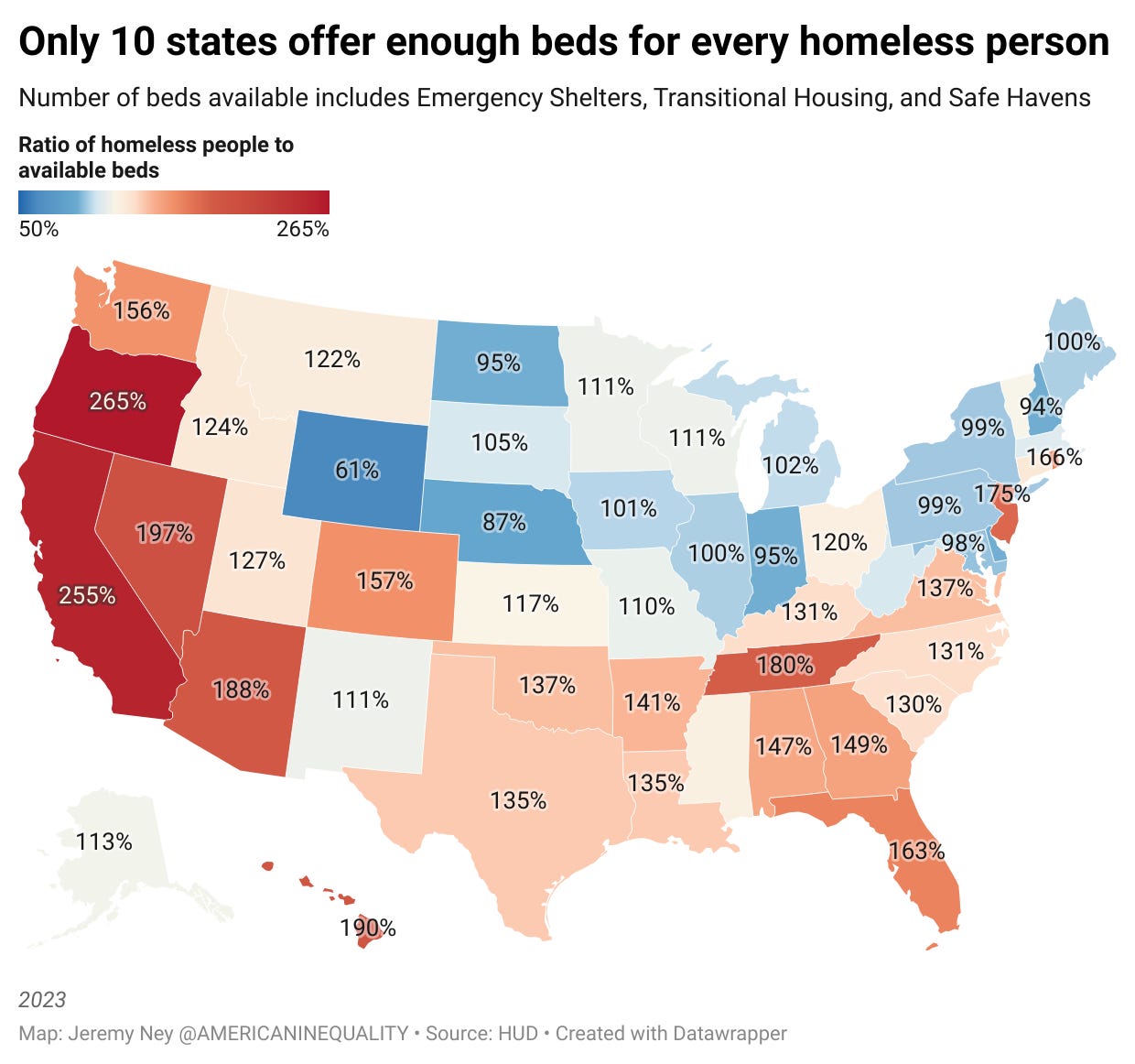
The primary resource in the Continuum of Care is shelters. There are three types of shelters: emergency shelters, transitional housing, and safe havens. In first of its kind research, we found that in California, Oregon, and Nevada, there is only 1 bed for every 2 homeless people in the state. Pre-pandemic this was even worse for several states, with California only offering 1 bed for 3 every homeless people. Only 10 states have at least 1 bed for every homeless person. That means if a person is evicted from their home and wants to enter a shelter, that person is likely to be turned away in 4 out of 5 states. The goal for nearly every city is to move people out of shelters and into more permanent housing, but the country’s safety net is severely lacking to support this transition. In 2023, The three main federal housing programs – Public Housing, Section 8, and Housing Choice Vouchers – that are supposed to support those most in need, actually served 287,000 fewer households than they did at their peak nearly twenty years ago. At the same time, pandemic policies that stabilized rents and helped keep struggling families in their homes have now expired, leading to skyrocketing rates of homelessness. While some states have offered renewed housing assistance to help families make it through these challenging times, the vast majority of the nation is struggling to provide that next stage of housing. The Path ForwardHUD published a “systems response” earlier this year that recommended 19 different actions for communities to take to address their homeless crisis. We’ve distilled down the 3 most actionable ones that are well supported by the data for making a difference.
Even if states were able to provide enough affordable housing, the continuum of care that helps homeless populations move upwards from emergency shelters to transitional homes, to that permanent housing is often broken. Housing is deeply interwoven with incomes, infrastructure, and social services. Solutions to address this growing crisis require development, data, and investment. As we turn the corner on 2024, hopefully this year will yield more positive results.
You’re on the free list for American Inequality. Thanks so much for being part of our community! Most sincerely, Jeremy
|
среда, 10 января 2024 г.
Why homelessness just hit a 15-year high, rising 12% from last year







Подписаться на:
Комментарии к сообщению (Atom)
Комментариев нет:
Отправить комментарий
Примечание. Отправлять комментарии могут только участники этого блога.