| | Caregiving is insufficiently valued in our society Two events in the first weeks of January have highlighted a gulf in American politics. The good news first: A bipartisan group of lawmakers is working on a bill that would expand the Child Tax Credit. (The group is trying to reach broad support by pairing the expansion with an extension to tax cuts enacted during the Trump administration.) You may remember that the government broadened the Child Tax Credit during the pandemic and by doing so kept close to 4 million children from poverty in 2021 and 2022, according to Columbia University's Center on Poverty & Social Policy. Unfortunately, the expanded credit expired when West Virginia Democrat Senator Joe Manchin (along with Senate Republicans) refused to support it. While it looks like the proposed Child Tax Credit deal has a good chance of succeeding , the animus against welfare programs that support our most vulnerable continues. And here's the bad news: While lawmakers on Capitol Hill were working to build support for the tax credit, "Republican governors in 15 states are rejecting a new federally funded program to give food assistance to hungry children during the summer months, denying benefits to 8 million children across the country," as the Washington Post reports, and exposing a callous disregard for caregiving. The pandemic proved just how shaky the supports of our childcare system are, even as it emphasized how deeply we need those caregivers. (Another lesson: the failure of the caring economy to care for its own workers.) What this all adds up to, as Stephanie H. Murray recently explained in The Atlantic, is that, compared to other wealthy countries, "the job of raising children is simply different in the U.S. It comes with fewer assurances and requires navigating a level of precarity that is unique in the developed world. It is, in a word, harder." And it isn't just child care. As I wrote in WTF? What's the Future and Why It's Up to Us, "Caring is a necessity of life, just as is food and shelter, and should not be denied to anyone in a just society." But as I pointed out there (and in my review of Mariana Mazzucato's The Value of Everything), our society doesn't value caregiving enough—not just morally but as an essential sector of the economy. And the consequences are many. Caregivers are often "stressed about finances." Unions offer one means of negotiating raises, as we saw with the recent strike of Kaiser healthcare workers, but in many cases, caregiving falls to family members, not to the professional labor force. And caregiving is spread unevenly. We need to bring the caring economy into the regular economy in a profound way. + From the Washington Post: "The Child Tax Credit May Expand in 2024. Here's What It Means for You." + From NPR: "To Tackle Poverty, More States Will Offer Bigger Child Tax Credits in 2024." + From the World Health Organization: Caregiving Impacts on Unpaid Informal Carers' Health and Well-Being—A Gender Perspective + From the American Prospect: "Labor Leader Ai-jen Poo Confronts 'the Biggest Driver of Economic Inequality That Nobody Talks About.'" | | | | | For-profit chains probably aren't the answer Businesses trying to lure employees back to the office have been throwing around perks to make the transition more palatable. Flexible hours is a big one (especially for caregivers). On-site child care is another. Slate's Kendra Hurley examines employer-sponsored care of the sort provided by for-profit chains like BrightHorizons and KinderCare. In what should come as no surprise, Hurley finds that as investor-backed, profit-driven entities, though [these companies] serve families, they are foremost beholden to their investors and bottom lines. And time and again, they have shown themselves to be more frenemy than friend to the working parent. . . .In their quest to extract as much profit as possible, these conglomerates follow the usual corporate playbook: pay workers horribly and CEOs lavishly, and charge paying customers top dollar, carrying out regular price hikes. | | | | | Neither is means testing Supplemental Security Income (SSI) is a federal program that provides funds to people with disabilities or with extremely limited income or resources, assisting those who need help most. But as The Nation's Rebecca Cokley recently reminded us, SSI hasn't been updated in more than 30 years, and the strict rules of the program hinder recipients from improving their situations: SSI is a means-tested program—there are financial requirements to be eligible. In the case of SSI, as of its last adjustment in 1989, enrollees cannot have savings of more than $2,000 as an individual or $3,000 as a family. Furthermore, SSI beneficiaries are prohibited from having retirement accounts, life insurance policies, certain types of personal property, funeral/burial policies, and access to other types of income. The reality is the current structure of the program and its asset limits ensure that low-income seniors, disabled people, and their families, are never able to move away from a life of poverty, and any attempt to do so would result in a denial of SSI benefits. Late last year, lawmakers introduced the SSI Savings Penalty Elimination Act, which, as Cokley explains, "would move the amount an individual on SSI can save from $2,000 to $10,000, and the amount a family can save from $3,000 to $20,000. It would also adjust the limit for inflation in the future and exclude retirement savings." Removing these barriers is already extremely popular: Cokely points out that 6 in 10 Americans are already on board, and that includes bank CEOs like JPMorgan Chase's Jamie Dimon . It's worth considering what other long-standing bureaucratic barriers might be obstructing people from getting ahead. + From Vox: "The Case Against Means Testing" | | | | | Maybe it's as simple as giving money to those who need it As the pandemic-era expanded Child Tax Credit proved, sometimes the simplest solution to difficult problems is to offer money with no strings attached. Certainly, there's a vigorous debate to be had over how to implement social welfare programs, but recent case studies related to so-called universal basic income (UBI) programs are very promising. The Los Angeles Times' Rebecca Plevin explores how $1,000 a month, given for a year as part of a City of Los Angeles UBI pilot program, changed the lives of those who received it . Recipients of the grant—all of whom "were pregnant or had at least one child, lived at or below the federal poverty level and experienced hardship related to COVID-19"—used their funds for education, for housing, and to support their own businesses, as well as to pay for necessities like car repairs, clothing, and food. The biggest success: while the program lasted, recipients were able to start looking toward the future, whether to a new job or just a break from the relentlessness of spending the days struggling to get by. Plevin turns to Amy Beth Castro, the cofounder and faculty director of the Center for Guaranteed Income Research, to explain why a guaranteed income makes such a difference. Castro notes, What happens with guaranteed income is that it smooths that income volatility. . .and it creates predictability. . . .When you have that floor, that scarcity starts to go away. And we know that it calms the mind, it calms the spirit, and it creates space for people to re-imagine an alternative future, or to maybe take steps toward a goal that they've always had but have not been able to actualize. A similar program in Denver proceeded in much the same way, as Charles R. Davis writes in Business Insider: in that program, "direct cash assistance reduced homelessness and increased employment." And both Davis and Plevins cite a number of other UBI programs across the country that are showing favorable results. While to some UBI may seem like nothing more than an expensive handout, as Oshan Jarow argues in Vox, it's actually "less radical than you think." + The Guarantee: Inside the Fight for America's Next Economy, by Natalie Foster, "asks us to imagine an America where housing, health care, a college education, dignified work, family care, an inheritance, and an income floor are not only attainable by all but guaranteed, by our government, for everyone." + From the Progress Playbook: "How Finland Won the War on Homelessness (Mostly)" | | | | | Deeper reading: Mass Flourishing 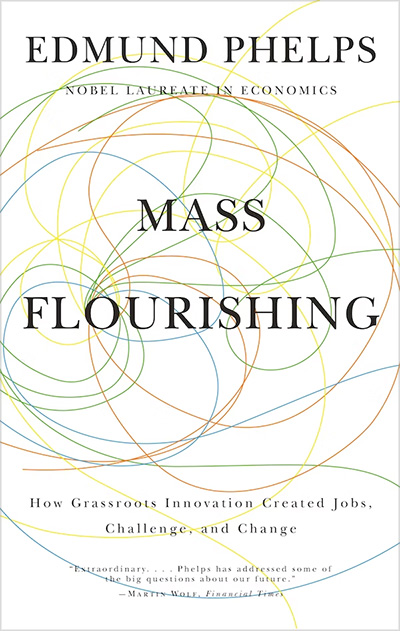 Last week, we shared Brink Lindsey's "Speculations on an Arc of History," which probed the challenge of attaining "mass flourishing" for our society. But we were remiss in not calling attention to the work of Nobel Prize-winning economist Edmund Phelps, who popularized the term "mass flourishing" in his 2013 book of the same name. In Mass Flourishing: How Grassroots Innovation Created Jobs, Challenge, and Change and in his more recent Dynamism: The Values That Drive Innovation, Job Satisfaction, and Economic Growth (coauthored with Raicho Bojilov, Hian Teck Hoon, and Gylfi Zoega), Phelps analyzes the historical role innovation has played in driving prosperity—and attempts to account for a stagnation in productivity since the 1970s. (Dynamism, Phelps explains, "is the willingness and capacity to innovate" (MF 20), and it is through dynamism that the mass flourishing of a modern economy comes into being.) As we argued last week, innovation is the key to building sustainable yet transformative businesses. Phelps's work helps put this innovation into perspective and emphasizes why it's so vital to the Next Economy. 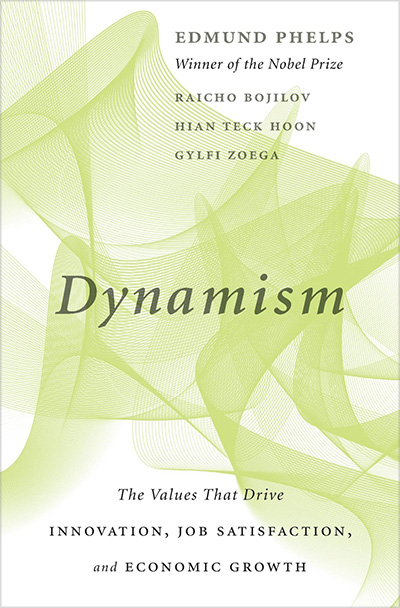 You can watch Phelps delve into the topic in this talk he gave to the RSA. Thomas Hemphill reviewed Mass Flourishing for the Cato Institute and Martin Sandbu reviewed Dynamism in the Financial Times, while Steve Denning covered both tomes over at Forbes , thinking through the limits of Phelps's argument particularly with regards to digital technology. + Phelps is no fan of UBI, but he still sees the opportunity for government programs to fight injustice and poverty, in part by creating the conditions for people to partake in "meaningful work." | | | | | | —Tim O’Reilly and Peyton Joyce | | | |





Комментариев нет:
Отправить комментарий
Примечание. Отправлять комментарии могут только участники этого блога.